

28 Years Later: The Bone Temple Gives Ralph Fiennes' Kelson An Unexpected Hobby – And It's Perfect

This article contains spoilers for "28 Years Later: The Bone Temple."
Any fan of the "28 [insert time period] Later" franchise knows that needle drops and source music play a huge role in it. The original "28 Days Later," directed by Danny Boyle, had a soundtrack album that blended the original, guitar-and-drum heavy score by John Murphy with tracks from Grandaddy and Brian Eno. The trailer for "28 Weeks Later" was scored to a B-side song from the band Muse, and the score for "28 Years Later" was composed by the Scottish hip-hop/pop band Young Fathers. The use of music is a way of keeping the films as sonically vibrant and experimental as their camerawork and general tone.
Director Nia DaCosta doesn't merely continue this tradition with her installment in the series, "28 Years Later: The Bone Temple." She (in conjunction with screenwriter Alex Garland) uses the needle drops in the film diegetically, separating them from the orchestral score by Hildur Guðnadóttir and incorporating them into the story. Although we met Dr. Ian Kelson (Ralph Fiennes) in Boyle's "28 Years Later," "The Bone Temple" spends much more time with the man, enough for us to learn that he has hobbies beyond building his titular memento mori. He's apparently quite a big music fan from back in the day, and has retained (and/or expanded through looting) a vinyl collection which he listens to as much as possible.
Where "Years" revealed Kelson's gentle soul as a plot twist, "The Bone Temple" uses its needle drops to deepen his character in conjunction with Fiennes' superlative performance.
Kelson's music saves his life
Early on in "28 Years Later: The Bone Temple" we learn that Kelson is a huge fan of Duran Duran, the English pop/rock group who rose to prominence during the 1980s. He owns several of their albums, including 1981's eponymous "Duran Duran," which opens with the track "Girls on Film" that Kelson sings to himself while dragging dead Infected around. Among the mementos in Kelson's bunker is a poster of lead singer Simon Le Bon, and the songs "Rio" and especially "Ordinary World" soundtrack Kelson's budding friendship with the Alpha Infected he calls Samson (Chi Lewis-Parry). In general it seems like Duran Duran is Kelson's favorite band, but it is interesting to note that the group were having a bit of a revival shortly before Great Britain fell to the Rage Virus in 2002; their 1998 greatest hits compilation, "Greatest," went triple platinum in the UK.
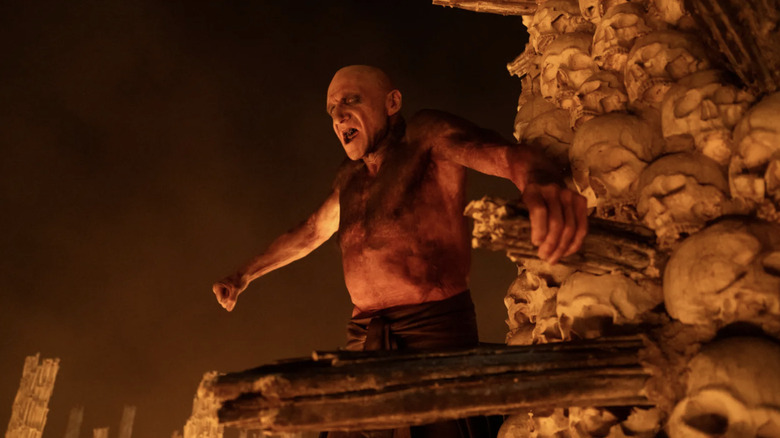
Kelson's music tastes certainly seem very Gen X, as he also has a copy of Radiohead's 2000 album "Kid A" (from which we hear "Everything In Its Right Place") and Iron Maiden's 1982 record "The Number of the Beast," the title track of which becomes not just a needle drop, but a plot point in the film. Kelson uses it as part of his performance as Satan, aka Old Nick, at the behest of the mad and murderous cult leader, Sir Lord Jimmy Crystal (Jack O'Connell). Kelson's performance is successful because of how fully and creatively he gives himself over to his music. He dances, gyrates, and generally is theatrical and inventive with it thanks to how much it clearly inspires and moves him. If even for a moment, his music literally saves his life.
Kelson and the film's needle drops help prove that the human soul is not eradicated
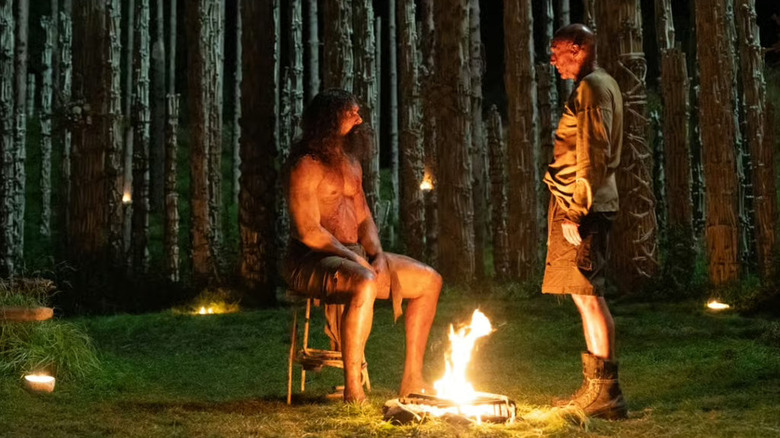
There's an ideological and spiritual struggle at the heart of "The Bone Temple" that Nia DaCosta and Alex Garland keep front and center. It's no less than a struggle between Good and Evil, even though the visual signifiers for each team are all twisted around. To wit: Kelson appears to be Satanic, but is genuinely a force for good. Meanwhile, Jimmy Crystal seems humorous and friendly, but is actually a disturbingly amoral villain. The hopeful tipping point between these two figures is Samson, who begins the film as a Rage-filled being ripping people's heads from their bodies and eating them, before having a transformative experience through communing with Kelson where he's ultimately cured. It's especially telling that Kelson's cure apparently gives Samson some form of immunity to the virus, as he cannot be re-infected by bites or blood contamination. In effect, Kelson gives Samson his soul and humanity back.
Fiennes and Garland give Kelson numerous virtues throughout both "Years" and "The Bone Temple," demonstrating the man to be clever, witty, educated, cultured, and calm. Yet his greatest virtue may be his love of pop/rock music, as it keeps him from being solely highbrow in his tastes; Jimmy Crystal loves the Teletubbies, after all. Kelson's wealth and range of interests as well as his general attitude of acceptance (he initially acquiesces to helping Crystal if it'll save his life) speaks volumes. As Jim (Cillian Murphy) explains to his daughter, Sam (Maiya Eastmond), during the film's coda, post-WWII Britain adopted the idea that those who forget history are doomed to repeat it. Kelson is a character who is all about remembering, and it's through him and his peers that humanity may have a way out of darkness.