

Mercy Review: Not Even AI Could Generate A Movie As Dire As This Chris Pratt-Led Disaster
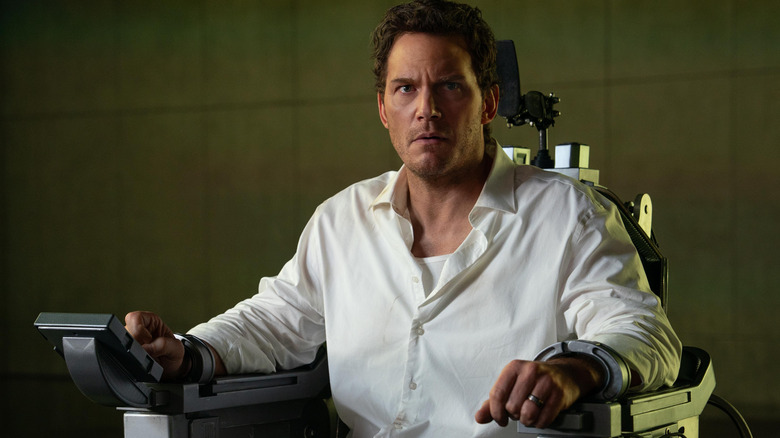
Under most circumstances, the middle of January would be far too early to declare any movie the worst of the year ... but, boy, does "Mercy" give it the ol' college try. It's hard to pinpoint exactly where it all begins to go off the rails. That's not necessarily because there are too many options to choose from (although there certainly are), but mostly due to the startling realization that there are no real low points to speak of. Put it this way: If your garden variety blockbuster disappointment resembles an EKG chart, peppered with occasional peaks that only put the valleys in sharp relief, this disastrous undertaking mostly feels like a total flatline from start to finish. That sinking feeling kicks in as early as the opening sequence that lands with a resounding thud, a perfunctory exposition dump laying out the world-building details of this dull and uninspired sci-fi dystopia, and doesn't stop until the oddly inert final shot brings this all to a merciful end.
Honestly, the reason that I've held back from including some groan-worthy pun here like, I don't know, "The only justice this movie deserves is a mercy killing," is because I have much more respect for my audience than "Mercy" does for its own.
Okay, that's not entirely fair. It'd be simple to write this off as the hallucinations of a half-formed Grok or ChatGPT prompt, but pointing the finger at just one responsible party would be letting this off too easy. For a film about humanity ceding ground to artificial intelligence to act as "judge, jury, and executioner" for our worst criminals, one semi-coherent message at least manages to rise above the wreckage: It genuinely takes a village to break a system beyond all repair. Director Timur Bekmambetov ("Wanted," "Abraham Lincoln: Vampire Hunter," and, incredibly enough, producer of Ice Cube's "War of the Worlds") and writer Marco van Belle will inevitably shoulder the lion's share of blame, yet that's almost like pretending as if everything wrong with the world lies at the whims of America's President and Vice President alone. Are they instrumental in making our collective lives infinitely worse? No doubt. But could they have been allowed to get this far without a concerted, wide-scale effort to ignore or disregard common sense at every turn? Nope!
That's the only way we end up with a shell of a movie like this: claustrophobic enough to be mistaken for a quarantine-era COVID-19 movie, insipid enough to offer up mealy-mouthed "commentary" on AI, and sadistic enough to torture viewers with an on-screen running timer throughout this affront to well-paced movies. At least it had the decency to let us see this coming. At the end of the day, anyone watching this will relate a little too much with star Chris Pratt — strapped to a chair and counting down the minutes until it's all over.
Almost nothing in Mercy works on any level whatsoever
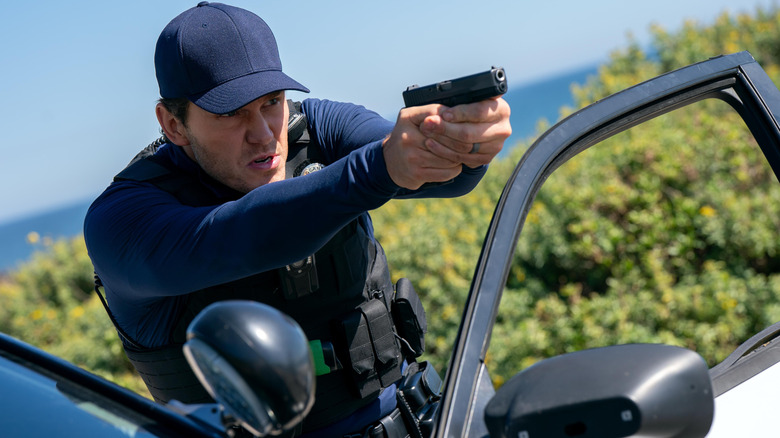
It's not particularly complicated to grok (please, let's reclaim that word's real meaning from the tech bros) the major beats of "Mercy" from its basic setup. In the near future, a new form of judicial process reigns supreme in the form of the Mercy program. An AI judge presides over every farcical trial for those accused of capital crimes and, using a "Guilty until proven innocent" approach, forces each alleged criminal to provide just enough evidence of their own innocence within 90 minutes to lower the "guilty probability" by just a few percentage points ... or face summary execution. In a painfully on-the-nose twist, one of the biggest champions of this system finds himself at its mercy (get it?) when accused of killing his own wife (Annabelle Wallis, saddled with a role that redefines "thankless" in ways rarely seen before). But fear not, folks, because Chris Pratt's LAPD officer Chris Raven — yes, that's his actual name — is on the case.
At its core, this is ostensibly a sci-fi thriller about the most pressing of modern concerns: AI. What it is in actuality, however, is the exact opposite of what this genre was intended to be. Where "RoboCop" or "Minority Report" had the teeth to hold systems to account and the creative vision to tell an entertaining story along the way, "Mercy" has the temerity to do neither. Rather than add anything of value to the sci-fi scene, this movie settles for a run-of-the-mill murder mystery that oftentimes forgets to put the "science" in "science fiction." (For those wondering what the future looks like, it's apparently limited to cops flying what can only be described as airborne riding lawn mowers.) Despite the very same director hailing "screenlife" as the next step of cinema, his haphazard approach here will only convince you that "Searching" and "Missing" were total flukes. If this were meant as a cautionary tale about technology run amok, prepare yourself for a cavalcade of half measures that puts "Ready Player One" and it's bold "Eh, I guess we can turn our phones off twice a week" shrug of a conclusion to shame.
Very little in "Mercy" stands up to scrutiny, whether it be narratively (don't think too hard about how the script twists itself into a pretzel to stick to its screenlife gimmick and still visually depict several events necessary for the plot), logically (you'd think a cop accused of murder investigating his own alleged crime would constitute a conflict of interest, but you'd be wrong), or thematically (I kid you not, Chris Raven passes the buck at one point by earnestly announcing that, "Human or AI, we all make mistakes").
Mercy is a waste of everyone's time -- but especially Rebecca Ferguson's
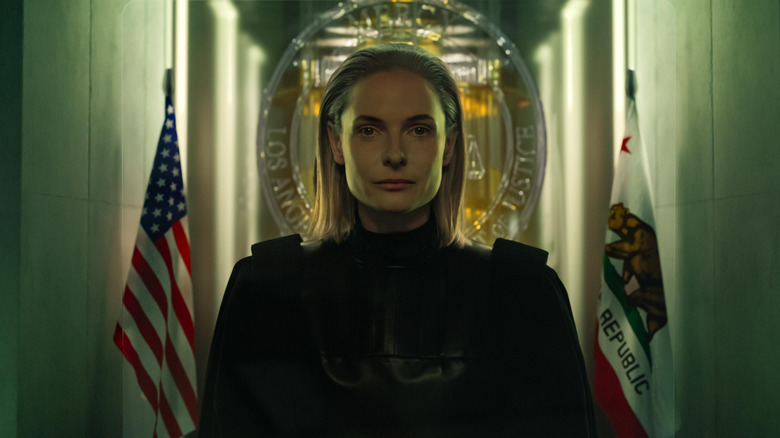
In case anyone was hoping that at least some of the talent involved in "Mercy" would walk away from this train wreck unscathed, let me disabuse you of that notion right now. Despite flashing the potential to be one of our more interesting leading men in "Parks and Recreation," the "Guardians of the Galaxy" trilogy, and even voice roles in films like "The Lego Movie," Chris Pratt regresses to bland action hero mode in the same vein as "Jurassic World," "The Terminal List," or "The Tomorrow War." Granted, not that even our greatest thespians could do much with a screenplay requiring them to sit in a chair for almost the entirety of the 100-minute runtime, but there's something particularly galling about the lack of commitment or energy here. When we meet Chris Raven (no, I'm still not joking, that's his actual name) slowly waking up in shackles from a drunken slumber, it couldn't be a more apt metaphor for Pratt's sedate "performance" that follows. Worse yet, this also infects the great Rebecca Ferguson. Confined to an entirely static appearance shot from the midsection up and forced to pantomime as a digital robot with no real personality, her overall function in this film amounts to spouting instructions at Pratt, verbalizing the minutes ticking away on the clock (which is visible at almost all times anyway), and inadvertently providing some soothing ASMR.
That last bit is sorely needed, unfortunately, as the filmmaking on display might actually leave you nauseous — and not even because of the (frankly baffling) decision to release this film in 3D formats. With the majority of the action unfolding on computer screens and virtual reality recreations, the camera follows no basic rules of framing, blocking, or editing. Instead, it floats aimlessly from one piece of information to the next like one of those TikTok filters, abruptly cutting to various scenes with transitions that range from jarring to inexplicable. The only thing more distracting is the recurring use of a main musical theme that sounds like a pale imitation of the haunting cue from the "Annihilation" score — tragically, even composer Ramin Djawadi seems off his game here.
"Mercy" is a sight that may induce sore eyes, a punishing experience for those with even the lowest of expectations, and appears destined to land among the dregs of the year. But, worst of all, this feels like an alarming glimpse into a world I want no part of — one where our entertainment isn't so much as created by AI, but explicitly tailored for those who no longer care enough to see the difference. On the bright side, 2026 can't get any worse than this ... right?
/Film Rating: 3 out of 10
"Mercy" opens in theaters on January 23, 2026.