

Absolute Batman's Joker Is A Notorious Real-Life Serial Killer
We may receive a commission on purchases made from links.
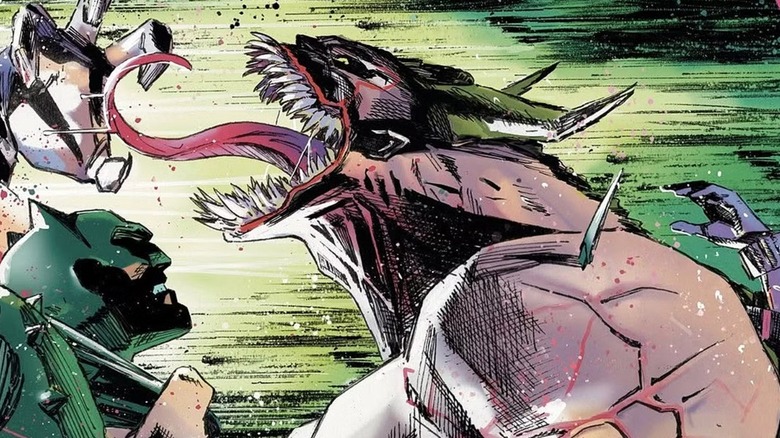
"Absolute Batman" #15 filled in some details of the "Absolute" Joker's origin; trillionaire mass murderer Joseph "Jack" Grimm has been alive since the 1800s, sustaining himself with children's blood and pretending to be his own descendants to hide his immortality. That was only a small slice of the Joker's history, though. The new "Absolute Batman: Ark M Special" (co-written by Snyder and Frank Tieri, art by Joshua Hixson and colorist Roman Stevens) explores a new angle.
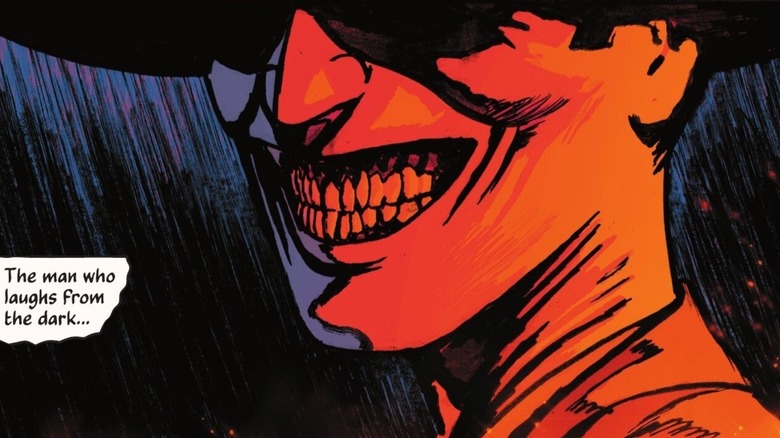
This issue strongly implies that this Joker was once a real villain of history: Jack the Ripper. "Jack" was the unidentified murderer who, in 1888, killed and mutilated several sex workers in London's Whitechapel district. Jack the Ripper is one of history's most notorious serial killers, if not the root of the serial killer cultural archetype. That he was never caught means the case retains intrigue, and suspects (notably barber Aaron Kosminski), to this day.
"Absolute Batman" isn't even the first tale to pit the Dark Knight against the Ripper; "Batman: Gotham by Gaslight" followed a Victorian-era Batman trailing Jack the Ripper. The definitive fictional depiction of the Jack the Ripper case, though, is Alan Moore and Eddie Campbell's comic, "From Hell." Titled after a letter sent supposedly by the killer (along with a human kidney), "From Hell" is a tour de force; the details of Moore's research mixed with Campbell's realistic pencilling means there's no better, more lifelike recreation of 19th century London.
The "Absolute" Joker having once been the Ripper builds on his established immortality and on enduring themes of the Joker's character. Villains are scarier the less you know about them; that's why we're drawn to the Joker, whose past is often a mystery, and Jack the Ripper, because we'll never know with certainty who he was.
Absolute Batman explores Joker's history with Arkham Asylum
Arkham Asylum is usually the institution that imprisons Batman's costumed foes. In "Absolute Batman," the Joker has sent up "Ark" black sites across the globe; the one in Gotham is Ark M, built on land that once housed Arkham Asylum (which burned down in the early 1900s). The "Ark M Special" goes back to 1945, showing how Joker acquired Arkham and the asylum's fiery destruction.
The comic is narrated as a diary from asylum founder Amadeus Arkham, who writes back from a recent encounter with Jack Grimm and his life leading up to it. An orphan of a mentally ill mother who died in murder suicide, Arkham built his asylum to help people like his mother. In 1885, Arkham took in a young boy off the street, raising him as a son and his successor.
Then, a particularly violent patient — "Jack Doe" — led a breakout and seemingly murdered the boy, destroying Arkham (the man and the asylum's) reputation. In 1945, Grimm reveals the truth: he was that boy Arkham adopted, and he staged the breakout, not Doe (who he murdered). A terrified Arkham burns the Asylum, himself, and his patients: "That truth might be my legacy, but this place will not be." The Joker still takes the land, though, and intercepts Arkham's last testament before it reaches the Gotham police.
Scott Snyder's Batman work is indebted to Peter Milligan and Kieron Dwyer's "Batman: Dark Knight, Dark City," which added a twist of supernatural horror to Gotham City history. Much of that comic is narrated by diary entries of Jacob Stockman, an 18th century Gothamite recounting how he once partook in a human sacrifice to the bat demon, Barbathos. Like Stockman, Arkham writes a confession and an unheeded warning.
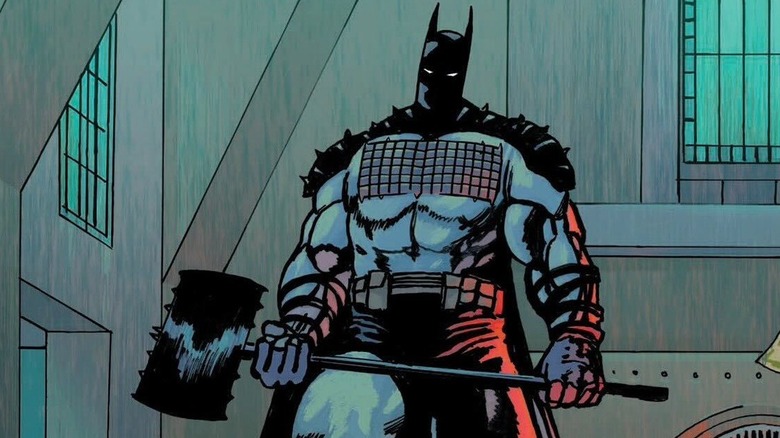
The Joker is about to unleash Ark M's monsters on Batman
The red herring Jack Doe pointedly resembles the classical Joker in appearance and persona; he has no real name, he's noted to laugh at his violence (whereas the "Absolute" Joker never laughs), and Arkham calls Doe "A smiling demon, a hellish Jokester." The young Grimm murdering Doe, and his sleight of hand pulled on Arkham, reflects the "Absolute" Joker supplanting the classical one.
This story tracks with "Absolute Batman" #15, which showed in 1889, Joker was a young street performer in Gotham who dosed his audience with nitrous oxide (dental laughing gas). But the issue still leaves mystery. When Grimm arrives on Arkham's doorstep, he's covered in blood, claiming he couldn't remember where he came from. Arkham took this to mean the boy had endured a hard life, but really, Grimm probably killed some people to smear their blood on him. Why did Joker worm his way into Arkham's life before destroying it, though? Arkham believes it's because the boy wanted to share hope in Arkham's mission and then leave it in smoldering ruins. In the present, the Joker is shown reading Arkham's diary and smiling at its memories.
The Ark M torture den is miles away from Arkham's charitable mission. Batman himself was held prisoner in Ark M during the previous "Abomination" arc, and the Joker's staff is indeed creating abominations aplenty. The issue ends with Joker unleashing two Ark M "patients" — Poison Ivy and Man-Bat — while he also has Scarecrow and Deathstroke on stand-by. In the upcoming "Absolute Batman" #16, Bruce is literally going to Hell with his new pal Wonder Woman. Whatever the Joker has in store for Batman might make Tartarus look like a sunny vacation.