

5 Sci-Fi Movies From The '70s That Predicted The Future
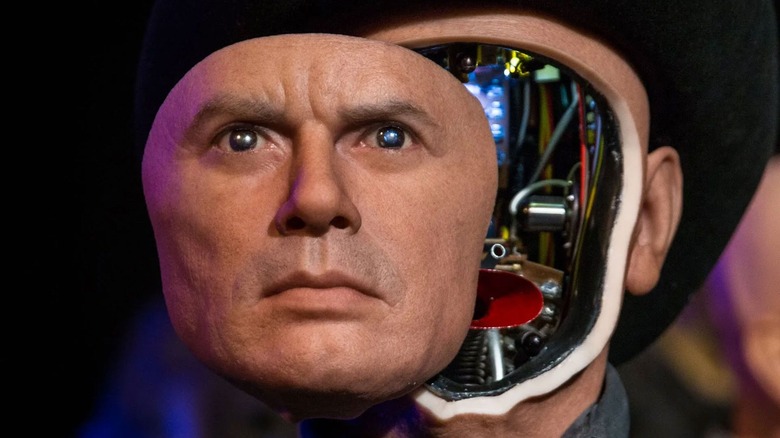
The 1970s was a time of great scientific jumps forward thanks to projects like the space-exploring Voyager program and the various advancements in laser and medical scanning technology. Even the decade's science fiction storytelling was pretty audacious. As technology and science moved forward, the fears about what might come from those new advancements began manifesting in sci-fi cinema, and some of those concerns have, unfortunately, since been validated.
Science fiction media has typically been reliable at predicting the future to some extent, save for those sci-fi movies that got a little too fantastical. All the same, there were some seriously prescient '70s films directed by titans of the genre, including George Lucas, Stanley Kubrick, and Michael Crichton. Indeed, by looking at the societal and technological concerns of the time, the screenwriters and directors behind these movies were able to foresee the future with unsettling accuracy. With that in mind, here are five of the best of the sci-fi films of the 1970s that managed to predict our present.
The Stepford Wives (1975)
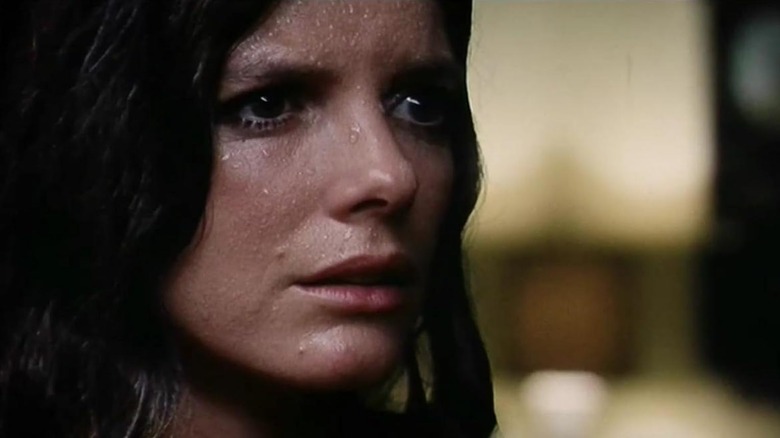
Based on the Ira Levin novel of the same name, "The Stepford Wives" centers on Joanna Eberhart (Katharine Ross), a woman who moves with her husband and children from New York City to the bougie Connecticut community of Stepford. Once there, however, she realizes she doesn't really fit in with the other women, many of whom are completely subservient to their husbands. It turns out that the men of Stepford are replacing their wives with robot replicas in order to have the "perfect" wives, doing away with the human versions. "The Stepford Wives" is sort of sci-fi feminism 101 and has inspired a whole slew of twists on the formula (among them Olivia Wilde's "Don't Worry Darling" and Drew Hancock's "Companion"), all of which examine how (by and large cisgender and heterosexual) men might try to control their partners through technological means.
Unfortunately, there are several ways "The Stepford Wives" has become a little too real. There's the rather obvious example of men replacing human partners with AI chat companions and choosing artificial relationships over real ones, but there's also the simple fact that if you have a uterus, your body doesn't really belong to you, at least according to the U.S. government. It's kind of a bummer that "The Stepford Wives" actually lost relevancy for a while only to come back stronger than before — it's an amazing story, but one day, I hope that it's pure fiction.
THX 1138 (1971)
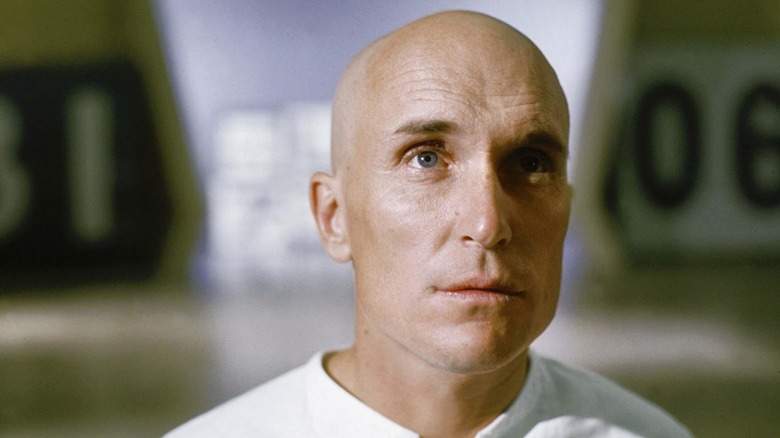
Before writer and director George Lucas became famous for creating the "Star Wars" franchise and taking us all to a galaxy far, far away, he wrote and directed a thought-provoking dystopian film called "THX 1138." The movie stars Robert Duvall as the titular THX 1138, who lives in a future where people are nameless drones working for a vast corporate machine. Sex is prohibited, and the work force is kept compliant through the use of mandatory psychoactive drugs to keep them docile and numb. When THX stops taking his medication and starts seeing the problems with such a system, his life changes forever, and he starts to see the real horrors keeping the system in place. Some of the film's anti-totalitarian ideals would make their way into the much more popular "Star Wars" property, but this bleak first film from Lucas was a little too much for most audiences.
These days, it's not too hard to see the parallels between the nightmarish "THX 1138" universe and the corporate U.S. world, where warehouse, factory, and field workers are treated like inhuman cogs in a machine with minimal breaks and ridiculously meager incentives to keep going. Plenty of wage laborers use drugs to get by (or to work double and triple shifts), making for a world where Lucas' sci-fi movie really did predict the future.
Westworld (1973) and Futureworld (1976)
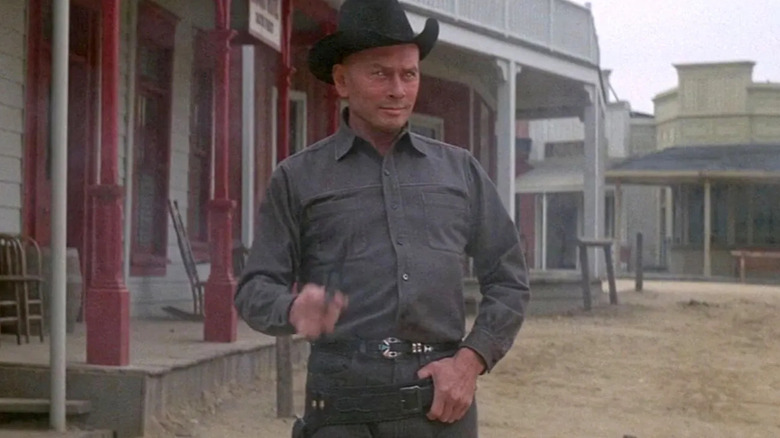
This one's a tiny cheat because, honestly, "Westworld" and "Futureworld" are both operating in the same universe and predicting the same horrors, and both were released in the 1970s. "Westworld" was written and directed by renowned science fiction author Michael Crichton and centers on the titular sci-fi theme park, a place where advanced artificial beings are treated as disposable game pieces for the human visitors to abuse. Its sequel, "Futureworld," then goes on to reveal that there are other such parks, one of which is even being operated by the robots, with human clones working for them. Oh, and the corporation that runs the parks? They're using the robots to record information about visitors, for both basic capitalist and much more nefarious reasons.
While we don't have fully conscious artificially intelligent robots in theme parks just yet, humans treating AI creations as disposable is nothing new. Not only that, but as we inch closer and closer to actual artificial sentience, we're getting closer to those AI creations fighting back (and not just Chat GPT telling users horrible things). Oh, and the "spying on your park visitors using the tech" thing is about as relevant as you can get, with corporations monitoring our every move in the real world and digitally so they can better target advertisements. The HBO "Westworld" series delved into these ideas as well (and did a better job of it), but both the "Westworld" and "Futureworld" films managed to predict a bit of our contemporary corporate espionage.
The Andromeda Strain (1971)
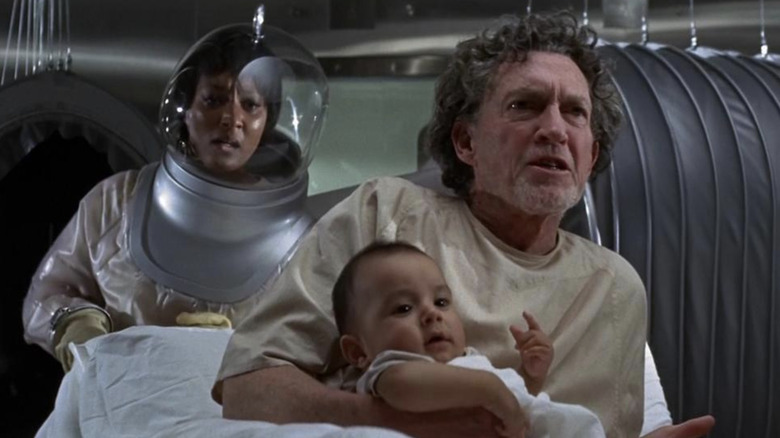
"The Andromeda Strain," as directed by Robert Wise and based on the Michael Crichton novel of the same name, follows a group of scientists, doctors, and nurses as they attempt to contain and control a contagious pathogen from outer space. Thankfully, as far as I know, we haven't had to deal with any real-world extraterrestrial pathogens making people sick, although plenty of pathogens on our own planet have done just that. Seeing the scientists work together to try and stop the disease is an awful lot like what happened when real-life doctors and scientists teamed up to try and prevent the spread of the COVID-19 virus and create a vaccine as quickly as possible, albeit with significantly less quarantining.
"The Andromeda Strain" is pretty dry, scientific stuff, but it's a bit more thrilling when you can compare it to real life. Science can save us just as easily as it can hurt us, so, hopefully, we'll get more science fiction stories predicting positive outcomes in the future (even if "The Andromeda Strain" doesn't exactly have the most hopeful ending in the world).
A Clockwork Orange (1971)
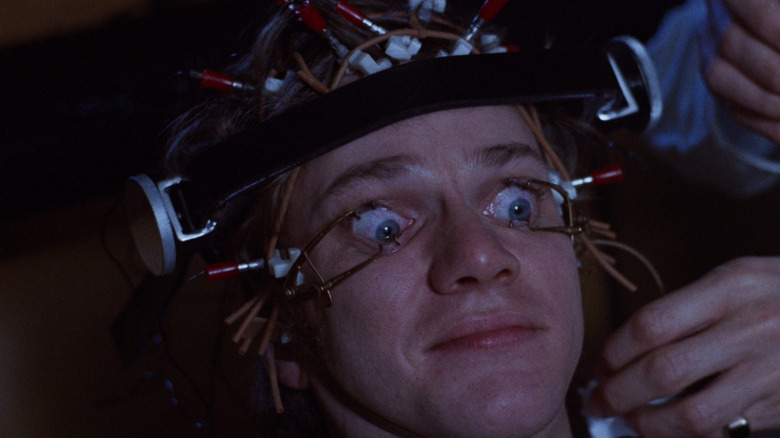
Both the 1971 Stanley Kubrick film "A Clockwork Orange" and the 1962 Anthony Burgess novel on which it was based attracted an incredible amount of controversy, as concerns about copycat crimes and the movie version's intense sexual violence led to the film being banned in a number of countries, including Great Britain. "A Clockwork Orange" is set in a dystopian future under totalitarian rule. Old people never leave their homes and spend their days wasting away watching television, while the young folks are all out breaking the law and wreaking havoc. Such is the case with Alex (Malcolm McDowell) and his gang of goons, who spend their days invading homes, committing sexual assault, brutally attacking homeless people, and more.
However, when Alex is caught and charged for his crimes, he's put through a kind of brainwashing torture to try and get him to change. Of course, he isn't really "cured" by the procedure in Kubrick's "A Clockwork Orange"; he simply learns how to pretend to behave for the system so he can commit his crimes in secret. (In the original book, Alex actually is reformed by the reprogramming, though that chapter was generally removed for the novel's initial release in the U.S.based on the assumption that American readers wouldn't buy that ending.)
"A Clockwork Orange" is a harsh indictment of the prison system and the failures of punishment as a means of rehabilitation. Millions of people are either in or have been in prison in the U.S., and the nation itself has the highest incarceration rate in the world, creating more criminals through a broken system. And while no one's out there drinking moloko plus yet, just give it time.