

What Happened To David Fincher's Planned Girl With The Dragon Tattoo Trilogy?
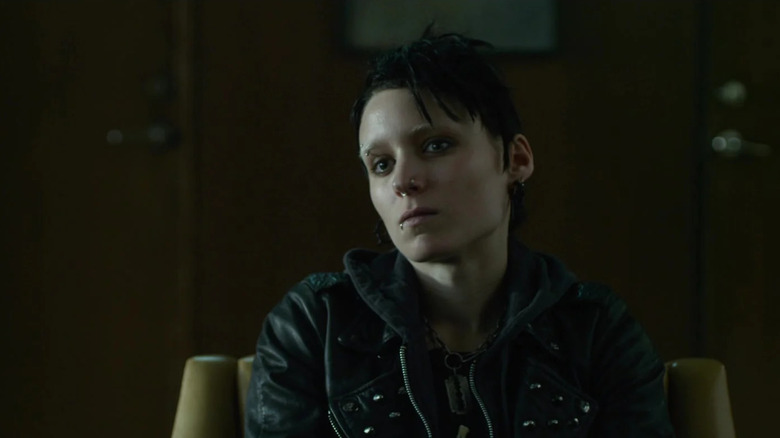
Stieg Larsson excellent airport novel "The Girl with the Dragon Tattoo" was published posthumously in 2005. It was the first part of the Millennium series, all centering on a spiky Goth/punk computer hacker named Lisbeth Salander, and her reporter compatriot, Mikael Blomqvist. Together, they investigate malfeasance and murder in Sweden. Larsson intended the Millennium series to be ten novels long, but he was only able to complete three books — "Dragon Tattoo," "The Girl Who Played with Fire," and "The Girl Who Kicked the Hornet's Nest" — before his death in 2004.
The books grew to worldwide acclaim in 2009 when they were adapted into a series of excellent Swedish feature films. The movies starred Noomi Rapace as Lisbeth, and Michael Nyqvist and Mikael Blomqvist. The films were widely seen around the world, with the first "Dragon Tattoo" making over $103 million on its $13 million budget. Rapace's depiction of Lisbeth as a walking, enraged middle finger captured the eyes of audiences everywhere.
The numbers were too big for Hollywood to ignore, and in 2011, director David Fincher was hired to remake "Dragon Tattoo" in English. The new film starred Rooney Mara as Lisbeth and Daniel Craig as Mikael. Curiously, the American film was still set in Sweden, and people were seen reading books in Swedish, even as they spoke English. The $90 million production made $239.3 million back. Fincher fully intended to make "Played with Fire" and "Hornet's Nest" into films as well ... but he never actually did.
Back in a 2023 Masterclass interview (covered by EW), Fincher explained why he never got around to making the sequels, and the answer was logical: the first wasn't quite successful enough. Also Daniel Craig's price tag went up.
The Girl with the Dragon Tattoo wasn't successful enough
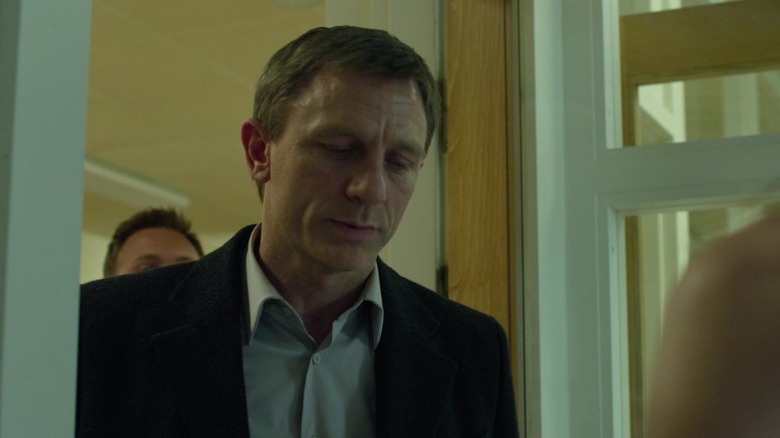
Fincher revealed that he was actually approached sometime in the mid-2000s, before the Swedish "Dragon Tattoo" movies had been made, about the possibility of adapted Larsson's novel to the big screen. Fincher, however, didn't really jibe with the material, thinking it was too corny. "I was offered 'Dragon Tattoo' long before the first movie was made," he said. "I was in the middle of something else, and I was like 'lesbian hacker on a motorcycle? I don't think so.'" But then the Swedish movies were made, making the books into a giant hit. With its popularity behind it, Fincher's interest was renewed. He read the books, and immediately became a stickler for authenticity. He said:
"I thought [...] 'If you took this piece of material that has millions and millions of people excited, and you did it within an inch of its life, could it support the kind of money it would take?' And we pledged early on that we wanted to make a movie that was not embarrassing to its Swedish heritage. We didn't want it to seem like we just came in. When they said, 'Could you shoot it in Atlanta?,' I said no. And we didn't want to transpose it, we wanted it to be true to its essence. In Sweden you're shooting nine-hour days if you're lucky, so the film took 140 days to shoot."
That's quite a long time. The prolonged shoot was likely one of the reasons that the budget was so high. The film was an Oscar darling, but it wasn't the overwhelming blockbuster that Sony wanted.
David Fincher is still proud of his version of The Girl with the Dragon Tattoo
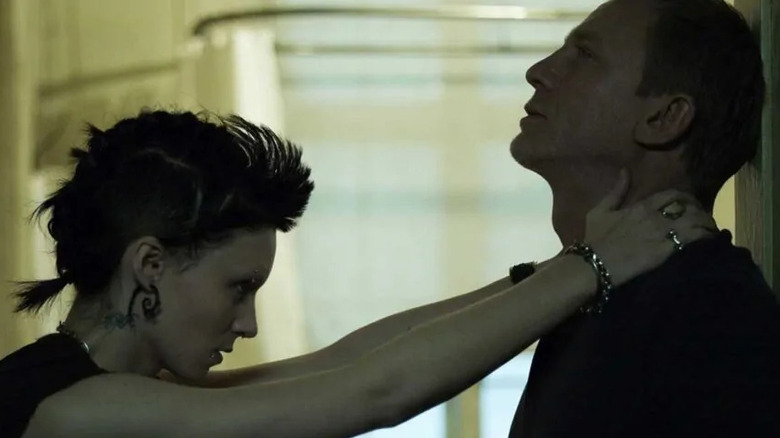
Ultimately, though, Fincher was frank, saying that his movie didn't make enough of its money back. In his words:
"I was proud of it. I thought we did what we set out to do. I have the same reservations about whether or not long-dead Nazi stories on a remote island in the north of Sweden would really be a ripping yarn. But we did it the way we could. Then, when people said it cost too much, and showed what the return on investment was ... 'Okay.' A swing and a miss."
It should be acknowledged right away that there were many other stories in the Millenium series, both on the page, and on screen. The 2009 Swedish movies, for instance, were such hits in theaters that all three were re-edited and expanded into a six-art miniseries for Swedish television. Those were released as Fincher was putting his version of "Dragon Tattoo" into production. Fincher and the rest of the public saw Larsson's books as a completed trilogy unto itself. After Larsson died, however, an author named David Lagercrantz continued the Millennium series for three additional books, the first being "The Girl in the Spider's Web" in 2015. More recently, Karin Smirnoff has penned the seventh and eighth books in the series.
In 2015, the Hollywood Reporter noted that another "Tattoo" film was in the works, but without Rooney Mara or David Fincher. Also Craig's star was still on the rise, so his salary increased, making him too expensive for another sequel. In 2018, director Fede Álvarez adapted "The Girl in the Spider's Web" into a feature film, starring Claire Foy as Lisbeth. That film, however, bombed at the box office.