

How Former Disney Boss Michael Eisner Helped Save The Star Trek Franchise
We may receive a commission on purchases made from links.
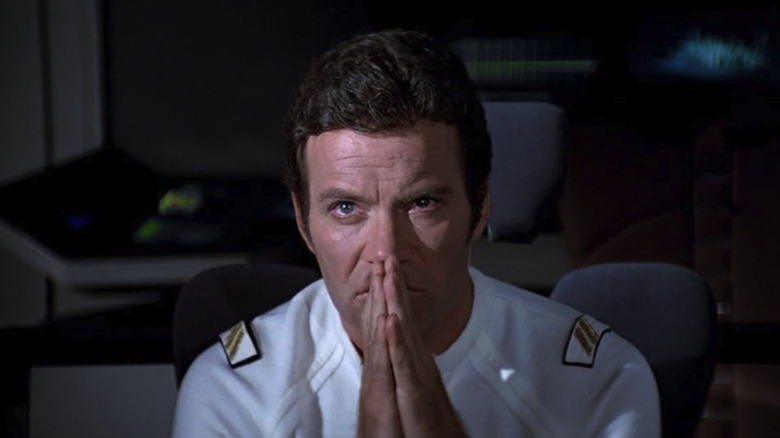
It's difficult to imagine pop culture without "Star Trek." The franchise spans literally hundreds of episodes of television and more than a dozen movies across six decades. A pivotal moment came in 1979 when the series made the jump to the big screen with "Star Trek: The Motion Picture." Though it's a movie that many accuse of being boring, it was crucial to securing the future of the franchise, and a legendary Hollywood executive is largely to thank for the movie's existence.
Michael Eisner, who preceded Bob Iger as the longtime CEO of Disney, was serving as the newly-minted president of Paramount in 1976. One of his first orders of business was to bring "Star Trek" to theaters. "The project should have been done in 1975, but the enthusiasm wasn't there," Eisner said to the New York Times in January 1979. "Frankly, I think my predecessors made a mistake. There was a lack of understanding of how important TV is. 'Star Trek' already had its audience."
Even though Gene Roddenberry's "Star Trek: The Original Series" ended its three-season run in 1969, its impact was lasting. Science fiction was also having a big moment, with "Star Wars" breaking box office records in 1977, and other sci-fi pictures, like Spielberg's "Close Encounters of the Third Kind," finding success around this time. Eisner saw an opportunity.
He boldly promised at the time that "Star Trek will be the biggest picture we have ever made." The executive also demonstrated an understanding of the challenge that making this movie represented in terms of working for a wider audience:
"'Star Wars' started off with a science fiction audience and then attracted a general audience. That's what 'Star Trek' will have to do — if the sci‐fi fans reject it, so will the mass moviegoers."
Michael Eisner gave Star Trek new life on the big screen and beyond
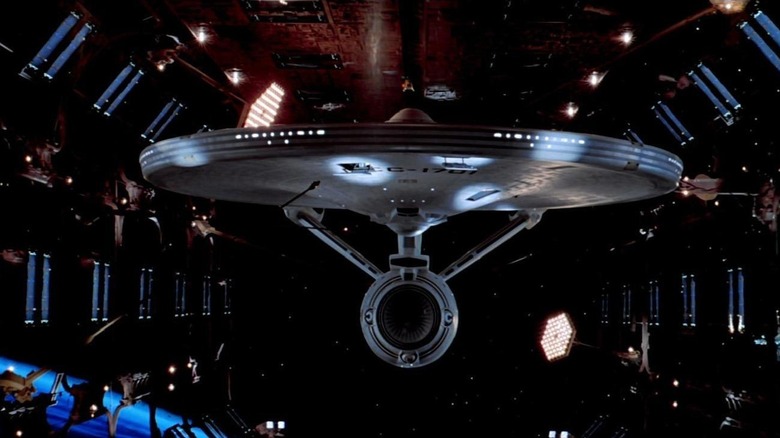
"So we're doing technical things that have never been done before," Eisner added. "The appetite of our technical people is insatiable. They'd go on for 10 more years if we let them."
Directed by Robert Wise ("The Sound of Music"), the making of "Star Trek: The Motion Picture" was famously difficult. Leonard Nimoy almost didn't sign on to reprise his role as Spock, there were script issues, budget issues, VFX issues. It was rough. It was also remarkably expensive, with the final budget said to be north of $40 million — a monstrous sum for the time.
Even so, "Star Trek: The Motion Picture" was a modest hit, taking in $139 million at the box office. It wasn't a runaway hit, but it did enough business to prove that this franchise could work on a theatrical scale. With a lower budget and a better story, "Star Trek II: The Wrath of Khan" was a more well-rounded success, with a series of sequels centered on the original cast arriving in the ensuing years.
While the movie did kill Roddenberry's plans for a new TV series titled "Star Trek: Phase II," it opened up all new opportunities as well. "Star Trek: The Next Generation" would premiere in 1987 and enjoy an incredibly healthy seven-season run, totaling nearly 180 episodes. The "TNG" cast would similarly star in their own series of movies. While they weren't all successful, it's undeniable that the movies helped increase the franchise's footprint globally. Eisner is in no small part owed thanks for believing in that idea and committing the resources to make it happen.
You can grab "Star Trek: The Motion Picture" on 4K or Blu-ray on Amazon.