

The Orville Creator Seth MacFarlane Disagrees With A Star Trek Writer's Replicator Opinion
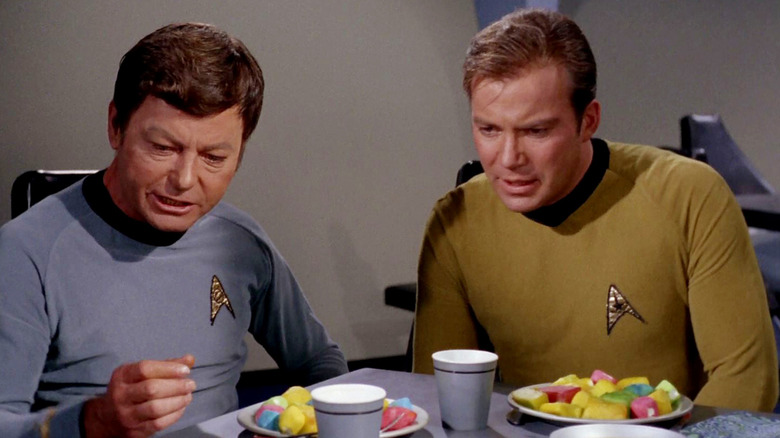
The replicators are perhaps the most miraculous technology on "Star Trek." Officially codified on "Star Trek: The Next Generation," replicators are in-wall alcoves on a starship that can convert energy directly into edible, nutritious food. Replicators are programmed with a wide variety of recipes, so Starfleet officers have ready access to their favorite foods and drinks at any time. The replicators are one of the key "Star Trek" technologies that dictate the show's overall utopian themes. In a world where food can literally be manifested out of thin air, no one will ever starve.
Replicators can also be used for other small, portable items, and officers are sometimes seen replicating gifts, books, hand tools or other items. However, to ensure that "Star Trek" isn't totally free of drama, replicators have their limitations as well. They can't replicate booze, for one. They also can't replicate weapons. They certainly can't replicate anything living, which would be a whole ethical can of worms. And they can't replicate large-scale items like furniture. Starships still have to be built piece by piece, and independently powered. The idea of replicating an entire starship would rob "Star Trek" of any traditional tension.
Still, many of "Star Trek's" writers hated the replicators for how convenient they were. Ira Steven Behr, the showrunner of "Star Trek: Deep Space Nine," called them a sign of a "doomed, finished society." Ronald D. Moore also hated them; there is no drama, he felt, if any character can manifest all the tools they need.
Seth MacFarlane, the creator of the "Star Trek"-adjacent series "The Orville," was recently interviewed by TrekMovie, and he openly disagreed with Behr and Moore. He felt that the replicators were a necessary element to Trek's glorious, optimistic future.
Seth MacFarlane feels that replicators are a key element of Star Trek's utopia
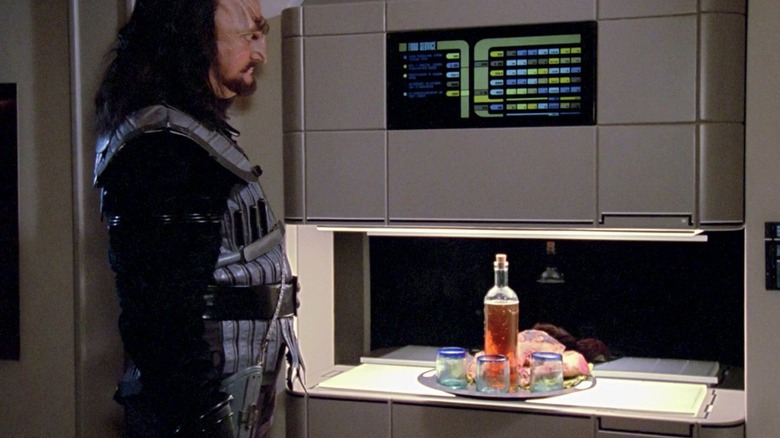
It should be noted that "The Orville" borrows a heck of a lot from "Star Trek: The Next Generation." Not only the uniforms, the technology, and the starship-bound setting, but also the general philosophy of hopefulness. "The Orville" also seemingly takes place in a future where prejudice is being actively fought, needs are met, and peace is attainable. MacFarlane even borrowed the concept of replicators for "The Orville," calling them "synthesizers."
The interviewer brought up Ron Moore's issues with writing stories about replicators, and MacFarlane was quick to disagree. He loves the replicators, and countered Moore's objections by saying:
"I think the replicator was one of the greatest inventions because the replicator, more than any other device, allowed the philosophy of that show to exist. How is there no money? Of course you wouldn't need any money because you have f***ing replicators. More than any other device on the show — more than the warp drive — it was the replicators that defined the social reality of that series. I respectfully disagree with Ron Moore, who happens to be one of my favorite writers."
Indeed, thanks to replicators and faster-than-light travel, not to mention miraculous advancements in medicine, everyone everywhere should be able to live comfortably in the universe of "Star Trek." That hopeful comfort is one of the show's most endearing traits. Moore, as a writer on the series, would most certainly be frustrated by the lack of drama in a world of plenty, but MacFarlane was 100% correct in saying that it was one of the most vital pieces of tech on the series. Replicators could never be written out or dispensed with.