

Chainsaw Man's Creator Wrote A Found Footage Movie... As A Comic Book

We may receive a commission on purchases made from links.
Tatsuki Fujimoto, creator of "Chainsaw Man," adores movies and brings that love into his comics. Makima, the eerie antagonist of "Chainsaw Man," shares her creator's cinephilia. One chapter, adapted in the recent "Chainsaw Man: The Movie — Reze Arc," sees Makima bring our hero Denji out on a movie marathon date. "Reze Arc" itself is Fujimoto exploring romance movie/romcom conventions, then brutally twisting them. In the climax of "Chainsaw Man" Part 1, Makima explains she only wants to cleanse the world of ills — including bad movies.
In Fujimoto's first serialized manga, the web series "Fire Punch," vengeance-seeking hero Agni gets a hanger-on, Togata. A movie-obsessive, Togata wants to film Agni's revenge and isn't above manipulating others to stage the best "scenes." Fujimoto revisited documentaries in his 2022 one-shot "Goodbye, Eri," released between "Chainsaw Man" Parts 1 and 2. The 200-page comic is framed through the lens of a cell phone camera — a comic "shot" like a found footage film. Yet somehow, "Goodbye Eri" is one of the only Fujimoto works (along with "Fire Punch") that hasn't been made into an anime yet, even though its formal tricks all pull from cinema.
"Goodbye, Eri" follows a young Japanese boy named Yuta, who at his terminally ill mother's request films her dying days. The first 20-pages of the comic play out like this, before it's revealed the panels we were seeing were from Yuta's finished movie, which is screening for his classmates and then panned (because he chose to end it with him running from an explosion). Everyone hates Yuta's "insensitive" movie... except a girl named Eri, who decides to teach Yuta how to make a better film by making him watch dozens of movies with her. The comic follows Yuta filming his days with Eri, which too may be numbered.
Fujimoto explores the power of movies in Goodbye, Eri
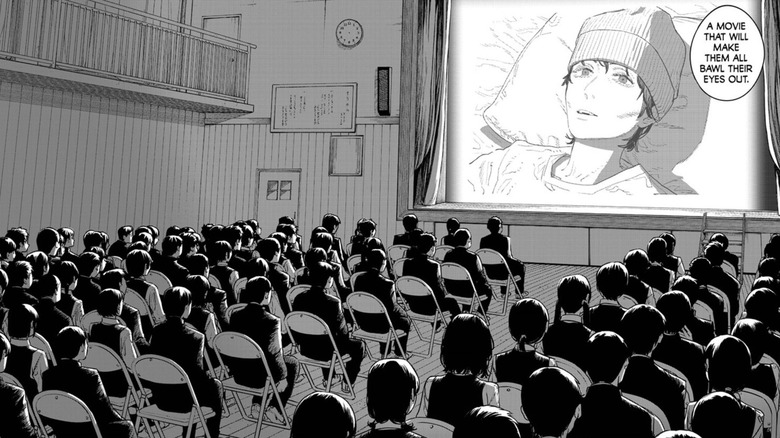
"Goodbye, Eri" hits similar emotional (and metatextual) notes as movies like "Me, Earl, and the Dying Girl," which is also about a teenage boy filming someone's last days, and Steven Spielberg's semi-autobiographical "The Fabelmans." "Goodbye, Eri" is Fujimoto looking inward to explore what drives him as an artist and why he's so fascinated with movies. In this way it overlaps with another one of his extended one-shots, "Look Back," about two girls who bond over shared passion for drawing manga art. "Look Back" was Fujimoto asking why he draws, while "Goodbye, Eri" is him asking why someone films the world and its people.
The comic concludes that someone would want to be filmed because it offers immortality and shapes how a person is remembered. Found footage is rather synonymous with horror movies and it's not just because the janky-camerawork lends itself to a nightmarish atmosphere. Horror found footage movies offer a supposed look at the "real" last moments of the person filming the footage. What's more unsettling to watch than that?
They may be filmed like documentaries, but found footage movies are of course truthfully fictional, offering only the aesthetic of reality. In "Goodbye, Eri," Yuta feels compelled to always bring "a pinch of fantasy" to his movies. For the movie he makes following Eri, he depicts her as not just a sick girl but a 1200-year old vampire. This, of course, reflects Fujimoto adding his own "pinch of fantasy." He's the one telling the story of Yuta and Eri to us, the same story that Yuta is making into his next movie, and Fujimoto throws in the possibility of a vampire (reflecting how people never die if caught on film) to what's otherwise a slice-of-life premise.
Goodbye, Eri divides reality and found footage
Found footage exploded in popularity in the early 2000s, right when digital film and camera were becoming the norm. Cellphones, with their built-in cameras and microphones, are now a tool as ubiquitous as paper and pencil. It's, in theory, as easy to make a movie as it is to draw a comic. In "Goodbye, Eri," Fujimoto does the latter to tell a story about doing the former. The cell phone framing of "Goodbye, Eri" is never a taxing gimmick, though.
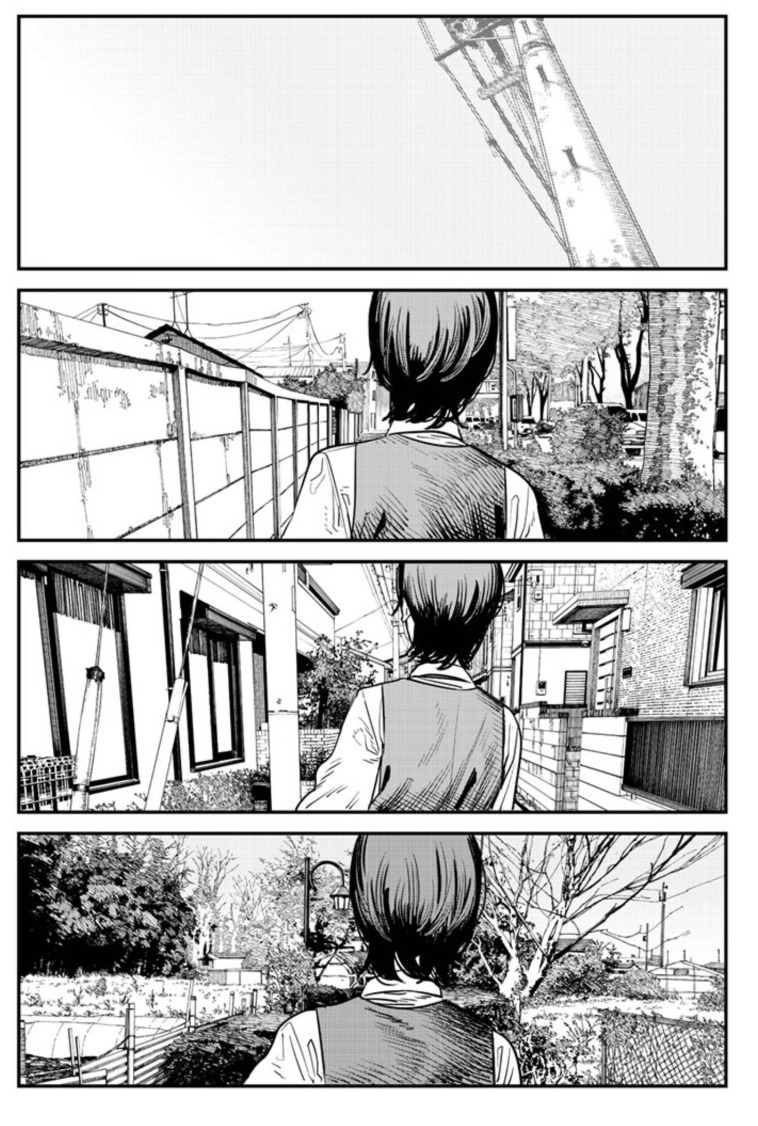
Most pages of "Goodbye Eri" use four long rectangular panels, suggesting the uniform and boxy view of a cell phone screen. The jumps of time and place between these panels range from miniscule (take the multiple pages to Yuta and Eri sitting on a couch together watching movies) to huge.
 Viz Media
The opening pages depicting Yuta's movie about his mom use one panel for one shot of the movie, suggesting filmic montage editing. The decompressed pages of "Goodbye, Eri," though, convey the feeling looking into a cell phone camera and the image not changing.
Several panels in "Goodbye, Eri" are purposefully drawn with a blur, to convey that the imaginary cell phone filming the frame is moving. Since Yuta is filming everything, and that's the (literal) lens through which we see the story, pages rarely ever begin with clear indication of what's real and what's a staged scene. The comic is able to pull off scene-within-a-scene twists even more easily than any movie.
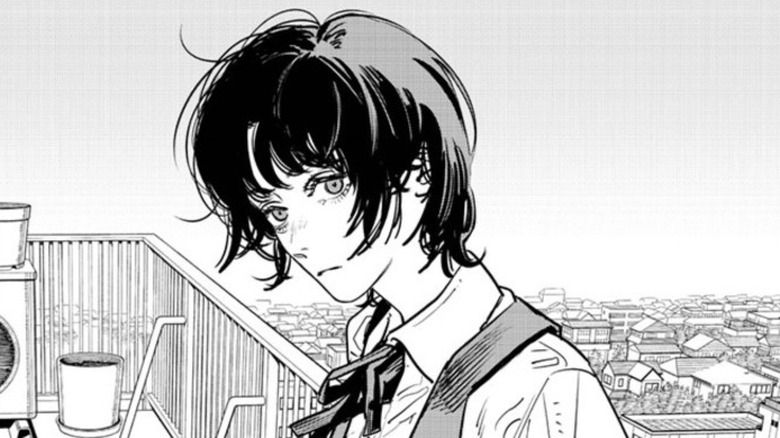
As for the subject of Yuta's movie, Eri fits alongside other Fujimoto characters like Reze and Makima; a woman with hypnotic eyes who simultaneously looks both innocent and not. A good movie needs something or someone compelling to follow and Eri passes that test.