

One Of Marty Supreme's Craziest Moments Really Happened In Real Life
This article contains spoilers for "Marty Supreme."
Josh Safdie's "Marty Supreme" is sorta, kinda, party inspired by the real-life table tennis champion Marty Reisman. Really, Safdie just took the outsized personality of Reisman and translated it into a very similar character, then invented a new life and new adventures for him. In real life, Reisman was a notoriously good table tennis player at a time when it wasn't widely recognized by the athletic community. He was also famous for his incessant hustling, often faking low skill levels only to make big bets and skunk any takers. He was also a showman, performing crazy ping pong stunts as an opener for the Harlem Globetrotters.
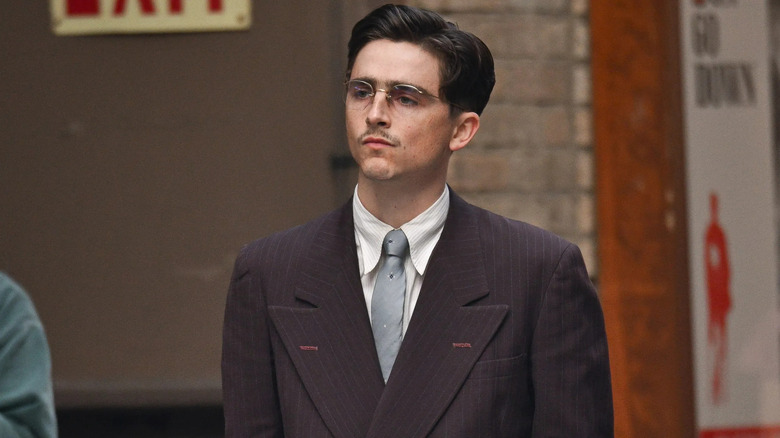
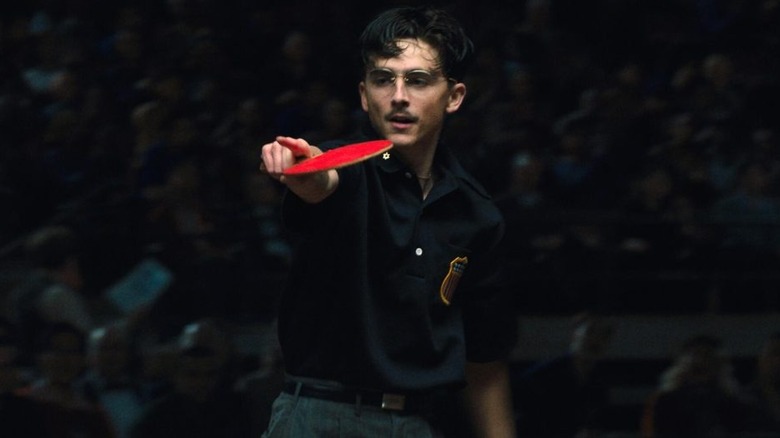
In the movie, "Marty Mauser" was played by Timothée Chalamet. Mauser was just as much of a fast-talking hustler as Reisman, and he also performed with the Globetrotters, but he was also said to have impregnated a married woman, to have fallen in with a gangster (Abel Ferrara) over a pet dog, and to have survived a collapsing bathtub accident. "Marty Supreme" climaxes during an exhibition ping pong match in Japan, against the fictional Endo Kato (based on the real-life champ Hiroji Satoh).
The fictional Marty was friends with a Hungarian ping pong champ named Bela Kletzki (Géza Röhrig). This character was extrapolated from the real-life table tennis champion Alojzy "Alex" Ehrlich, said to be the best player in Polish history. The Kletzki character tells a story partway through "Marty Supreme" about how he was once a denizen of Auschwitz, and how he once was able to sneak some contraband honey into the camp by smearing it onto his body under his clothes.
As it happens, that's a true story from Ehrlich's own life. This was confirmed in a recent article in Rolling Stone.
The Holocaust flashback in Marty Supreme was based on a true story
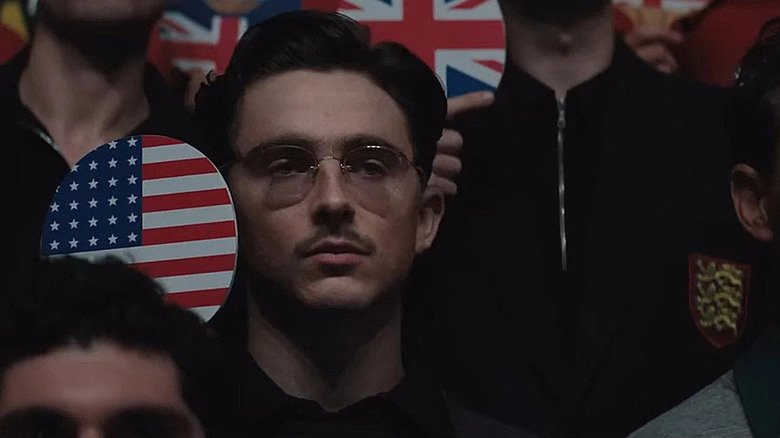
The moment comes after Marty and Kletzki compete for the first time. "Marty Supreme" takes place in the mid-1950s, so the shadow of World War II still hangs over everything. Marty Mauser, as well as the real-life Reisman, was born in 1930, so he wasn't old enough to experience the combat and the persecution. Both the fictional Kletzki and the real-life Ehrlich were born in 1914, so they remember quite well. Indeed, Ehrlich was apprehended by the Nazis during the war and forced to live at Auschwitz for four years. Kletzki tells Ehrlich's story. It seems that, while being held at the camp, the Nazis would send Ehrlich out into the woods around Auschwitz to defuse bombs. He was allowed to do this alone to keep everyone else out of danger.
Ehrlich, it seems, was allowed to wander around the woods briefly before returning to the camp. One day, he happened upon a beehive that was attached to a tree at eye level. Using a cigarette to smoke out the bees, Ehrich was able to crack open the hive safely and extract the honey inside. Having no means to hide a honeycomb, Ehrlich stripped down, smeared his body with honey, and re-dressed. Back at the camp, he would wait until the Nazis were out of visual range, then strip, and allow his fellow Auschwitz inmates to lick the honey directly from his body.
This story is dramatized on camera in "Marty Supreme," with the Kletzki character standing in a grim, dark room, having fellow inmates lick him. It may have looked weird visually, but it was presented as a vital moment of bonding between survivors.
The real Alojzy Ehrlich lived until 1992
The Rolling Stone article also pointed out that Alojzy Ehrlich was also a member of the French Resistance. None of this, by the way, was transposed onto the Kletzki character. Only the honey story made it to the movie. But it seems that Ehrlich was often ordered into the gas chambers at Auschwitz, and then later at Dachau, but was always spared when one of the Nazi soldiers recognized him as a table tennis champion. He was spared repeatedly and survived the horrifying ordeal. Ehrlich would continue playing table tennis after the war, but because he had done so much traveling in Western Europe before the war, the Polish Communist Party ostracized him for being too "decadent." This forced Ehrlich to compete for France. He competed for many years, winning more championships. He would eventually open up a resort on the French Riviera. He died in 1992 at the age of 78. Well done, sir.
And why did Josh Safdie include such an explicit tale in his movie? "Marty Supreme," one can see, is very much about Jewish identity, and how much of Jewish identity was wrapped up in the survival of the recent deathly persecution of World War II. Marty, also Jewish, is finding his own identity through the experiences of other Jewish people around the world. Marty, indeed, spends a lot of "Marty Supreme" infiltrating what are clearly "gentile spaces," where goyim go for entertainment; fancy balls, exclusive hotels, and the like. Marty is adaptable, bloviating to gain acceptance, flaunting his Jewish identity as a strength, rather than a weakness. He also bears numerous indignities throughout the movie.
Ehrlich's story of survival, then, is a story Marty takes with him. This is part of his heritage, too.