

Why Marty Supreme's Divisive Ending Is Tearing Movie Fans Apart
This article contains spoilers for "Marty Supreme."
'80s synth band Alphaville may have yearned to be "Forever Young," but you know what never gets old? Fighting to the death about differing interpretations of art. That's what cinema is all about, Charlie Brown.
Maybe it stands to reason that the recently-released "Marty Supreme" would end up becoming such a flashpoint moment just as 2025 draws to a close. The Josh Safdie-directed film asked (demanded?) us to endure weeks of increasingly escalating marketing stunts, from that ominously orange blimp invading the skies over Los Angeles to its leading man scaling the Las Vegas Sphere like some kind of miniature King Kong. There's the ongoing controversy over Timothée Chalamet as a movie star, too, embroiling many a moviegoer in the debate over whether he's truly this generation's Leonardo DiCaprio or not. On top of it all, his performance as Marty Mouser breathed life into the most unlikable protagonist in recent memory. Is it any surprise that the final moments of this feature are tearing us all apart, both online and off?
Alternately, may we suggest that all the hubbub surrounding "Marty Supreme" isn't necessarily a bad thing, in and of itself? Perhaps it has less to do with provocation for the sake of it, and more to do with audiences completely buying into this strange journey into the world of 1950s table tennis, fully engaging with it on its own terms, and coming away 100% invested in a story that refuses to hold our hands every step of the way. Does the final shot, with our immature hustler sobbing over seeing his newborn infant for the first time, mark a dramatic change of heart? Is this emotionally unearned? Or is there something else altogether happening here? Let's dig into it.
Marty Supreme fans (and detractors) are split over the ending
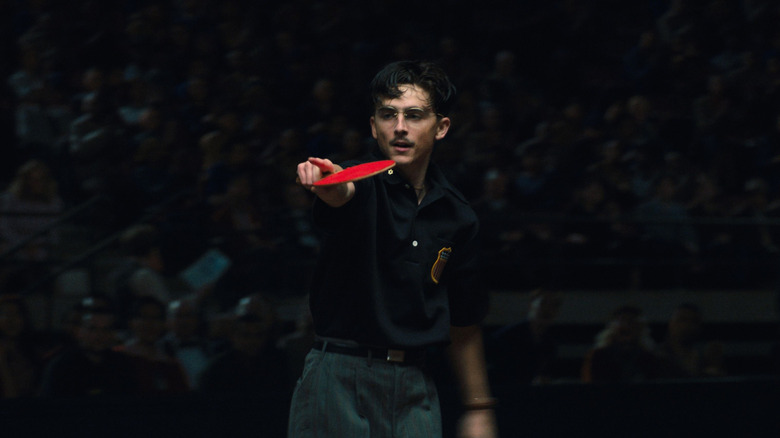
With perhaps one exception, "Marty Supreme" is fairly straightforward. The insufferable Marty Mouser spends the entire film alienating everyone in his immediate circle — his partner in crime Wally (Tyler the Creator), his on-again/off-again (and very pregnant) lover Rachel (Odessa A'zion), his business partner and friend Dion (Luke Manley), and even former film star/current target of his seductions Kay Stone (Gwyneth Paltrow). Becoming the world's foremost tennis table champion won't just manifest itself, after all, and so he plunges headfirst into a calamity of errors that somehow takes him all the way to Japan ... albeit playing against his hated rival Koto Endo (Koto Kawaguchi) in a meaningless exhibition match that he's meant to lose. Despite emerging victorious, he returns home a failure. But, in an abrupt 180, he visits Rachel after she's given birth, professes his love for her, and breaks down in tears once he lays eyes on his newborn — a baby he's refused to acknowledge as his own up to this point.
The entertaining Marty Supreme follows the exploits of an entitled white man who scams through life, hurting those along his path. The emotional ending is unearned and shallow, much like the movie itself. Unlike the protagonist in Uncut Gems, Marty has no soul, no emotional pull. pic.twitter.com/WXX08DE3Jk
— Candice Frederick (@ReelTalker) December 25, 2025
It's that last lingering shot, however, that's stirred up so much ruckus. For those less inclined to tolerate Marty's arrogant hijinks, his emotional breakdown (one that's awfully reminiscent of a similar one that concludes the Chalamet-starring "Call Me By Your Name") is somewhat hard to swallow. Is he really a new person now, ready to take responsibility for his actions and settle down with someone he once angrily dismissed as a nobody with no purpose in life? Journalist Candace Frederick is one of many who voiced that potential hot take on social media, firing one of the first shots in this argument. Roxana Hadadi of Vulture expanded on this in a full-length article that's well worth reading. Others, however, couldn't disagree more.
In defense of Marty Supreme's divisive final shot
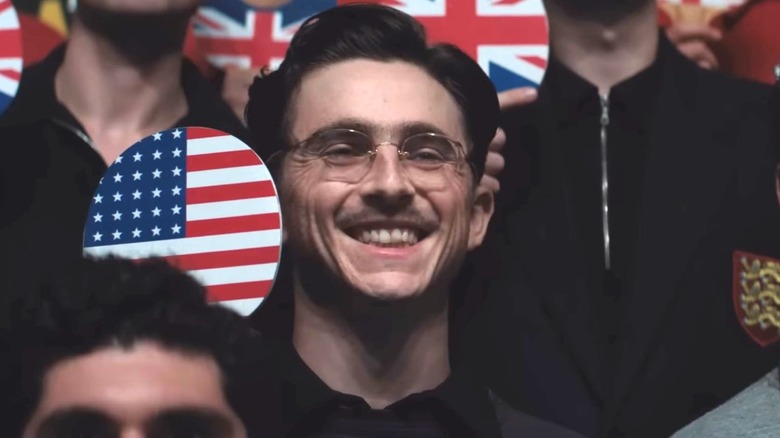
There are a few basic camps that "Marty Supreme" viewers tend to fall into. One argues that Marty shows no capacity for redemption whatsoever throughout the course of the story, rendering even his profound humbling in Japan as a footnote and his crocodile tears in the end rather ... unconvincing. (One such opinion from pop culture writer and podcaster Joanna Robinson draws an interesting comparison between this and "Jay Kelly.") The second group would generally agree with this read, though with one significant difference. Where others see the ending as one where we're meant to believe Marty has undergone an emotional epiphany of sorts, these fans interpret those tears quite differently (as evidenced by this post on X) — not of joy, necessarily, but of mourning that his freeloading life removed from all responsibilities is finally coming to an end. In that sense, it's hardly incongruous with his actions up to that point.
Allow us to propose a third option: That Marty has experienced an emotional revelation, but only to a degree. His tears and his crumbling face when confronted by his child are entirely genuine; but it's simply a first step on a very, very long journey that will likely take the rest of his life to complete. One assumption we're sometimes prone to making with movies is that an ending, however dramatic it may be, is meant to be a definitive statement on our protagonist. This binary approach doesn't allow for the story to continue long after the credits roll, robbing us of an ending that may represent an ellipsis rather than a period.
Is one side more correct than the other, or is the truth somewhere in the middle? Either way, "Marty Supreme" is now playing in theaters.