

4 Action Movies From 1985 That Are Better Than Anything Released Today
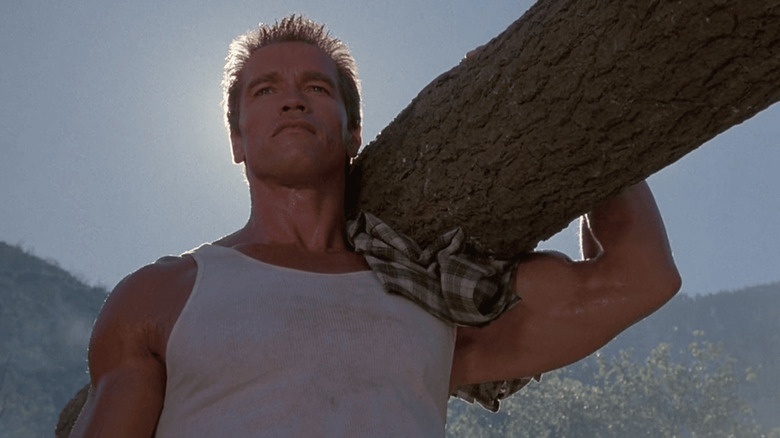
1985 was a year of nostalgia. The biggest hits of 1985 were all throwbacks of one kind or another, each one designed to stress the glories of American exceptionalism. Robert Zemeckis' "Back to the Future," for example, saw Marty McFly (Michael J. Fox) thrown back in time to the 1950s, when America was more purely conservative, and where he could discover his roots in a simpler, squarer time. "Rambo: First Blood Part II" saw Rambo (Sylvester Stallone) return to Vietnam where he could symbolically win the war this time. "Rocky IV" saw Rocky (Stallone again) in a brazen jingoistic film about a muscled American boxer using his down-home, organically-grown strength to fight off a massive, lab-trained super-Russian. It was all so embarrassing.
When it came to action, ultra-masculinity was the word of the day. Action stars were often bulging with steroid enhanced (and sweat-glistening) muscles, and they were almost always well-armed. A hero was defined by their capacity to murder with efficiency, often killing far more people than the villains they fought. In only one of the films below was the hero praised for their lithe, capable, acrobatic abilities. Action films of 1985 often saw their heroes proving a lesson to villains via the blitzkrieg method. If you dared to kidnap one girl in 1985, her dad had the moral right to murder 1,000 people. If you operated a street gang, an ex-architect would level your whole apartment building with a machine gun. 1985 was an aggressive time in the cinemas.
The action films of 1985 weren't exactly cinema classics, but they are exhilarating for how unguardedly overwrought they are. Action cinema of 1985 was screamingly demonstrative, almost operatic, and often dumb. But it was always amazingly entertaining. The following four films are some of the genre's best.
Commando
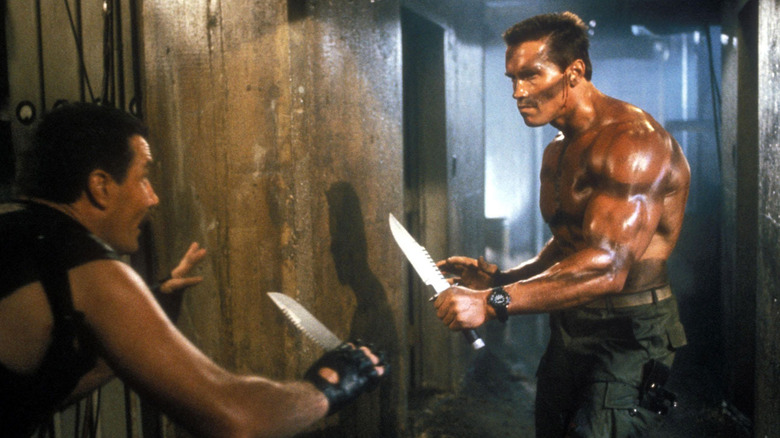
Mark L. Lester's "Commando" has one of the most twisted moral codes of the 1980s, and that's saying something. Arnold Schwarzenegger plays a character named John Matrix (snicker), a former Special Forces colonel who is attempting to live a peaceful life with his young daughter Jenny (Alyssa Milano). John's former life comes back to haunt him in the form of General Kirby (James Olson), an ex-partner who was kicked out of the army for being too violent. Kirby has been getting revenge on all his old compatriots, and attacks John in his home and kidnaps Jenny.
The plot is actually not terribly important. All we know is that John Matrix operates by the same rules as Harpo Marx or Bugs Bunny, in that if you do him one wrong, he now has the moral right to do whatever he wants to you as retribution. John Matrix spends the rest of "Commando" finding ways to murder the hundreds of thugs in Kirby's employ. He uses knives, guns, fists, rockets, and carefully thrown rotary saw blades to accomplish his mission. Schwarzenegger is unflappable and flippant, careful to deliver badass one-liners as he offs his foes. John Matrix kills more people than in "Friday the 13th Part V: A New Beginning" from the same year.
"Commando" is so morally wrong-headed, and Schwarzenegger so cartoonishly violent, that the film emerges almost as the Platonic ideal of New Action. With "Commando," it was almost as if action movies dropped the pretense. These are not stories of soldiers, of struggle, or even of justice. These are stories of violence and violence alone. And there's a certain integrity to that block-headed purity. Few films have touched "Commando."
Death Wish 3
The third installment in any long-running film series is always something of a dodgy proposition. In the first installment, a new premise or character or story is introduced, and audiences become very fond of its novelty. For a sequel, filmmakers tend to repeat the same premise or story, but larger and slicker, making for an improved version of the original (see: "Lethal Weapon 2," "Child's Play 2," "Batman Returns" or any of 100 other examples). For the second sequel, however, everything tends to fall apart, as the filmmakers either have to up the ante yet again, making something overblown and chaotic ("Spider-Man 3," "Guardians of the Galaxy, Vol. 3," etc.) or they have to take a "new angle" on the material, shifting focus to a new character, or taking the series to a new setting.
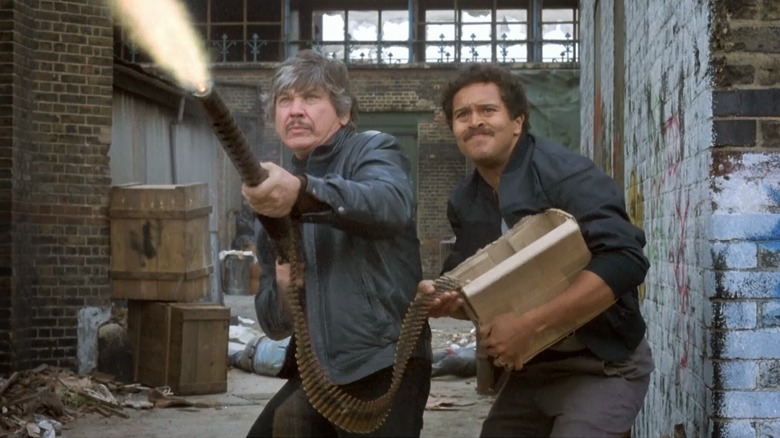
Michael Winner's vigilante thriller "Death Wish 3" did both. It removed the revenge-obsessed Paul Kersey from his gritty New York roots, and placed him in a cartoonishly outsized version of Los Angeles. While there, Kersey finds that a small, impoverished L.A. neighborhood is lousy with gang members and crime, and no one feels safe in the streets. There are just too many creeps. And what does Paul Kersey do better than anything but waste creeps? The film was produced by notorious(ly great) shlock studio Cannon, so you know you're in for a low-budget, high-violence, non-moral caper of the highest order.
And "Death Wish 3" has a few fun cameos to keep an eye out for. Alex Winter had a small role as a gang member before his days on "The Lost Boys" and "Bill & Ted's Excellent Adventure," and Trekkies can keep an eye out for future Counselor Troi actress Marina Sirtis (although she is brutally victimized).
Gymkata
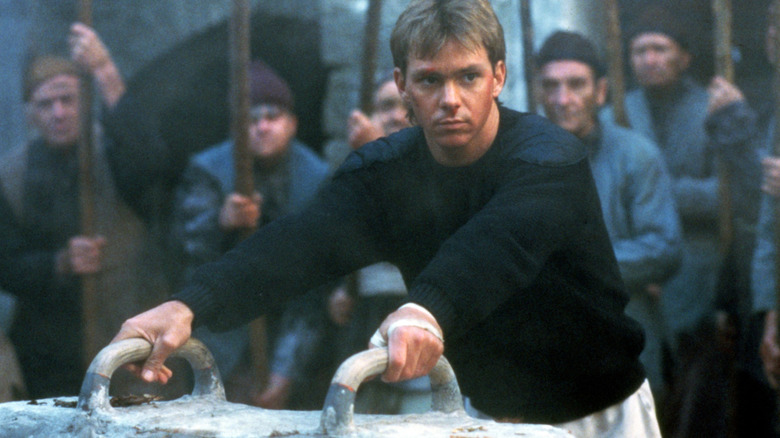
Is Robert Crouse's absurdly stupid action film "Gymkata" one of the worst films of 1985, or is it one of the best? Can it be both at once? Perhaps. "Gymkata" is a film about a new martial art that was born specifically for this film, and that died as soon as it ended. Real life Olympic gymnast Kurt Thomas played the film's main character, Jonathan Cabot, who is an expert is using gymnastics routines as a means of fighting. He is enlisted to travel to the fictional country of Parmistan to compete in a mysterious competition called simply The Game, which involves a long string of difficult endurance tests while simultaneously being hunted by Parmistani warriors. The winner gets, essentially, one wish, enacted by Parmistan's ruler, the Khan (Buck Kartalian).
Like many of the films on this list, the plot hardly matters. The film exists to hang set-pieces on, and allow Kurt Thomas to ply his gymnastics skills in action scenarios. Thomas isn't a very good actor, but he does have boyish good looks and an athlete's physique that serve him well as a screen presence. The gymkata set pieces are pretty silly, however. Thomas swings upside down on a bar and thwacks bad guys with his feet as they run past. In the film's most ridiculous sequence, the Cabot character finds himself in a small village populated entirely by crazed, insane weirdos, and he fights them off by swinging his legs over a conveniently placed pommel horse.
"Gymkata" has been featured on "How Did This Get Made," and other similar "bad movies" podcasts. And, yes, "Gymkata" is quite bad. But, golly, you're going to enjoy watching it more than, say "Out of Africa." You're going to remember it better than "Spies Like Us."
Mad Max Beyond Thunderdome
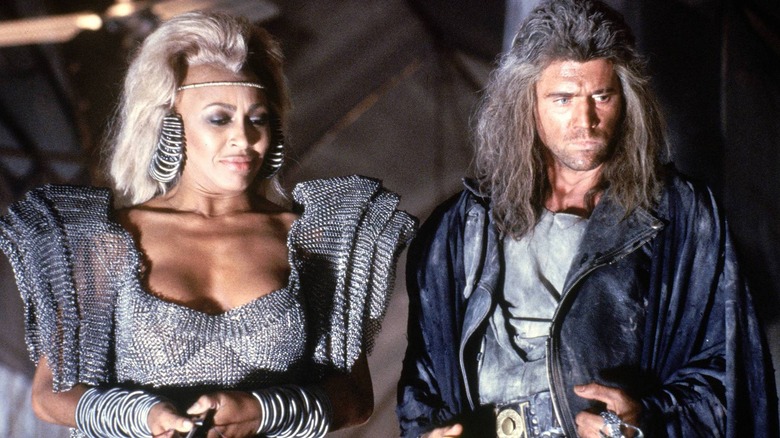
George Miller's "Mad Max Beyond Thunderdome" was the third film in the "Mad Max" series, and it was the wildest to date. The "Mad Max" movies detailed the fall of humanity and its movement into a post-apocalyptic landscape wherein humans were teetering on the brink of extinction; no matter how hopeful the "Mad Max" films feel, it's likely that humans only have maybe 30 or 40 years left. And on the way down, it seems that we, as a species, will go wholly insane. The Thunderdome of the title is a gigantic jungle-gym-like cage with swords and knives protruding inward. Two gladiators are forced into the Thunderdome by a mad empress named Aunty Entity (Tina Turner), and hooked up to bungee cords (!) that allow them to leap and bounce as they fight. Jump too high, and you get impaled. This is a wild idea and I cannot, for the life of me, figure out how or why anyone would have come up with it. It seems that cocaine made its way into the post-apocalypse.
Mel Gibson returns as Max, but the gray in his hair denotes that some time has passed since the events of the last movie. Or they are unrelated. The interconnected canon of these films can be debated. The first half of "Beyond Thunderdome" is a crazed, coked-out fever dream as Max runs afoul of Aunty Entity and is forced to fight in the Thunderdome. When he escapes, Max flees into the desert and finds a rogue tribe of parent-less children living in a glade. The kids hardly remember the world prior to the post-apocalypse, indicating that the collective unconscious of the species has been reset, Etch-A-Sketch style. "Thunderdome," then, adds vital context to "Mad Max" that the previous films lacked.