

6 René Auberjonois Movies & TV Shows Star Trek Fans Need To Watch
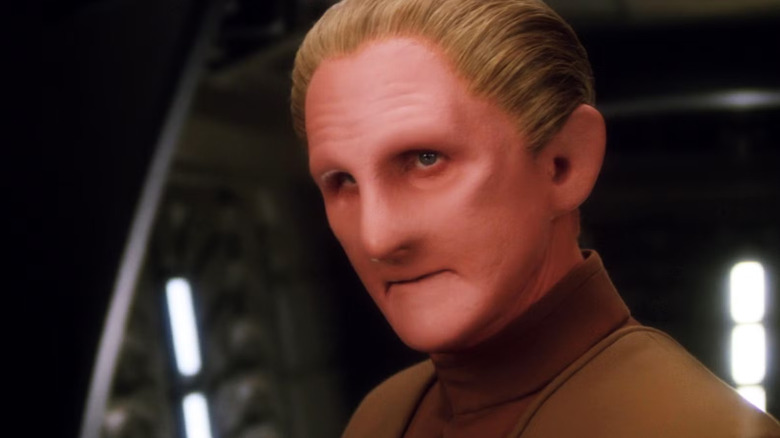
The great René Marie Murat Auberjonois — a descendant of Napoleon – passed away in December of 2019, and the world lost one of the world's greatest and most prolific character actors. For Trekkies, Auberjonois was best known for playing Odo, the Changeling security officer on "Star Trek: Deep Space Nine." Odo, in the mythology of the show, was actually made of liquid, and could solidify himself into a humanoid shape in order to work with other humanoids, but he was never quite an expert at emulating human facial features, making his face look smooth and without detail. This character detail forced Auberjonois to wear a full-face mask throughout the series that made emoting difficult. It's a credit to Auberjonois' talents that he was able to define the character so well. Odo was a deeply principled character who believed in justice almost as a holy writ. He was gruff and impatient, but would eventually reveal a tender loving side, confessing his affection for Major Kira (Nana Visitor).
But Auberjonois' career was far, far more extensive than "Deep Space Nine," beginning on stage in the early 1960s, and proliferating in movies and on TV quickly thereafter. Auberjonois' first film credit was for the 1964 Warren Beatty film "Lilith," and his first TV credit was for playing the title character in a TV staging of the play "Ofoeti." He also had an extensive voice acting career, appearing on "The Snorks," "The Flintstones Comedy Hour," "Superman." Some of his better-known voice credits will be listed below.
Auberjonois racked up hundreds of credits in his decades-long career. The below roles are only a few of his more notable credits.
McCabe & Mrs. Miller (1971)
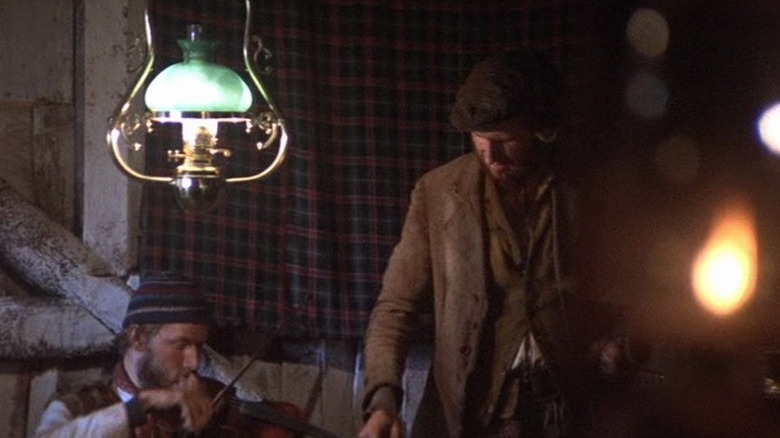
Early in his film career, Auberjonois fell in with director Robert Altman, appearing in his 1970s films "M*A*S*H" and "Brewster McCloud." He would also go on to appear in Altman's "Images," and "The Player." Of Altman's films, though, the best one to boast an Auberjonois performance in 1971's "McCabe & Mrs. Miller," a slow-moving, tragic film about a gambler named McCabe (Warren Beatty) who aims to open an inn/brothel in a tiny Washington town in 1901. McCabe teams up with a local madam, Mrs. Miller (Julie Christie), and their relationship seems loving, but is more based in commerce and convenience than passion. They are both cynics.
Auberjonois only has a supporting role as a character named Patrick Sheehan, but he seemed to represent all the citizens of the town. Thanks to Altman's naturalistic directing style, Auberjonois came across as fully formed and completely understandable in his scant scenes. Also, his big blue eyes and befuddled expression underpin a lot of the film's tragedy. The people of this town, Altman seems to be saying, are not the brightest lamps in the camp. But, as we see, they afford themselves creature comforts. Of all the supporting players in "McCabe & Mrs. Miller," Auberjonois stands out the most. Well, one might also take note of William Devane and Shelley DuVall.
Eyes of Laura Mars (1978)
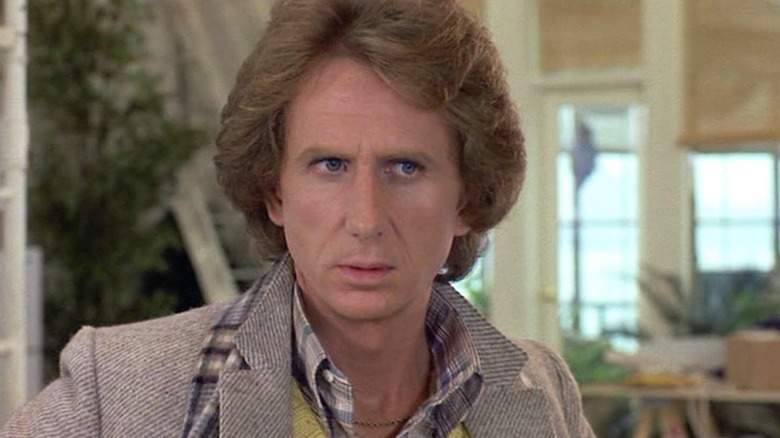
"Eyes of Laura Mars" was a supernatural thriller directed by Irvin Kershner, and written by John Carpenter. I needn't say that Kershner went on to direct "The Empire Strikes Back" in 1980, and John Carpenter went on to be one of the best-regarded genre filmmakers of his generation. "Eyes of Laura Mars" starred Faye Dunaway as the title character, a professional high-fashion photographer who suddenly finds herself cursed with the gift of foresight. Specifically, Laura Mars can see through the eyes of a serial killer, and witnesses his murders from his own point of view. The visions are already disturbing, but Laura soon finds that she is tangentially connected to one of the victims (the victim was dating her ex-husband).
Auberjonois plays Donald, Laura Mars' agent. He's a beleaguered character who seems concerned about his client. Partway through the movie, there's an amusing thrill sequence where Laura is at Donald's birthday party, and has a vision of his death. In order to fool the killer, Laura and Donald switch clothes, with Donald taking to the streets in a dress and coat. He was followed by the cops (as Laura was a person of interest), only to be busted. Auberjonois covers himself well by announcing that it is his birthday, and he's allowed to dress however he wants.
Sadly, Donald doesn't make it to the end of the movie. Also, the plot goes a little off the rails. But "Eyes of Laura Mars" is a fascinating curio from several film legends. It should be talked about more.
Benson (1980 - 1986)
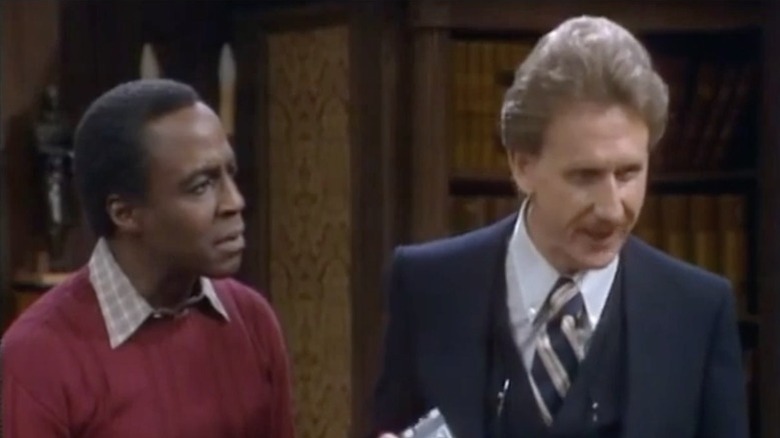
Prior to his starring turn on "Deep Space Nine," Auberjonois was probably best known for playing Clayton Endicott III on the long-running sitcom "Benson." "Benson" was a spinoff of the sitcom "Soap," and took place in the mansion of ex-Governor Eugene X. Gatling (James Noble). Benson (Robert Guillaume), was the head of the mansion's affairs, and oversaw all of its comings and goings while also offering a sarcastic voice of reason to the people he worked with. The Governor's chief of staff was Clayton Endicott, a snippy, short-tempered character who appeared beginning in the show's second season. Auberjonois played Endicott in 135 episodes of the series, ending his run in 1986. He was nominated for an Emmy for Best Supporting Actor (Comedy) in 1984. It was the first of three major TV gigs for Auberjonois, wherein he played a series regular.
Clayton Endicott was a constant object of mockery, mostly because he was such a stuffed shirt. He was the show's Malvolio. He had no empathy, and was depicted as cutthroat and mean. But, y'know, in a funny way. Benson and Endicott butted heads constantly, forming a glorious comedic relationship. Guillaume carried the series, but his scenes with the frustrating Endicott sharpened the character. Endicott was notoriously bad as a lawyer, having lost every single case, making the character amusingly pathetic. He is, however, striking intelligent and capable otherwise. People generally don't like him.
But everyone liked Auberjonois in the role.
Walker (1987)
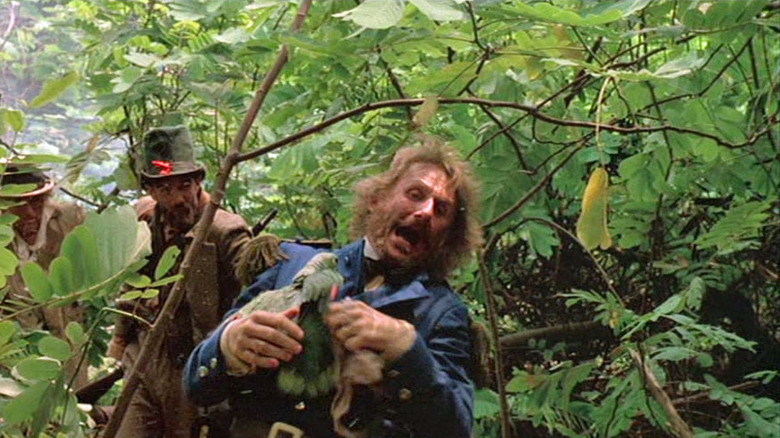
Auberjonois had another notable supporting role in a classic of the 1980s, playing the real-life Major Siegfried Henningson in Alex Cox's 1987 film "Walker." "Walker" is an odd duck, following the adventures of William Walker, an unabashed American colonialist who believed in Manifest Destiny down to his bones. Ed Harris, giving one of his best performances, played Walker in Cox's film as a stern, religious figure, a cross between an ascetic Amish priest and a marine corps drill instructor. The film follows Walker's bloody campaign in Nicaragua in the 1850s, where he conquered the land and then installed himself as president. He introduces slavery as a way to curry favor with the South during the Civil War, hoping to get American troops to come to Nicaragua and help him conquer more of the continent.
Of course, "Walker" was a direct rebuke of Ronald Reagan and his malfeasance in Nicaragua in the 1980s. In Cox's view, America was still living down the dark legacy Walker has begun 130 years earlier. Indeed, Cox wanted to make his point abundantly clear, and played footage of Ronald Reagan over the film's credits. Auberjonois played Henningson, the general who led Walker's military and who was responsible for burning Grenada to the ground. Henningson is played, like Walker, as a mad buffoon.
"Walker" notoriously bombed at the box office — it made only $257,000 on a $6 million budget — and was panned by many critics. Gene Siskel gave it zero stars. It was eventually reevaluated by modern audiences as a sharp, deliberately cartoonish satire of 1980s American politics. Sadly, its failure more or less scared Alex Cox out of Hollywood for the rest of his career.
The Last Unicorn (1982), The Little Mermaid (1989)
Auberjonois also had a prolific voice acting career, and sharp-eared cartoon fans might recognize his collection of snippy, screaming voices. His first film credits as a voice actor was playing a talking skeleton in the fantasy classic "The Last Unicorn" from 1982. His skeleton was dying of thirst, and didn't quite realize that he was already dead, and that he couldn't really drink. A wizard offers him a quaff anyway.
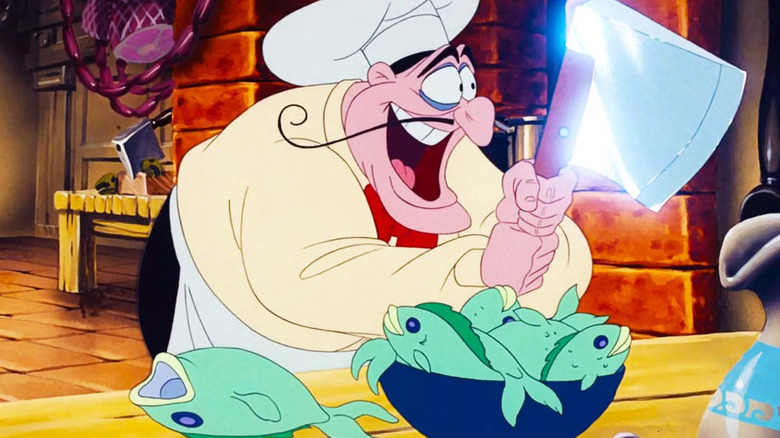
More notably, Auberjonois played the homicidal seafood chef in the Disney animated production of "The Little Mermaid." Auberjonois, as his name and lineage would have you understand, was French, and he was able to lean into his cartoonish French accent for "Mermaid." He also got to sing his own song, "Les Poissons," a ditty about ripping apart fish corpses and incorporating them into meals. In an otherwise straightforward fairy tale, the "Les Poissons" sequence is a marvelously violent comedic aside. Auberjonois reprised the role for the straight-to-video sequel "The Little Mermaid II: Return to the Sea." Indeed, Auberjonois made a few buck voicing characters in multiple straight-to-video sequels to high-profile animated successes. He was in "An American Tail: The Treasure of Manhattan Island," "Joseph, King of Dreams," and "Tarzan & Jane."
And this is nothing to speak of his dozens of TV voice roles, from "Snorks" to "Pound Puppies." If you were too young to be watching "Benson" in the 1980s, you were likely hearing Auberjonois' voice without realizing it. Once again leaning into his French-ness, Auberjonois even played Pepe Le Pew in 2011's "The Looney Tunes Show."
Boston Legal (2004 - 2008)
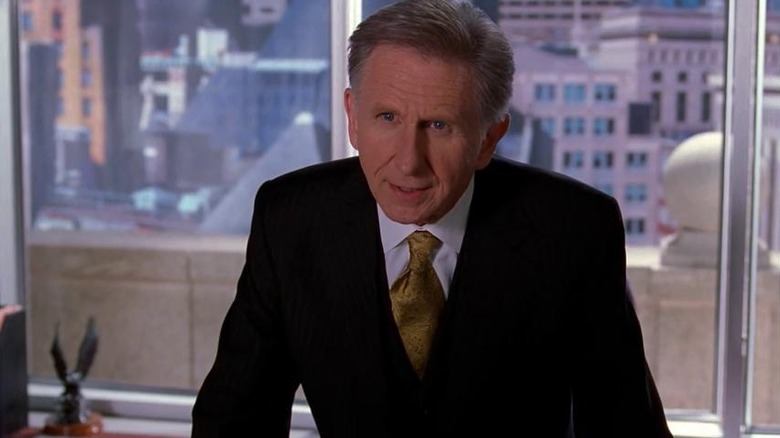
After "Benson" and "Star Trek: Deep Space Nine," the third series on which Auberjonois appeared as a regular was "Boston Legal," the successful spinoff of "The Practice." It may be a fun piece of trivia to realize that all three of Auberjonois' shows were spinoffs. The main characters of "Boston Legal" were Alan Shore, played by James Spader, and his half-mad boss Denny Crane, played by William Shatner. The dynamic between those two characters was the reason enough to tune into "Boston Legal," but the showrunners spoiled us by rounding out the show's cast with a wide panoply of talented actors. Candice Bergen played one of the central law firm's partners, and she was joined by the likes of Monica Potter, Craig Bierko, Mark Valley, Julie Bowen, John Larroquette, Saffron Burrows, and Taraji P. Henson.
Auberjonois played Paul Lewiston, a managing partner of the law firm, and a voice of reason. Like his characters on "Benson" and "Deep Space Nine," Paul was very strict, and abided by the letter of the law, leading him to butt heads with Alan and with Denny Crane throughout is run on the series. Paul also had a dramatic arc of his own. He starred in a story wherein he had his own daughter kidnapped and forcibly placed into drug rehab, as she had lost control of her life. Paul was often out of the office, as he had to spend more time raising his granddaughter. Auberjonois seemed to excel at playing principled, strict, angry characters, but would bring enough life and energy to these characters to invite writers to expand them. Auberjonois appeared in all five seasons of "Boston Legal," appearing in 71 of its 101 episodes.