

Avatar: Fire And Ash Reveals What Eywa Looks Like - And She Reminds Us Of A Classic Anime
The way of water has no beginning and no end — just like spoilers. This article discusses major plot details from "Avatar: Fire & Ash."
"Avatar: Fire and Ash" closes the second act of James Cameron's "Avatar" saga, essentially telling the second part of the story started in "The Way of Water." Despite criticisms to the contrary, the movie does a lot more than just repeat certain ideas from the previous film. This is the movie where James Cameron most overtly argues against pacifism, a movie that forever changes Na'vi and even Tulkun culture in regards to violence. "Fire and Ash" introduces an antagonistic clan with quite bloody aspirations, forever changing the trajectory of humanity's prospects to live in Pandora thanks to Spider's (Jack Champion) evolution.
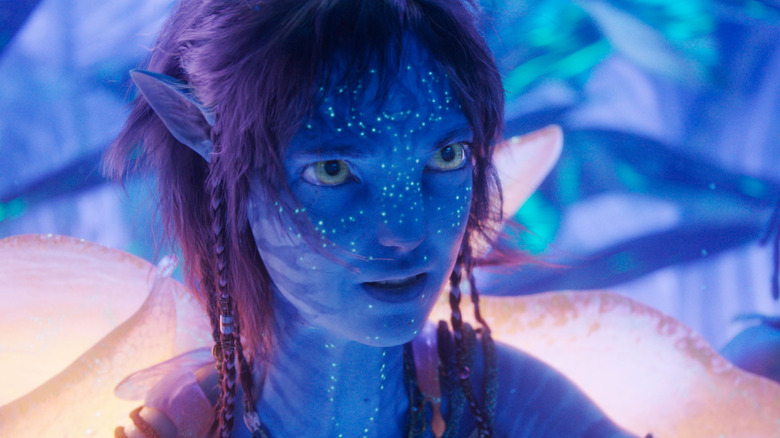
But without a doubt the place where "Avatar: Fire and Ash" does the most work in advancing the plot is Kiri (Sigourney Weaver) and Eywa. Kiri was a strange character from the moment she was introduced, but "Fire and Ash" confirms just how rare her existence is. She is bound to be hugely important for the future of the franchise as a religious figure, perhaps even an actual avatar of Eywa herself.
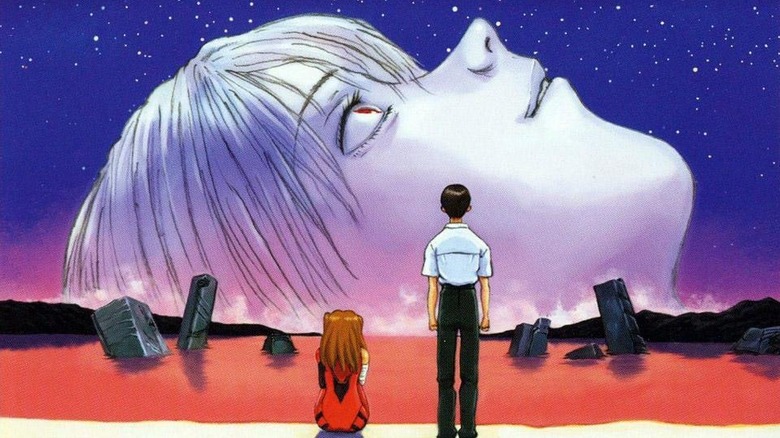
Speaking of Eywa, the mysterious deity and biological network that surrounds all of Pandora, the god finally makes an appearance in "Fire and Ash" during a moment of need. It's an incredible scene with big repercussions for the last two movies in the saga, yet all we could think about was how much she reminded us of a classic anime. Specifically, giant Eywa looks just like giant Rei Ayanami from "The End of Evangelion."
It all comes tumbling down
The reveal comes in the third act of the film as the fight against the RDA takes a turn for the worse. Kiri, who already knows she could have a seizure and die if she connects to Eywa underwater, makes a desperate attempt to connect to the Spirit Tree yet again and beg the Great Mother for aid. It is only with the help of both Spider and Tuk that she manages to push through her vision and reach the Na'vi deity.
When we finally see her, Eywa manifests herself as a giant face with both Na'vi (the long nose bridge) and human (she has eyebrows) features. She kind of looks like a baby, specifically the Star Child from "2001: A Space Odyssey." But given how much of an anime fan Cameron is, it wouldn't be surprising that he's actually channeling a different reference. The idea of a deity appearing as a giant, pearly white figure with a sort of ethereal glow is straight out of "The End of Evangelion."
In "The End of Evangelion," the soul of the Angel, named Lilith, is activated after being merged with the embryo of the first Angel, which is hosted inside the cloned body of the young Rei Ayanami — one of the three main characters of "Neon Genesis Evangelion." This causes Rei to turn into a giant naked being that grows taller than the Earth itself and initiates the end of the world — turning every human into orange Tang. The framing of Eywa looks a lot like the framing of giant Rei in the original poster for "The End of Evangelion," but also the way Kiri immediately calls for the annihilation of humanity after her visit to Eywa that resembles Rei's apocalyptic attack.
Avatar: Fire and Ash is a conflict of religion
"Avatar: Fire and Ash" packs a whole lot of plot and themes into its runtime. This is by far the densest movie in the trilogy, and the one where James Cameron both throws in the kitchen sink in case he doesn't get to make more, but also plants plenty of seeds in case he does get to finish the story.
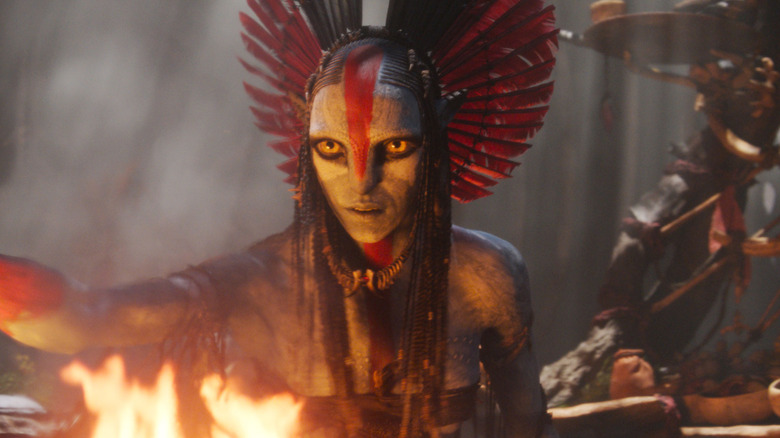
A big theme that becomes prominent this time is religion. Not only in the Kiri storyline with actually meeting Eywa, but generally her crisis of faith throughout the movie. She spends a lot of time struggling to come to terms with why Eywa seems to have shut her off, and why she allows all the suffering that is happening on Pandora. At the same time, the film's new villain, Varang (Oona Chaplin) is an ardent atheist set on a warpath to destroy the very faith of Eywa and her role in Pandoran society. That conflict of belief is clearly being posed to be an important part of the future of the "Avatar" franchise, with Eywa herself likely to have a more prominent and visible role in the story, taking more of a stand.
James Cameron clearly is working through some things in "Fire and Ash," and he uses religious imagery to tell this story. Take Jake Sully, aka the worst character in the movie. He gets his own Abraham moment in this movie when he almost kills Spider on a rock, as a sacrifice to Pandora itself. It's a devastatingly tragic moment (made hilarious by Spider's need to pee), and a clear sign that "Avatar" is heading deeper into religious territory as it reaches its climax.