

Roger Ebert Called This Game-Changing Comic Book Movie 'Morally Reprehensible'

Legendary film critic Roger Ebert passed in 2013, just as superhero movies had become the dominant obsession of Hollywood. While Ebert obviously didn't get to write about the genre's eventual plateau, he foresaw it in his 3-star, backhanded compliment review of 2012's "The Avengers," writing: "['The Avengers'] provides its fans with exactly what they desire. Whether it is exactly what they deserve is arguable."
If you think that's mean, then know Ebert had much harsher words for another cape flick: Matthew Vaughn's hard-R superhero parody, "Kick-Ass." Adapted from a comic by Mark Millar and John Romita Jr., "Kick-Ass" hit theaters in 2010. The Marvel Cinematic Universe hadn't cemented the superhero boom yet, but Sam Raimi's Spider-Man films were big enough cultural touchstones to make the parody land.
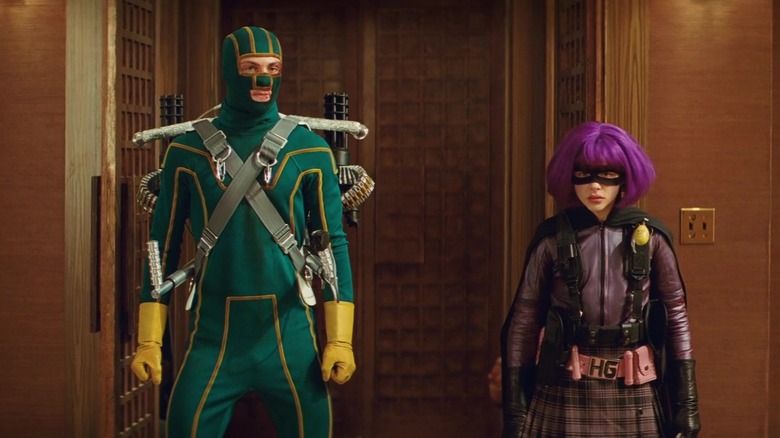
In "Kick-Ass," loser comic book geek Dave Lizewski (Aaron Taylor-Johnson) decides to become a superhero for real. Ordering a green-and-yellow costume with baton weapons, he starts patrolling the streets of New York City as "Kick-Ass." It goes poorly, especially once he gets drawn into a war between a mob boss and two lethal vigilantes, Damon McCready/Big Daddy (Nicolas Cage) and Mindy McCready/Hit-Girl (Chloë Grace Moretz).
The 13-year old Moretz played a child soldier in a purple wig who curses like a gangster in a Scorsese movie. That drummed up some moral outrage, and Ebert joined the chorus. In his 1-star review of "Kick-Ass," Ebert bemoaned:
"Will I seem hopelessly square if I find 'Kick-Ass' morally reprehensible and will I appear to have missed the point? [...] A movie camera makes a record of whatever is placed in front of it, and in this case, it shows deadly carnage dished out by an 11-year-old girl, after which an adult man brutally hammers her to within an inch of her life. Blood everywhere."
Kick-Ass delights in its vulgarity and violence
Ebert was hardly a prude or a moralist. This is the man who called political correctness "the fascism of the '90s" and wielded his pulpit to admire Alice Krige as the seductive Borg Queen in "Star Trek: First Contact." Even so, violence committed by children seems to have been a red line for him.
In Ebert's review of the 1990 film adaptation of "Lord of the Flies," he wrote that: "The story is less poignant nowadays than it once was, if only because events take place every day on our mean streets that are more horrifying than anything the little monsters do to one another on [author William] Golding's island."
You can see similar emotions running through Ebert's review of "Kick-Ass." He seems alarmed at Mindy's flippancy towards the violence she doles out and that's doled out to her, as if the movie doesn't grasp how disturbing (not cool) it is to see a little girl committing murder:
"This movie regards human beings like video-game targets. Kill one, and you score. They're dead, you win. When kids in the age range of this movie's home video audience are shooting one another every day in America, that kind of stops being funny."
Ebert questioned what the movie was even satirizing and that's because, by the end, it's nothing. "Kick-Ass" starts as parody but ends as superhero wish fulfillment. The original comic is extremely mean-spirited but it's more honest than the movie. Whereas Dave in the movie is an endearing nerd, in the comic he's an anti-charismatic creep with warped perceptions from a media diet of comics and "Buffy." (Casting burly pretty boy Aaron Taylor-Johnson, rather than someone who could truly pass as a pasty and unattractive teenage nerd, doesn't help the movie convey this.)
Kick-Ass' adaptational changes dilute its message

Dave pretends to be gay so his crush Katie Deauxma (Lyndsy Fonseca) will hang out with him. In the movie, they hook up after Dave confesses the truth. In the comic, she's infuriated. She sends Dave some nudes (including her going down on her boyfriend) to rub it in to Dave that he'll never be with her ... and let's just say Dave doesn't delete the pics.
Then there's Big Daddy, a former cop once framed and imprisoned for corruption who wants revenge on crime boss Frank D'Amico (Mark Strong). After his wife's death, he raised his daughter to help take down the man who ruined their lives.
In the comic, Big Daddy's tragic, Punisher-esque backstory was all lies. Damon was the same kind of nerd as Dave, but 20 years older, and decided escapism wasn't enough. He raised his daughter into a killer to give her an "interesting" life. Making Damon's sob story the truth in the movie turns him from deplorable to admirable (in the movie's eyes, anyway).
Now, Hit-Girl is a parody of Robin; Big Daddy's costume in the movie resembles Batman, and Cage does an impression of Adam West. As a crime-fighting little girl, Mindy is especially similar to Robin/Carrie Kelley from Frank Miller's "The Dark Knight Returns." That book revealed the second Robin, Jason Todd, had died in the line of duty, showing what's most likely to happen if you dress a kid up in a leotard and send them out to find gangsters. Miller, though, has maintained he only deconstructed parts of Batman to build him back up better. "Kick-Ass" attempts a similar balancing act, but despite their similar names, Mark Millar (and for that matter, Matthew Vaughn) is no match for Frank Miller at his '80s prime.