

James Cameron Almost Made A Huge Mistake With Avatar: Fire And Ash's Original Ending
This article contains minor spoilers for "Avatar: Fire & Ash."
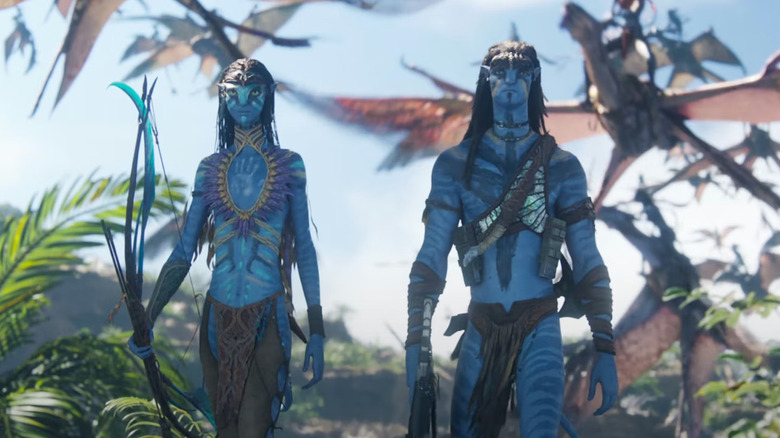
In James Cameron's ultra-successful "Avatar" film series, the filmmaker is using movie violence as a means to achieve, in his mind, a form of cultural justice. The aliens at the center of the series, the Na'vi, are a stand-in for any number of indigenous tribes around the world who have been historically wiped out by colonialism. Cameron has said in interviews that the Na'vi were inspired by the Lakota Sioux, and that the central Na'vi character, Neytiri (Zoe Saldaña), was inspired by Pocahontas. The director's solution to all this was to send a white soldier named Jake (Sam Worthington) into the Na'vi tribes — his consciousness shunted into a clone Na'vi body — to become their savior. Jake realized the peacefulness of the Na'vi and eventually became a soldier on their behalf. He would unite the Na'vi against the human colonizers and eventually become a Na'vi permanently.
Of course, there is an irony at the center of this story. Cameron's movies all climax with giant battles, with the Na'vi taking up arms against a gaggle of human war machines, and hundreds of people/Na'vi die. Cameron is using the language of an action movie to extol the virtues of a nature-connected, pacifist philosophy. Indeed, Jake begins "Avatar: Fire and Ash" salvaging weapons from the ocean floors of Pandora, left there by the action climax from the previous movie. If Jake loves the peaceful Na'vi, why does he still teach his sons how to use machine guns? Why does he still think like a Marine?
In a new interview with The National, Cameron confessed that he needed to rethink the ending of "Fire and Ash" when he realized that Jake needed to learn to put the guns down, not take them up.
James Cameron had to change the ending of Avatar 3 when he realized it had too many guns
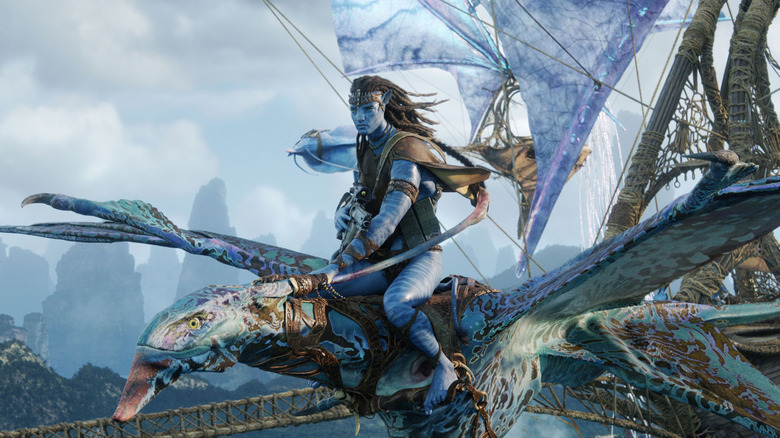
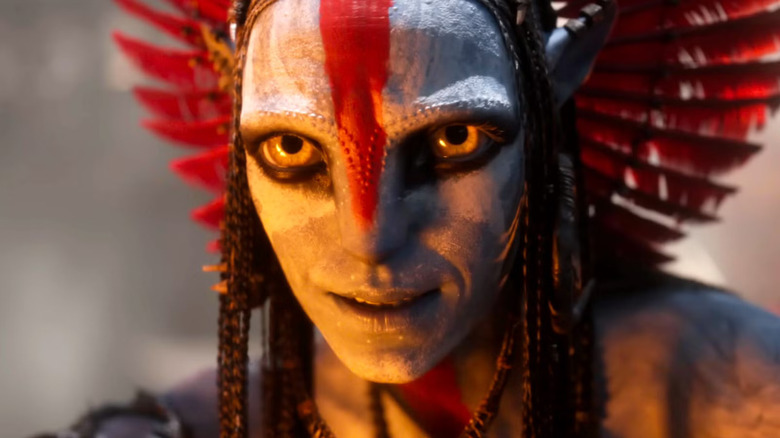
Part of the plot of "Fire and Ash" sees the rival Marine, Colonel Quaritch (Stephen Lang), teaming up with the wicked, violent Varang (Oona Chaplin), a Na'vi who cares more about conquest and destruction than peace. Quaritch, also in a Na'vi body, offers Varang his military support, inducting her tribe into the human fighting forces. The climax of "Fire and Ash" sees many members of the fire tribe firing machine guns at Jake and his family. Jake, meanwhile, has enlisted the help of multiple Na'vi tribes to fight back with arrows, spears, and specially trained intelligent attack monsters.
It seems that in an early draft of his script, Cameron wrote Jake to be shooting back with his own machine guns. It wasn't until he was in production on the film, though, that Cameron realized that he was essentially repeating some of history's grosser mistakes. Indeed, he realized he was just writing a story about white oppressors arming various indigenous tribes and hoping they would proceed to wipe each other out in violent wars. As Cameron said:
"When you watch the film, you probably think, 'Oh, absolutely, [Jake] must go and fulfil his destiny. [...] But actually, I did all that in post-production. [...] At a certain point, it just hit me; this maps to colonial history. [...] Arming the tribes and pitting them against each other is actually the wrong thing. That was part of the North American genocide of indigenous people. I can't have Jake doing the same thing."
Once he realized that, Cameron started rewriting his movie furiously.
James Cameron was re-writing his script as he went
It's worth remembering that Cameron filmed "Fire and Ash" at the same time as its predecessor, "Avatar: The Way of Water." As such, when he was filming "The Way of Water," his "Fire and Ash" script was undergoing massive changes based directly on Cameron's moral quandary. And he was fine with the tinkering. I'm not precious about what I wrote," Cameron said. "I'm constantly second-guessing it. I see the entire post-production phase as kind of a rewrite."
This led to Cameron wrestling with the very notion of pacifism, however. The "Avatar" movies feature a species of hyperintelligent whales called the Tulkun that actually do live a philosophy of utter pacifism, and who refuse to commit acts of violence. In Cameron's script, however, the pacifist whales are convinced to fight by Jake's son Lo'ak (Britain Dalton). This leaves the themes a little complex in terms of how it views violence. Is fighting good or bad? Cameron admits, though:
"I don't have all the answers. [...] I don't profess to be Gandhi or some great philosopher. But I do struggle with the issue of when armed conflict is justified. [...] The Tulkun have a pacifist mentality, which works right up until the moment you're going to be exterminated. [...] That pacifism was based on their history, which didn't involve a massively superior invading force."
So, for Cameron, he feels that pacifism is preferable, but cannot persist in a violent world. The pacifist message isn't really well-thought-out. "Star Trek" it ain't.