

Avatar: Fire And Ash Ending Explained: A More Radical Conclusion Than You Realize
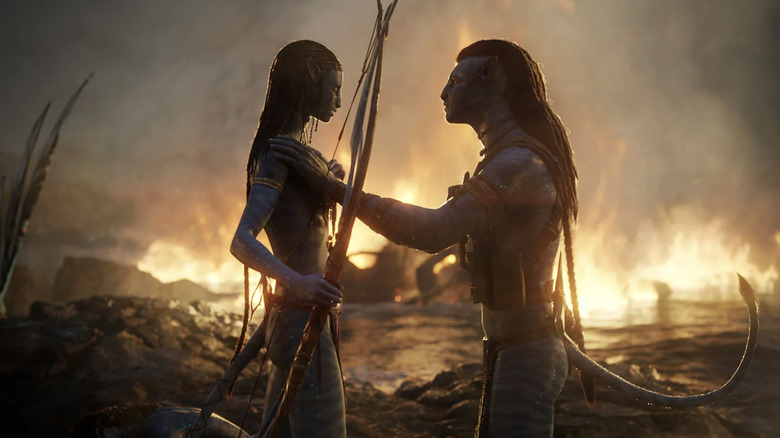
Only true followers of Eywa past this point! Full spoilers for "Avatar: Fire and Ash" to follow!
A staple of storytelling since time began is the two-sided structure, as seen in how just about every story has a hero and a villain. This can be abundantly seen in stories told within genre, as the pleasures of most genres involve having the relationship between the protagonist and antagonist clearly defined. Of course, that doesn't mean that all genre stories, and genre films by extension, are completely reductive. Most writers, directors, and actors inherently understand that the most flawed heroes and the most relatable villains only make for stronger drama. Yet while nuance is usually present, ultimately, the categories where the characters are placed tend not to waver.
That standard has begun to mutate over the course of the last couple decades of blockbuster genre films. As with so many elements of the sci-fi/action/fantasy/adventure movie, one could say this began with the original "Star Wars" trilogy, as the character of Darth Vader went from unabashed villain in the first movie to tragic figure in the third, with his character becoming even more filled out during the prequel films. Since those, we've seen the "Matrix" movies move and expand the definitions of good and evil, we've seen the Marvel universe pit hero against hero, and we've even seen the characters of the "Fast and Furious" movies switch sides.
The first "Avatar" in 2009 told a very familiar story of a human switching sides to a planet's indigenous people after coming to realize that his species was mistreating them. "The Way of Water" blurred those lines somewhat, but it kept them mostly intact. Now, "Fire and Ash" takes the characters and the world of Pandora into some fascinatingly nuanced territory. It all leads to a conclusion which, while not seeming too different on the surface, is actually more radical than you might realize.
What you need to remember about the plot of Avatar: Fire and Ash
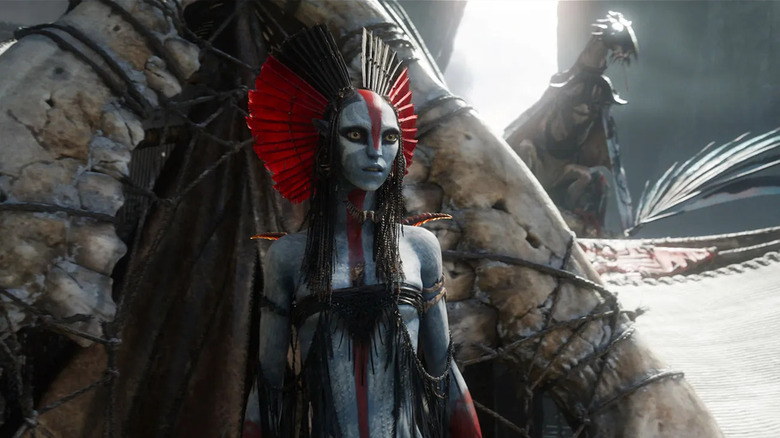
First and foremost, let's just say that a ton of stuff happens in "Fire and Ash." In fact, it may be the busiest "Avatar" film so far (and these movies are notorious for being overwhelmingly large in just about every respect, too). Suffice to say that after Jake Sully (Sam Worthington) and his family escape the clutches of the newly Na'vi Col. Miles Quaritch (Stephen Lang) at the end of the prior film, things have grown calm on Pandora for a bit once again. During this lull, Jake, Neytiri (Zoe Saldaña), Kiri (Sigourney Weaver), Lo'ak (Britain Dalton), and Tuk (Trinity Bliss) are all grieving the loss of their son and brother, Neteyam (Jamie Flatters). The Sully's adopted teen human son, Spider (Jack Champion), is the son of the human Quaritch, and Neytiri's growing bigotry combined with Jake's increasing worry that humans and Na'vi cannot coexist results in the family agreeing to drop Spider off with the Na'vi-friendly human scientist encampment.
However, thanks to pirate-like attacks by the Eywa-hating Mangkwan clan (or the Ash people), led by Varang (Oona Chaplin), the family get injured and separated. When Spider almost dies, Kiri uses her connection to Pandora to save him by causing a particular plant to transform his body enough to make him able to breathe Pandoran air and grow a neural queue.
Jake worries that this makes Spider too dangerous to live, a fear that is confirmed when Jake and Spider are captured by Quaritch, now teamed up with Varang, and the RDA look to reverse engineer the ability. After Spider helps Jake escape, the Sullys realize their love for the boy overcomes their bigotry and fear. Knowing that the RDA intend to slaughter the Tulkun species during their gathering ceremony, Neytiri convinces Jake to become Toruk Makto once again and unite the Na'vi clans for battle, including the pacifist Tulkun.
What happened at the end of Avatar: Fire and Ash?
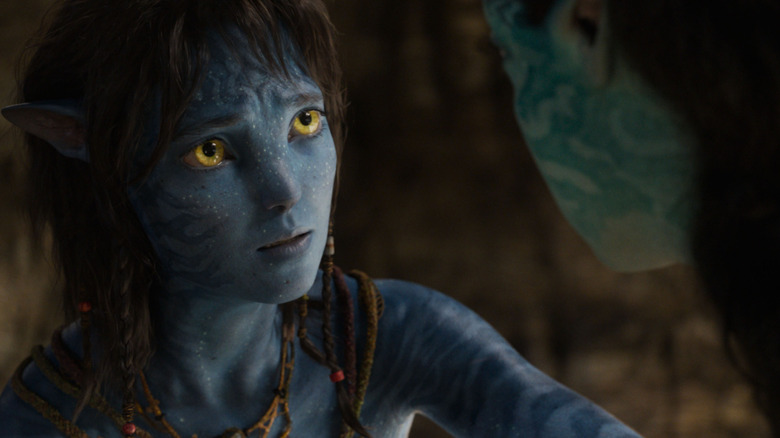
At the Tulkun gathering and under the shadow of Pandora's eclipse, Jake and the Na'vi forces wage war against the RDA, as the latter attempt to slaughter the Tulkun, only for the Tulkun to finally fight back, thanks in large part to Lo'ak and his Tulkun brother Payakan's efforts. During the battle, Ronal (Kate Winslet) is fatally wounded, but gives birth to her child and entrusts it to Neytiri's care before dying. As the Pandoran forces begin to become overwhelmed by the RDA's might, Kiri disregards the doctors' warning to not join with Eywa again and instead connects to the planet's network. She, along with Tuk and Spider's help, successfully pleads for Eywa's direct involvement in the battle, and the Pandoran flora and fauna help turn the tide in their favor.
Meanwhile, Jake, Spider, and Quaritch undergo their fight to the death. Despite the protesting of both men, Quaritch refuses to change or waver from his goal to fight for the RDA and end Jake Sully. Even when the battle reaches a stalemate, Quaritch decides to sacrifice himself rather than surrender, and he steps off a magnetically raised cliff into the unknown. The battle won, a celebration is held wherein Kiri, the Sullys, and others welcome the human (albeit genetically altered) Spider into their group joining, accepting him as one of The People.
What the end of Avatar: Fire and Ash means
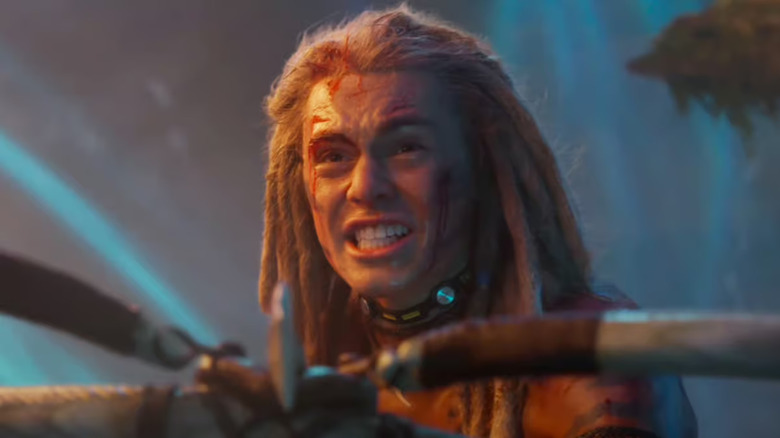
As a storyteller, James Cameron has always been keen on playing with a reversal of expectations. "The Terminator" doesn't reveal that its title character is a cyborg until about a third of the way through, "Aliens" restages the conflict from "Alien" with increased firepower on both sides, "The Abyss" is an extraterrestrial first contact story deep in the ocean instead of in outer space, "Terminator 2" flips the T-800 from villain to hero, and so on. This idea of reversals was baked into the concept of "Avatar" from the start, as the core of the story is about a human finding his legs (literally and metaphorically) in the body of another species while falling in love with a member of that species. It's also a conservationist parable, casting the greedy, opportunistic citizens of Earth as the bad guys.
"Fire and Ash" takes those foundations and stirs them around, expanding their nuances and revealing that the "Avatar" saga is far from being simplistic or repetitive. It takes the conflict between humans and Na'vi and reveals that coexistence is possible, just not in the militaristic and invasive manner of the RDA. It also shows how the RDA is not the only antagonistic force on Pandora, as the Mangkwan clan are just as closed-minded when it comes to a peaceful shared future, perhaps even more so.
Most of all, the ending of this film demonstrates how forward-thinking and sci-fi-oriented Cameron and his writers are when approaching these concepts and characters. Kiri is an immaculately conceived clone version of a formerly human woman, Spider is now a hybrid along with Jake and the other Sully children, and so on. The film shows how the power of a collective, community-minded group can include all types of beings, and how they can overcome the destructive and capitalistic forces who seek to quell it.
The ending of Avatar: Fire and Ash proves that an epic can be told multiple ways
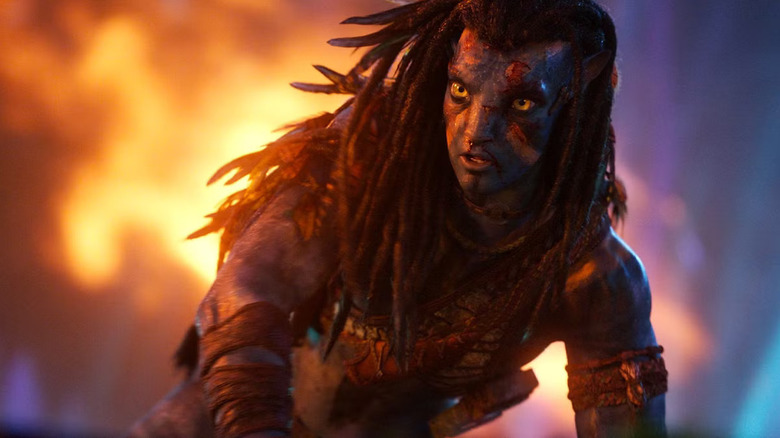
One of the most impressive aspects of "Fire and Ash" is how it tells an epic tale without resorting to cheap and/or cliched elements of serialized storytelling. For months, fans have theorized that a major character would suffer a tragic death at the end of the film, be it one of the Sully children or Jake himself. Cameron leans into this expectation for much of the movie, as he's savvy enough to realize how it fuels so much of the suspense and drama. Yet he's not so lazy as to just kill another Sully or kill off the hero for mere shock value. Instead, the most major death in the movie — Ronal — feels appropriate while still providing some dramatic and emotional stakes for a story that needs consequences in order to feel grounded.
Even beyond character deaths, every choice in the film feels rooted in the story Cameron wants to tell and the themes he wishes to explore, rather than beats which have been spit out of an algorithm or focus-grouped to death. This is why something as small as Quaritch refusing to change sides feels so radical, as does the scene where Jake nearly kills Spider out of fear for what his new abilities might mean for the future of the Na'vi. Instead of these moments playing out and returning to a status quo, they essentially redefine and enrich what used to be that status quo. To wit: Quaritch is still the antagonist, but he's an even more informed and defined one. Spider's hybridness may still become an issue, but his value as one of The People and the Sully family's love for him (including Kiri, who may love him in a romantic way, too) overcomes that paranoia.
What the ending of Avatar: Fire and Ash could mean for the franchise
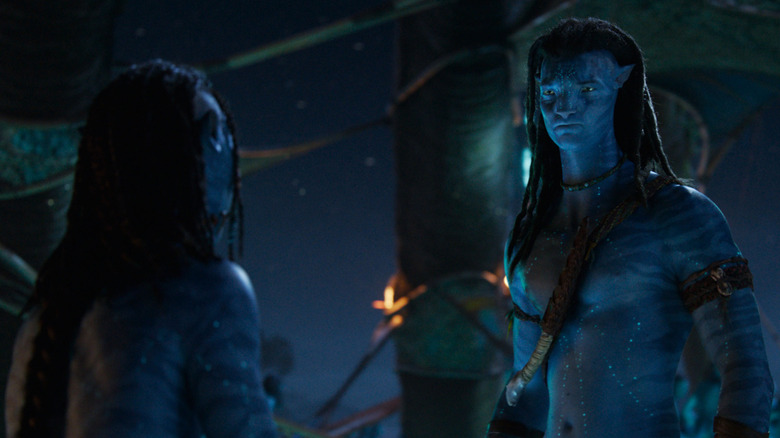
The fact that "Fire and Ash" feels so vibrant and unique amidst the "Avatar" films so far is indication enough that the series is hardly tapped out when it comes to ideas and imagination. Given that, the promise of two more films in the series (as made way back when) feels less like an obligation and more like a gift. There are a number of directions this story and these characters could go in. One element which has been mentioned by folks like Bliss and Dalton is the maturation of the Sully children into adulthood, and given how much creative juice the series got from the time jump between the first two films, it stands to reason that another leap forward could provide some more exciting opportunities. It also implies that "Avatar" is more of a generational epic, something akin to a Shakespearean history or Frank Herbert's "Dune" saga.
Then there are the numerous threads and elements within the story which "Fire and Ash" only hints at. There's still a massive RDA-run human city on Pandora now, in contrast with the slow dying out of the human race back on Earth, a planet we have yet to see (in the theatrical versions of the films, anyway). There's also the strange matter of Jake permanently living in the Na'vi avatar body, which was originally grown for his twin brother, Tom, not him. Is Quaritch dead (again), or if not, what's he planning? Thanks to the Amrita fluid the humans have taken from Tulkuns already, will we see humanity cease aging, thereby continuing this conflict beyond a normal lifespan? Will we see more of Eywa taking an active role in the future of Pandora?
Whatever happens, it's clear from "Fire and Ash" that the "Avatar" saga is only just beginning.