

A Stargate Veteran's Netflix Time Travel Series Is A Must-Watch For Sci-Fi Fans
You might know Brad Wright as the co-creator of the iconic "Stargate SG-1," which ran for 10 seasons on the SyFy channel. Turns out, "SG-1" was so widely loved that it warranted several offshoot stories, including "Stargate Atlantis" and "Stargate Universe." Wright was also involved in the creation of these later entries, which essentially shaped the ethos of "Stargate" and its ever-evolving lore. There's a level of tonal variety here, as "Stargate Universe" deliberately moved away from the cautious optimism of its predecessors and embraced a more bleak worldview. But Wright created a completely different kind of sci-fi series in 2016 — his "Travelers" helms a rather straightforward story, but doubles down on the optimism about humanity's shared future.
"Travelers" ran for three seasons: the first two were co-produced by Netflix and Showcase, while the third season saw the streaming platform as its sole broadcaster/distributor. It is, primarily, a time travel show, but don't expect convoluted storylines or red herrings like in "Continuum" or "Dark." Wright's 2016 series doesn't dwell too much on the science, as it's preoccupied with introducing fun twists into its post-apocalyptic premise. In this future, human society is on the brink of collapse, which prompts special operatives — yes, you guessed it, "travelers" — to send their consciousness back in time. These transfers are made into host bodies that will die soon to prevent untoward time paradoxes caused by potential timeline manipulation.
A self-serious series would've opted for a more sophisticated transfer process, but "Travelers" makes these scientific aspects wacky and fun. We're also not immediately told why the future needs saving, which helps retain intrigue throughout the initial episodes. But what makes this series a must-watch?
Travelers offers a fresh take on the time travel genre trope

Spoilers for "Travelers" ahead.
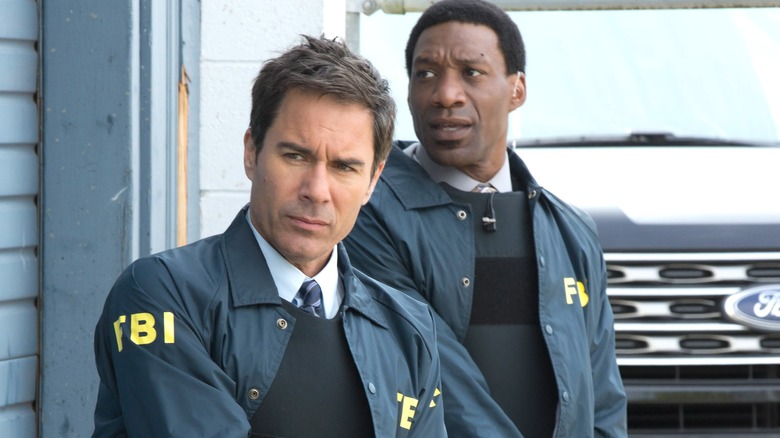
In Wright's show, the titular travelers want to change the past to improve the present, but this introduces a slew of problems. For starters, travelers Philip (Reilly Dolman) and Marcy (MacKenzie Porter) get transported into less-than-ideal host bodies — while the former has to endure the effects of addiction, the latter has a hard time blending into society after the consciousness override. Then there are those like Grant (Eric McCormack) who ends up in the body of an F.B.I. agent, which isn't the worst, all things considered. If we consider consciousness transfer as a trope, it rarely bodes well (like in "Soma"), but "Travelers" trades its grave ethical quandaries for something lighter, where the biggest problems are, at worst, inconveniences.
Every traveler has to blend in as per their host's pre-existing lives, which obviously introduces silly and absurd scenarios that gradually contribute to character complexity. The show does touch upon the darker aspects of the genre once in a while and manages to knock it out of the park whenever it does. This isn't surprising, as Wright's "Stargate" veers into some complex ideas, including rampant space colonization, time loop mechanics, and what-if scenarios. All "Stargate" shows also feature incredibly well-written characters, which is also the case with "Travelers," which juggles a stacked cast. These positives, combined with a fine balance of humor and tension, make the show more enjoyable than one would expect.
While the possibility of "Travelers" being revived is slim, "Stargate" is being brought back to life by Amazon MGM Studios — something no one had thought possible. Perhaps "Travelers" deserves a bit more love and appreciation before it can return with passion and gusto.
"Travelers" is available to stream on Netflix.