

5 Forgotten '90s Sci-Fi Movies That Still Hold Up Today
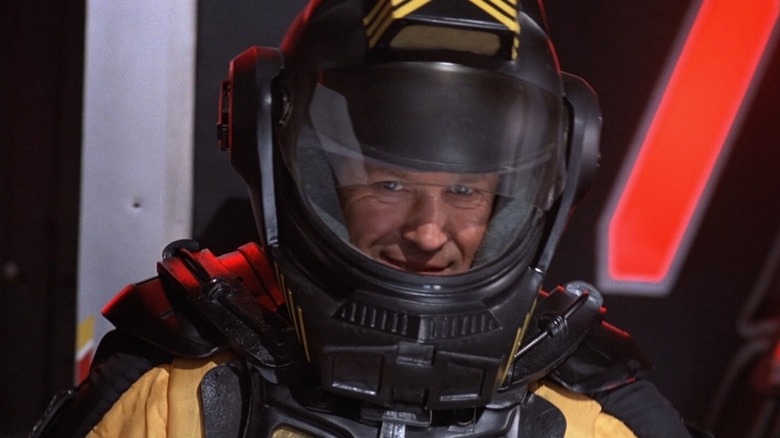
The 1990s were a pretty great time for sci-fi, mostly because we were in a strange period in special effects technology. Some of the bigger-budget studio films like "Jurassic Park" and "Terminator 2: Judgment Day" were advancing CGI technology in impressive ways, while smaller-budget movies were perfecting animatronics, stop-motion animation, miniatures, and other practical visuals. There was a cool sense that, visually, everything was in the toolbox. And even the smaller, less well-known 1990s sci-fi movies were interesting to look at.
In terms of style and theme, though, 1990s sci-fi didn't have too many unifying principles. In general, one might note that many of the sci-fi films and TV shows of the decade turned toward paranoia and suspicion. Shows like "The X-Files" pointed out how little American citizens trusted their own government, indicating that they were responsible for shadowy, potentially destructive cover-ups involving aliens and UFOs. But that was just a corner of the genre. There were still post-apocalyptic thrillers, space operas, cosmic terror, tech freakouts, and just about every subgenre of sci-fi one can imagine. There was an expansive pop culture biodiversity throughout the decade, where it seemed — for a glorious spell — that everything was available, even while the monoculture still existed.
The following films are perhaps a little obscure to modern audiences, so we here at /Film are here to remind you that these films are worthy of note. There are three dystopian thrillers on the below list, a psychedelic nightmare about machinery, and, yes, an alien abduction thriller based on a true story. People who were paying close attention to B-movies in the 1990s might have taken note of these films. For the young whippersnappers, be ready to have your mind blown.
Class of 1999 (1990)
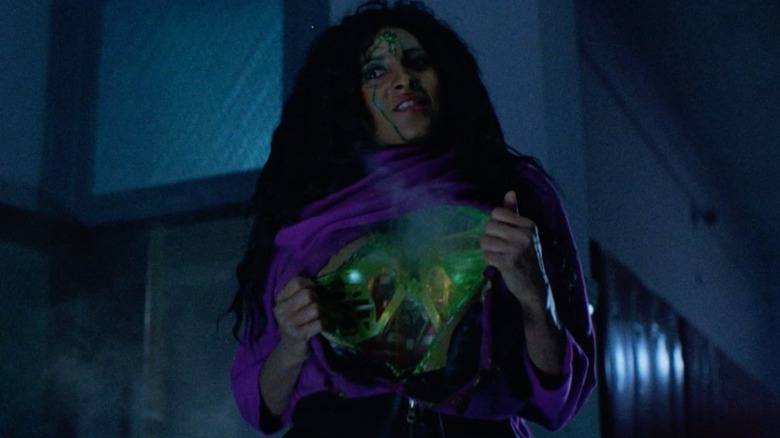
It is the near future, and teenagers have taken back the world. Gangs roam everywhere, and ensure that cities are living hellscapes of drugs and crime. Two major gangs vie for control of the nation: the Razorheads and the Blackhearts. Public schools are still operational, but they're more like prisons where gang members can handily do their recruiting. Kennedy High School has been set up as an experiment. All its students have been in juvenile hall, including the former Blackheart protagonist Cody (Bradley Gregg), and the school administration has tapped a high-tech robot company to create android teachers for the students. The androids, the thinking goes, will be stronger and faster than the students, and will be able to more coldly administer the necessary discipline.
Naturally, the androids go bonkers with their powers and abuse students with impunity. Moreso, they begin murdering students and even make schemes to start a full-blown gang war, hoping both sides will wipe each other out.
This is a bleak, ultra-violent version of the "kids rule, adults drool" mindset, which is perfect for a robot-loving teen in the early 1990s. If it seems like public systems for kids are crappy, it's because they're designed to kill you, not help you. There is a scene where a teen rips a robot in half with a forklift, and that's awesome. Pam Grier plays one of the androids, and a weirdly outfitted Stacey Keach plays the robot administrator. Malcolm McDowell plays the doctor who attempts to stop the robot program. If you have sharp eyes, you might spot a young Rose McGowan in a very early role.
Robot Jox (1990)
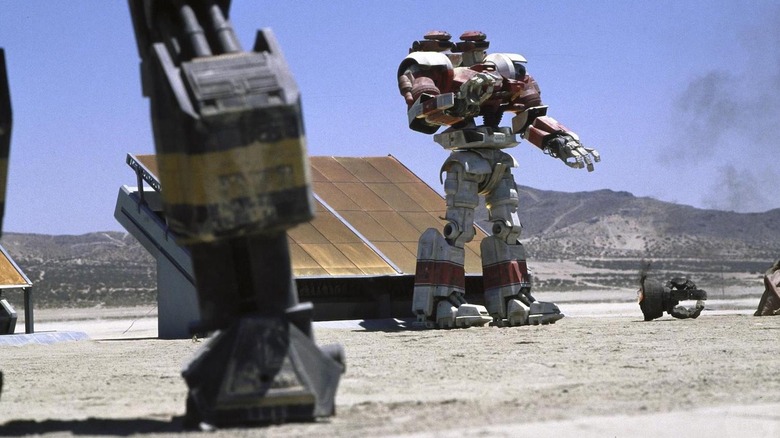
The conceit of Stuart Gordon's "Robot Jox" is brilliant. Following a devastating nuclear holocaust, war has been outlawed on Earth. Nations now settle international disputes in one-on-one fighting tourneys between two specially trained champions. In order to account for the money required by the military-industrial complex, however, the fighting is between fighters in five-story-tall weaponized robot suits. The robots are complex and secretive, and there is a network of spies inside each robot-building camp hoping to commit industrial espionage. The pilots, the titular jox, are trained their whole lives to fight. The current star fighter in Achilles (Gary Graham) who aims to retire. His replacement is the lab-grown Athena (Anne-Marie Johnson), a person he resents.
I love the conceit that war has been transformed into, essentially, high-octane boxing. It's a silly conceit, of course, but it's no less absurd than the current war model. Why bomb out cities and murder thousands when you can build a giant robot with a chainsaw penis? I'd feel more patriotic about the nation's war efforts if the only thing being lost is an expensive Robotech mech.
Gordon is very good about detailing the world of "Robot Jox" on a limited budget. It's never explicitly stated how the world fell apart, but there are posters in the backgrounds that encourage women to have more babies. Clearly, birth rates are falling. One family is happy to be having meat for the first time in months, and it's only a single hot dog. Achilles is a sexist ass who treats Athena very poorly, but who comes to respect her ... if only a little ... by the end.
Also, the stop-motion animation on those robots is stupendous.
Tetsuo II: Body Hammer (1992)
In Shinya Tsukamoto's 1989 film "Tetsuo: The Iron Man," a boring salaryman (Tomorowo Taguchi) finds that oppressive Japanese modernity is leaking into his body. He awakens one morning to find a small piece of metal growing out of his cheek. As the days pass, more and more of the poor man's body begins to transform, with metal haphazardly springing from his body. His genitals become a drill, his torso a junkyard. He begins to go mad, shoving his fork-like hands into wall sockets for a thrill. Meanwhile, across town, a metal fetishist (Tsukamoto) is undergoing a similar transformation, but deliberately; one of the film's earliest scenes is the fetishist deliberately inserting a metal pipe underneath the flesh on his leg.
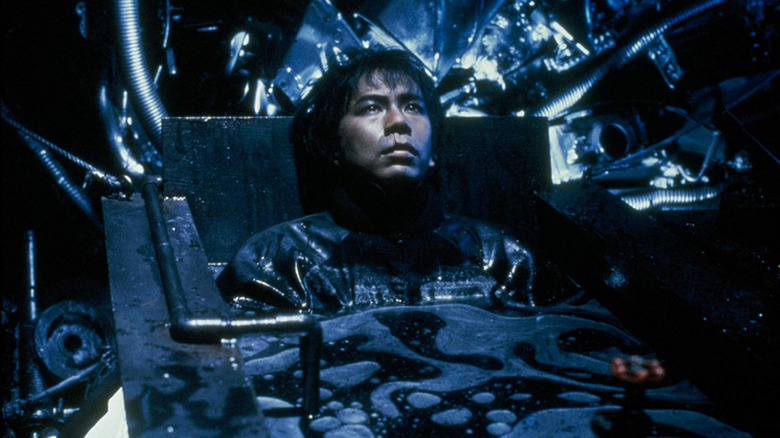
"Tetsuo II: Body Hammer" tells a similar story — it's a thematic sequel, not a direct one — but focuses in on machinery devoted to weapons and violence instead of modernity. Taguchi is back as a family man, but with untapped rage inside him. When his son is kidnapped, the family man begin to sprout guns bullets from his chest and arms. He becomes a weapon of destruction and death. Tsukamoto plays an eerie, machine-obsessed cult leader named Yatsu whose cultists inject themselves with motor oil and become weapon-like beings themselves. Naturally, there will be a secret connection between Yatsu and the protagonist. Like in the first "Tetsuo," their bodies will eventually mechanically merge.
Tsukamoto has created some of the most striking images in cinema with the "Tetsuo" movies, and he is clearly interested in the bleak relationship we mere organic beings have with the artificial world we have constructed around us. Does technology serve us, or are we just squishy cogs in the mix?
Fire in the Sky (1993)
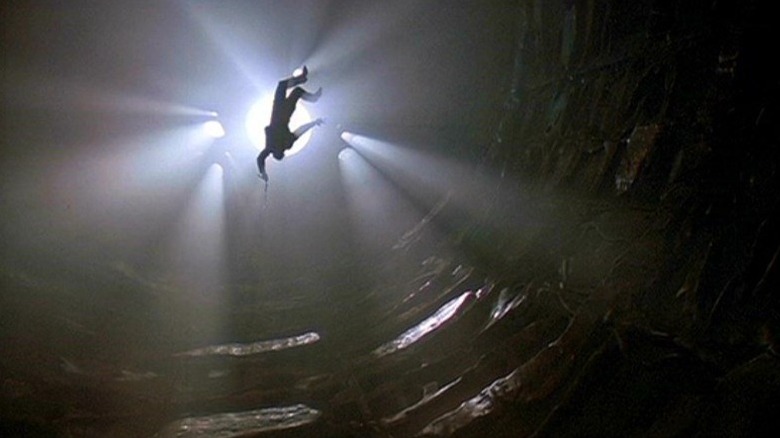
Robert Lieberman's 1993 film "Fire in the Sky" tells the true story of Travis Walton (played by D.B. Sweeney) who worked as a lumberjack in the woods of Snowflake, Arizona back in the mid-1970s. He and his co-workers went on a logging trip in mid-1975, and his friends returned back to town without him. They claimed that Travis had been picked up and taken away by a mysterious floating saucer-like craft. Naturally, no one in town believed them, and Travis' logger buddies were instantly suspected of murder. Robert Patrick gives a great performance as Mike Rogers, the head of the logging team who has to stand up for himself and for his co-workers. The bulk of "Fire in the Sky" is an investigation into Walton's disappearance, and the way small-town paranoia can eat up a community.
Of course, Walton was not murdered, and survived the ordeal. He was returned five days later, several counties away. Travis tells his story, and the audience learns, in the film's climax, that Travis was taken on board an alien vessel and kept in some kind of biological testing pod. He sees the now-familiar alien grays, only discovers that the big-eyed face we're used to seeing was merely a space suit.
"Fire in the Sky" explores the details of then-proliferating alien lore ("The X-Files" had debuted only shortly before the film's release), but is also a wonderful acting showcase for its cast. Patrick is great, as are his co-stars Craig Sheffer, Peter Berg, Henry Thomas, and Bradley Gregg. Many UFOlogists now consider the Travis Walton abduction to be a hoax, but that doesn't make "Fire in the Sky" any less fascinating a drama.
Six-String Smaurai (1998)
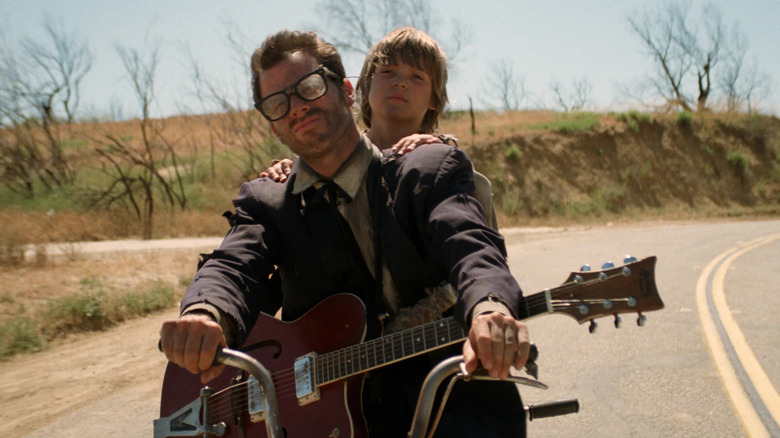
Sometimes the post-apocalypse is awesome. Lance Mungia's ultra-low-budget thriller "Six-String Samurai" envisions a parallel world wherein the Soviet Union nuked the United States back in 1957, leaving the country as an irradiated desert wasteland. The survivors, because of the pop culture at the time, are all into rockabilly and surf music, and roving musical gangs aim to outplay each other in a bid for dominance. The main character is Buddy (Jeffrey Falcon) who may or may not be Buddy Holly. Buddy is not just a musician, but a samurai, outfitted with a dueling sword and a readiness to kill.
It's been 40 years since the apocalypse, and the King of Lost Vegas, Elvis Presley, has just died. Buddy aims to travel to Lost Vegas, fighting forgotten Soviet platoons, and take his own rightful place on the throne. To make sure everything is more like a Western, Buddy also takes on a child companion called the Kid (Justin McGuire). In order to make sure that the proceedings are magical and mystical, Buddy is being stalked by Death himself (Stephane Gauger, voice by Lex Lang). In this universe, Death also carries a guitar. He wears a top hat and his face isn't visible, invoking Slash from Guns N' Roses.
"Six-String Samurai" was made for about $2 million, and its low-budget charm carries it a long way. This is a movie more about flippant attitude, cool, and style than cogency or spectacle. It's a genre-mashup of Westerns, sci-fi, martial arts, and musicals, and it somehow functions in all regard. The film also features the amazing Russian-American rockabilly band the Red Elvises as themselves, so keep an eye out for their giant balalaika.