

Isaac Asimov's Thoughts On 2001: A Space Odyssey Will Change How You See The Sci-Fi Movie
Isaac Asimov is, in many ways, the father of modern science fiction. He popularized concepts like "the robot" and even gifted us the Three Laws of Robotics. Asimov's own works have also been adapted more than once. Will Smith led an "I, Robot" project over 20 years ago. Apple TV is in the midst of its "Foundation" series, too. The latest season was a banger, and season 4 is already greenlit.
While his written words have had plenty of opportunities to make their way to the silver and streaming screens, Asimov had some additional thoughts on other sci-fi projects, including the iconic "2001: A Space Odyssey." In a 1977 issue of the magazine American Film, Asimov shared his thoughts on the Stanley Kubrick classic, which had come out nine years earlier in 1968. He praised, among other things, the film's down-to-earth nature and the fact that it took space seriously, paving the way for adults to enjoy the genre. After comparing most early science fiction to nothing more than a string of "youngster-oriented" Westerns, Asimov called out "2001's" writer, Arthur C. Clarke, as the key difference maker, saying the story and science were "In the hands of a crackerjack scientist/science fiction writer." He added:
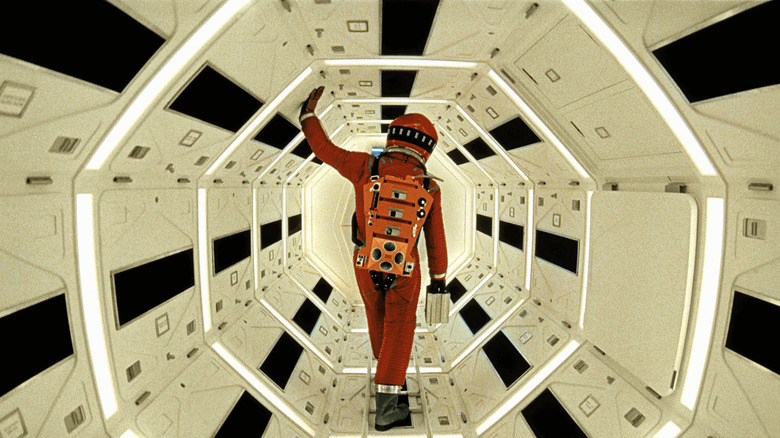
"That meant '2001: A Space Odyssey' could be relied on to have the elementary facts of science straight. Spaceships would look like spaceships, and the moon would resemble our satellite."
To put it another way, "2001: A Space Odyssey" was one of the first times we saw space stories grow up from "cops and robbers" yarns for kids to an opportunity to tell serious stories that mesmerized audiences and stirred the soul.
Asimov called out 2001's special effects as especially impressive
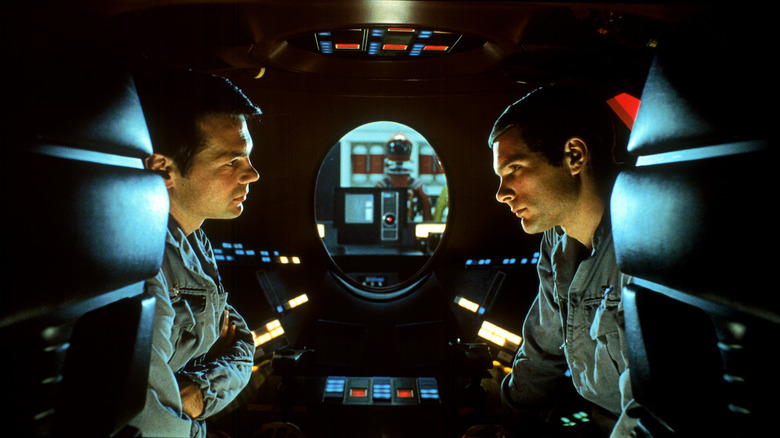
Along with the writing, Asimov highlighted the ability of director Stanley Kubrick to bring the visuals to life in new, unique, and exciting ways, saying:
Stanley Kubrick spared no expense on special effects in '2001' and for that reason it made movie history as the first hit adult-science-fiction film.
Asimov added that the movie wouldn't be surpassed in popularity until "Star Wars" arrived on the scene nearly a decade later in 1977. (The "I, Robot" author had some thoughts on George Lucas' universe, too.) Coincidentally, that was the same year he wrote his "2001" review. Despite the pivot to popularity, though, Asimov's commentary couldn't get away from the visuals. He came back to it, saying:
"What is, by all the odds, most remarkable about '2001: A Space Odyssey' are its visual effects. These do not achieve their interest through the display of extraterrestrials, but through the depiction of those sights of outer space which are there and can be seen in reality."
The ability to show the awe-inspiring and, at times, chilly realities of space is one of "2001: A Space Odyssey's" greatest strengths. It brings a fresh degree of realism to the space experience that doesn't feel like it's copying another genre. It's embracing the natural strengths of its own storytelling canvas.
Asimov saw Kubrick and Clarke's vision as prophetic
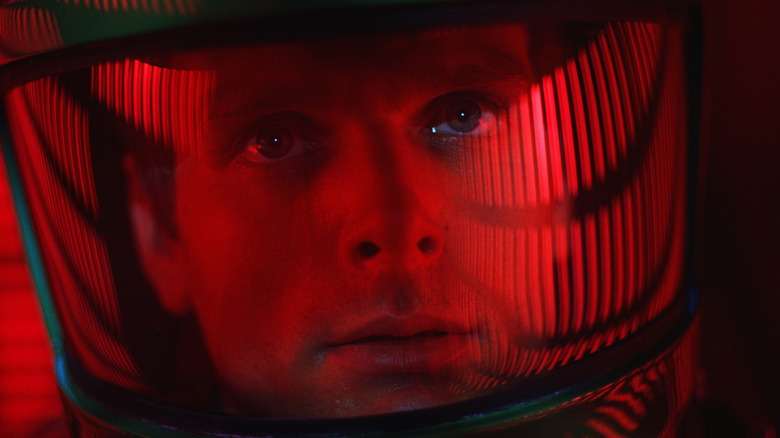
Asimov had such high praise for Kubrick and Clarke's accomplishments that he even went so far as to say that the experience they created was a prescient one, saying:
"'2001: A Space Odyssey' shows a world that does not yet exist and shows it not as it might be, but almost certainly as it will be, and that is unique.
He didn't stop there. The creator of countless sci-fi adventures wrapped up his praise by elaborating that he thought the experience of "2001" would not just predict the realities of space, but become an enduring comparison point that even surpassed reality:
"In fact, when the time comes that we are sufficiently at home in near space to take the kind of motion pictures in reality that 2001 took by means of ingenious special effects, I am quite certain the real will turn out to be just like the fictional, but inferior. People will turn to '2001: A Space Odyssey' to see space at its most beautiful."
For a man whose imagination shaped so much of the modern science fiction experience, it's fun to see how much value Asimov could see in other projects within the genre, be it the inspiring vision of Star Trek, the impressive stories of Star Wars, or anything in between.