

5 Perfect Movies Roger Ebert Loved That Everyone Should Watch At Least Once

Roger Ebert worked as a professional film critic for the Chicago Sun-Times from 1967 until his death in 2013. In that time, he reviewed thousands of films, often using a star scale of zero to four stars. Ebert often wrote about how much he hated the star scale, as it made all films seem comparable. He had to clarify repeatedly that a star rating measured how good a film is based on the movie's own stated purpose. It was not a way to put films on a scale. When Ebert began writing a series of essays on the most noted classics in cinema history (a bi-weekly practice he started in 1996), he called the series merely "Great Movies." Not "The Greatest Movies" or "The Best Movies." Just great ones.
Ebert's taste was often unpredictable, but that came from his vitally egalitarian view of movies. He was careful to give every film an even shake. He was aware of cinema history, but Ebert was always careful to view the film, as it played out, right in front of him. He was that rarest of beings: the populist intellectual. In 2013, the world lost a giant.
Thanks to his website, one can sort through all 8,107 reviews that Ebert wrote, and even sort them by year and star rating. In his career, Ebert gave 1,309 four-star reviews. That number, however, includes re-releases of older movies, all the "Great Movies," as well as re-ratings of films he "upgraded" in order to include on the "Great Movies" list. If one wants to be stingy and include only the four-star reviews Ebert published of new movies, written upon their release, that number is still high, totaling in the 900s.
Below are five notable four-star movies, one per decade, selected from that list.
The 1960s: Playtime (1967)
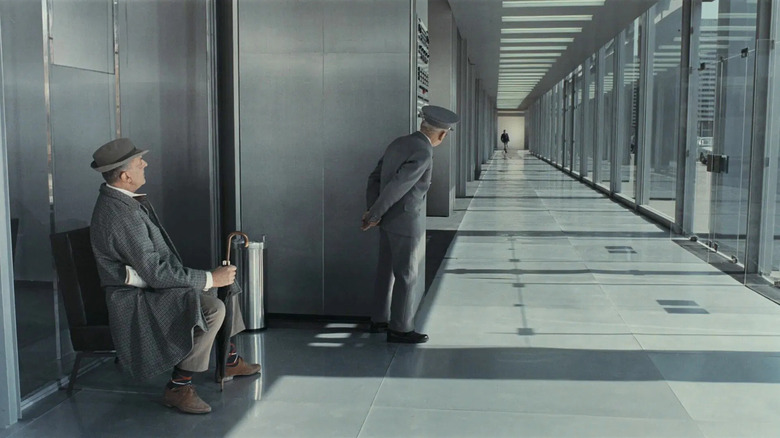
Jacques Tati was one of the greatest of all screen comedians, on par with the genius of Buster Keaton or Harold Lloyd. His films were quiet, non-incidental, and un-dramatic. He didn't really write stories, eschewed violent slapstick, and sometimes lost sight of his protagonist. His masterwork, 1953's "M. Hulot's Holiday," is emblematic of Tati's style, usually dramatizing small, amusing vignettes in a calming, incidental way. A paintbrush washes ashore in just the right place. A little kid's ice cream come aaaaaalmost falls over. That sort of thing. Little, incidental humor.
By 1967, however, Tati had become ambitious and sought to make the largest film of his career. For his movie "Playtime," Tati built an entire fake city — Tativille — for his innocent, suburban Hulot to wander around in. Hulot was no longer in a safe country town, but in the middle of urban sprawl. There, Tati still found small moments of incidental humor. The neon sign that makes it look like a priest has a halo. The stacked apartments that, when looked at in the right way, resemble neighboring units uncannily interacting. Tati's Hulot character (whom he played) disappears into the city, and isn't on screen for a lot of it. Indeed, there are a lot of "fake-out" Hulots throughout the film (that is: people wearing the same outfit and smoking the same pipe), making the audience see that pieces of the character are more or less transmigrating into the public. The film has no dialogue.
It was Tati's longest movie, too, at 124 minutes. It takes place over the course of one long night, and it feels tiring and satisfying, the same way an all-night party does at dawn. It's poignant, contemplative, and weirdly brilliant. Ebert eventually included "Playtime" on his Great Movies list.
The 1970s: El Topo (1970)
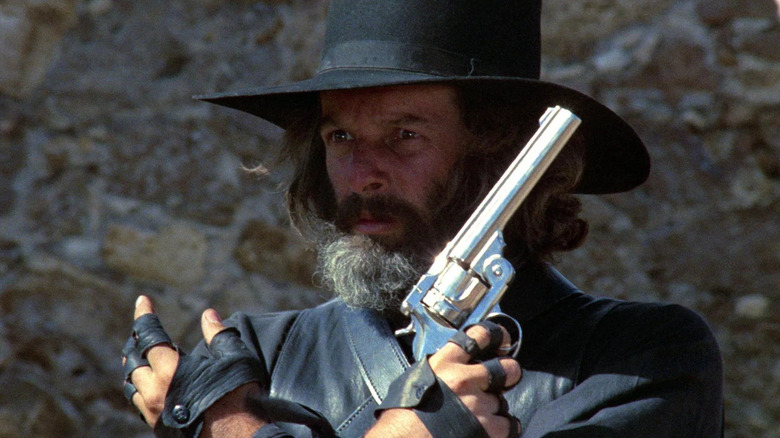
Alejandro Jodorowsky's acid Western "El Topo" pretty much launched the phenomenon of the Midnight Movie in the United States. An enterprising exhibitor in New York found that "El Topo" was too weird for mainstream audiences, but if he welcomed in weirdos after hours (and, importantly, let them smoke weed in the theater), then "El Topo" would play like gangbusters.
It did. Jodorowsky's film was about a gunslinger (that he played himself) who set off on a quest to best several desert-dwelling spiritual masters in a shoot-out. It takes place in an unspecific country, but violence lurks around every corner. The gunslinger and his young son often find themselves walking through abattoir-like murder scenes and stepping over rivers of blood. As the gunslinger kills each of the great spiritual masters, he begins to understand just how horridly he is destroying the world. Violent conquest destroys everything. Yes, this is a psychedelic film that can be interpreted in myriad ways.
Eventually, the gunslinger is bested, shot, and left for dead. He is revived in an underground cave, looked after by outcasts and disabled people. He becomes a great spiritual master himself, renouncing violence and devoting his life to prayer, mime, and love. The son we saw earlier (played by Jodorowsky's own son Brontis) will become a new gunslinger.
Ebert himself noted that reviews of "El Topo" are frustrating to read because, well, all they can really do is describe on-screen events. The film is so strange and varied, a simple review would not do the material justice. "The film exists as an unforgettable experience, but not as a comprehensible one," Ebert wrote. And that, of course, is an exhilarating experience in itself. It's gloriously surreal, bleak, and ineffable. And yet, we can understand it, symbolically and emotionally.
The 1980s: Sugar Cane Alley (1983)
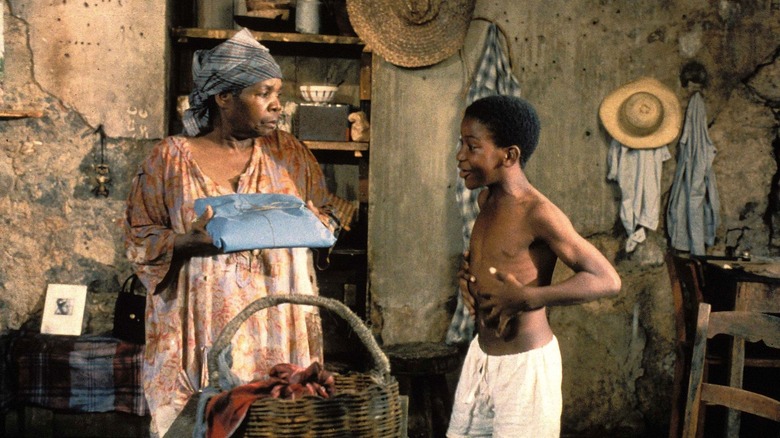
As Ebert began his review, "'Sugar Cane Alley' seems to grow so directly out of old memories that it's a surprise to discover that the director based it on a novel; it feels so real we assume he based it on her own life." The film was the debut feature of Euzhan Palcy, who went on to make "A Dry White Season" and "Siméon," and it was set in her native Martinique. It's natural to the point of feeling like a documentary, even though it's set in the 1930s. The film follows a young orphan named José (Garry Cadenat) as he's being raised by his put-upon grandmother Ma'Tine (Darling Legitimus). He and everyone else in his small, rural community works in the nearby sugar cane fields, where they are mistreated and abused by the French colonialists who oversee the crops.
The story follows José's rise through school, as he and his grandmother (especially his grandmother) toil endlessly to make sure he can afford to escape his impoverished origins. José isn't always appreciative, but he is clever and smart enough to see that he has the potential to grow up elsewhere. But this is no corny Horatio Alger tale or J.D. Vance rags-to-riches myth. This is an honest, textured story of a very specific time and place. Ebert wrote "'Sugar Cane Alley' sees its world so clearly because it's an inside job," meaning that Palcy, also from Martinique, knew everything about the local detail.
As it's been said, the more specific a story is, the more universal it becomes. One doesn't need to be a 1930s Martinican boy to understand and appreciate "Sugar Cane Alley." It's a great film, reminiscent of Satyajit Ray's "Pather Panchali," but honest about kids, like Francois Truffaut's "Small Change."
The 1990s: Fast, Cheap & Out of Control (1997)

Documentarian Errol Morris has long been interested in fascinating outsiders, as seen in films like "Gates of Heaven" (about a pet cemetery) or "Vernon, Florida" (about the strange title town). In his 1997 film "Fast, Cheap & Out of Control," Morris interviews a quartet of kooky outsiders who are all searching for the meaning of life through their own niche professions. Morris used his notable invention, the Interrotron (which allowed interview subject to seemingly look right at the camera), to talk to George Mendonça, a topiary gardener in Rhode Island. He also talked to Rodney Brooks, a robotics expert at MIT; Dave Hoover, a lion tamer; and Ray Mendez, an expert on naked mole-rats. What do these four professions have to do with one another? One has to have a great deal of passion and expertise to make them work.
And while "Fast, Cheap & Out of Control" can be enjoyed as a whimsical contemplation of strange jobs, it slowly turns into a philosophical premise over time. Here are four people who seek mastery over their corner of the world. In the Camus sense, they are making their rocks their things. Ebert wrote in his review that all four men "have the same goal: to control the world in a way that makes them happy." The interviews are intercut with a terrible old film serial called "Darkest Africa," which starred Clyde Beatty, an animal trainer that Hoover very much admired. The clips add an element of kitsch to the proceedings, but also reveal that great skill and grand inspiration can come from anywhere.
That, of course, was Ebert's ethos as well.
The 2000s: 13 Conversations About One Thing (2001)
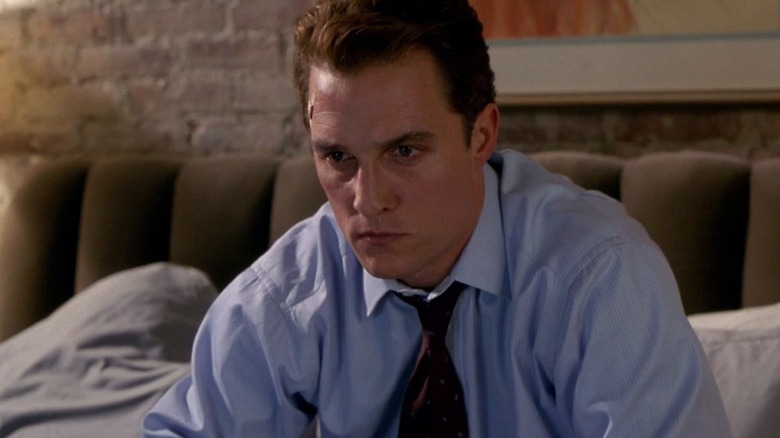
The title conversations in Jill Sprecher's "13 Conversations About One Thing" are all about happiness. The film is presented in 13 vignettes, all following a group of six characters. There's ambitious lawyer Troy (Matthew McConaughey), a happier-than-thou hotshot whose personal idyll comes to an end when he engages in a hit-and-run. There's struggling cleaning lady Beatrice (Clea DuVall), who somehow manages to hang on to her idealism even after suffering from an injury, angering her cynical co-worker Dorrie (Tia Texada). There's middle-aged couple Walter and Patricia (John Turturro and Amy Irving), whose marriage begins to fall apart when Walker has an affair with a student. There's Gene (Alan Arkin), a beleaguered office wonk whose son is falling deeper into drug addiction.
The stories all eventually intersect, but that's not the point of "13 Conversations." The film is contemplative and, well, conversational. It's like a Jim Jarmusch film, but the conversations actually have direction and meaning. It takes place in those moments when one realizes that they aren't happy with their lot, and have to face a reckoning about what to do next.
Ebert was impressed with Sprecher's work, writing that she captured something universal about the human condition. "The engine that drives the human personality," he wrote, "is our desire to be happy instead of sad, entertained instead of bored, inspired instead of disillusioned, informed rather than ignorant. It is not an easy business." For Ebert, this is a movie about how nothing makes sense and how happiness and pain are both random, despite our struggles toward one and away from the other. But this is not a nihilistic film. Because we are all connected, we can take joy from our place in the world. Life is amusing. Happiness is in the cracks.