

Edward James Olmos Says Blade Runner And Battlestar Galactica Share A Universe (And Bloodline)

We may receive a commission on purchases made from links.
Throughout "Battlestar Galactica," one particular line is repeated: "All of this has happened before and will happen again." "This" refers to the cyclical conflict between humanity and the sentient machines called Cylons that they create. In the "Galactica" universe, human and Cylon life seemingly began on the planet Kobol, whose history is shrouded in mystery. When humans left Kobol, they colonized 12 planets. The civilization that sprouted there eventually created Cylons that destroyed them in nuclear fire. The survivors, in a starship fleet led by the Battlestar Galactica, search for the mythical 13th tribe on the planet Earth. In the "Galactica" season 4 episode "Revelations," the Galactica reaches Earth and learns its people already destroyed themselves by creating Cylons long ago.
"Battlestar Galactica" star Edward James Olmos (who played Commander William Adama) previously starred in "Blade Runner," one of the most famous man-versus-machine movies ever (though director Ridley Scott doesn't see the picture as science fiction). The connection was not lost on Olmos, and he even suggested half-seriously that "Blade Runner" and "Galactica" could share a universe. How?
The "Battlestar Galactica" finale, "Daybreak," reveals the series is set 150 thousand years in the past. The Galactica fleet colonizes a world they name "Earth" in tribute to the 13th tribe, and that gives rise to our civilization. The ending of "Daybreak" is set in modern day: A montage showing advances in robotics hints the cycle will repeat once more. Olmos, speaking to AMC in 2009, months after "Daybreak" aired, said in bemusement: "You see the last scene, all you have to do is put in 'Blade Runner' a few years later and you've got a complete story!" Olmos then threw out his own theory that his "Blade Runner" character, LAPD Detective Eduardo Gaff, is a (very) distant descendant of Adama.
The Cylons in Battlestar Galactica resemble Blade Runner's Replicants
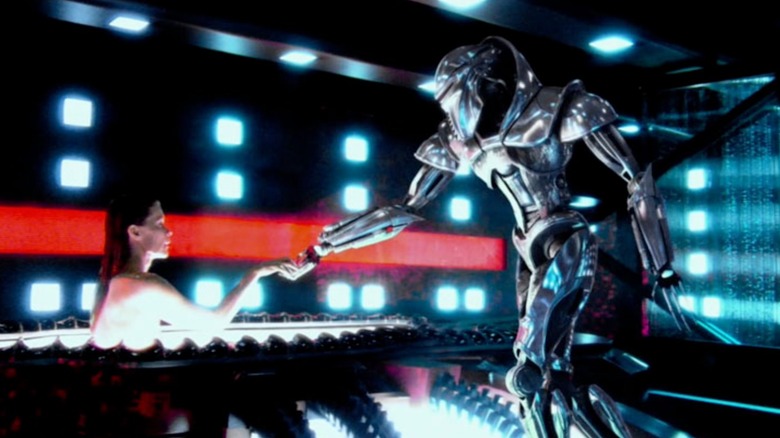
To quote the Marvel comic "House of X"/"Powers of X" (by Jonathan Hickman, Pepe Larraz, and R.B. Silva): "Artificial intelligence is like fire. It's a discovery, not an invention." In "Galactica," whenever a new human civilization rises, it destroys itself by creating life, and then the cycle repeats.
"Blade Runner" depicts a dreary dystopia where climate change and urbanization have ruined the natural world. The original novel, "Do Androids Dream of Electric Sheep?" by Philip K. Dick, spends a lot of time showing that animals are valuable commodities in this future. People are leaving Earth for the pipe dreams of better lives in "the off-world colonies." Also on those colonies are Replicants, organic androids used as slave labor that are created with short life spans to disincentivize rebellion. Replicants led by Roy Batty (Rutger Hauer) escape to Earth and demand their creator, Eldon Tyrell (Joe Turkel), extend their lifespans.
If you watch "Galactica" as a "Blade Runner" prequel, then Tyrell is echoing the mistakes of Cylon creator Daniel Graystone (Eric Stoltz in "Battlestar Galactica" prequel "Caprica"). Linking the two stories is a fun idea, and also a fitting one, because "Galactica" took a lot of influence from "Blade Runner" (not just in casting Edward James Olmos, either). In the original 1978 "Battlestar Galactica," the Cylons were alien invaders. They looked like chrome-plated Stormtroopers and spoke like computers.
In the reimagined "Galactica," the Cylons were created by and looked like humans. The human Cylons began as a budget-saving move, per co-creator Ronald D. Moore. At a 2013 Comic-Con, Moore recounted how the costs of both practical Cylon costumes and CGI were going to be too limiting for the series. Note how Cylon Centurions, created by CGI, only appear sparingly across "Galactica."
Battlestar Galactica is Blade Runner as a space opera
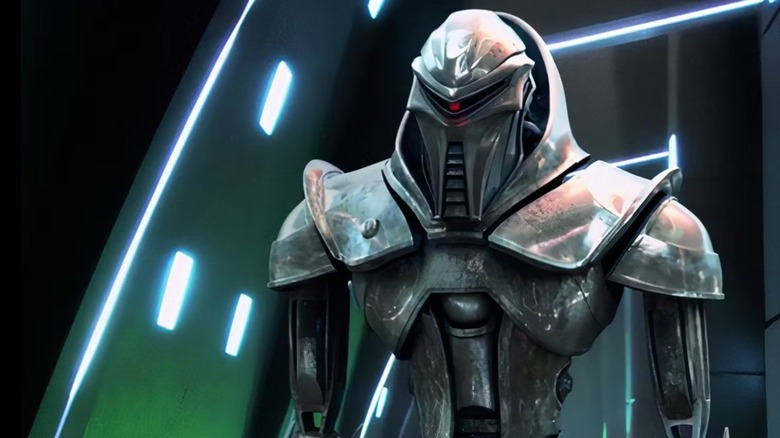
As Ronald D. Moore explained:
"Somebody said why not go the 'Blade Runner' route and make [the Cylons] look like human beings? My first response was like, 'That's lame.' I came around. I wondered, if they look like people and used to look like robots, what does that imply? The robots decided to evolve themselves to look like humans. Why would a robot decide that?"
The answers to that question added so much depth. The Cylons, Moore decided, are as preoccupied by big questions about the meaning of life as us humans are. To better understand their parents, the Cylons took on human form. (It's also easier for an audience to empathize with human-looking androids, which gave the drama of "Battlestar Galactica" a gravitas you can't get from actors in silly robot costumes.)
"Just as Western man believes himself to be created in God's image, the Cylons molded themselves into the likeness of their own creator," Moore wrote in the "Battlestar Galactica" series bible. The Cylons too believe in a single God, and see the humans' polytheism as disordered. Like most young people, the evolved humanoid Cylons think stubbornly that they have all the answers and resent their elders.
As organic androids lashing out at their creators and searching for meaning, the reimagined Cylons felt like a mix of the classic Cylons and the Replicants. In "Prometheus" and "Alien: Covenant," Ridley Scott returned to tell another story about a rebellious android, David (Michael Fassbender). David asks a rhetorical question that also drove the Cylons: "Don't we all want our parents dead?"
Even if you don't read "Blade Runner" as the literal next cycle of the human/Cylon war, it is undoubtedly part of the storytelling lineage that led to "Battlestar Galactica."