

Wake Up Dead Man Is The Darkest Movie In The Trilogy, And For Good Reason
Mild spoilers follow.
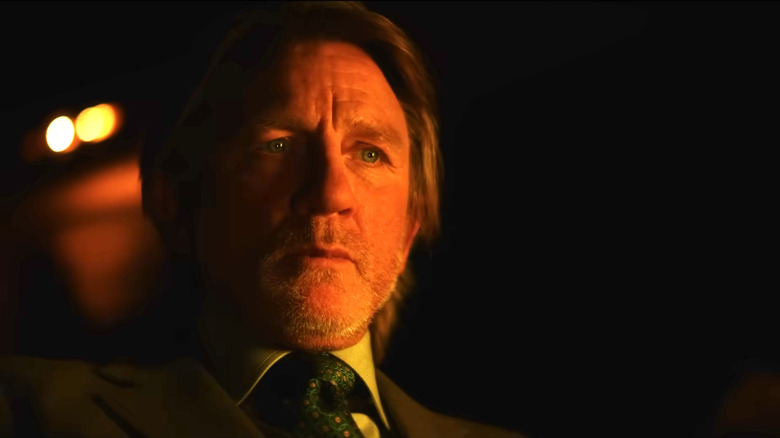
The first thing that sticks out with "Wake Up Dead Man" is how heavy it feels. The first "Knives Out" centered around a cozy New England whodunnit and featured a quirky protagonist who vomits when she lies. The second "Knives Out" film takes place on a beautiful Greek island, with a villain more funny than threatening. But this third movie takes place in a creepy Gothic church, with a protagonist stuck in a spiritual crisis and a group of suspects who aren't particularly funny at all. The suspects range from sad to despicable; they'll get funny lines sometimes, but that's not enough to dispel the terrible vibes most of them give off.
There are a couple reasons for this tonal shift. The first is that "WUDM" takes clear inspiration from gothic writer Edgar Allan Poe, who wrote the first-ever detective story ("The Murders in the Rue Morgue," referenced directly in the film) and who's famous for writing tragic tales of people suffering from overwhelming guilt, obsession, despair, and so on. For director/writer Rian Johnson to truly embrace the Poe-esque vibes, he'd have to show more restraint than usual in the jokes department.
Another reason for the shift is the switch in theme. The first two "Knives Out" films are class commentaries, with the script constantly skewering its cast of rich and superficial characters. There's a lot of easy comedy to mine from out-of-touch millionaires whose proclaimed values disappear the second their wealth is threatened, and both "Knives Out" and "Glass Onion" take full advantage of this. But "Wake Up Dead Man" isn't really about class, but about faith. The stakes for the main mystery are mostly spiritual, not financial, and that changes up the vibes entirely.
Wake Up Dead Man is about a battle for America's soul

Rian Johnson's approach to each "Knives Out" movie has always been to reflect on modern times, with his characters serving as modern-day archetypes in the same way Agatha Christie's characters served as 20th-century archetypes. Every character is written with enough specificity to feel like a real person, but they also represent a larger trend going on in the real world.
Case in point: one of the new film's most important characters, Monsignor Jefferson Wicks (Josh Brolin), is a cruel, domineering leader who has a stranglehold over his community that our protagonist Father Jud (Josh O'Connor) finds baffling and disturbing. Wicks believes that his role as leader of the church is to rule through fear, lies and hatred, while Jud believes his role should be about helping people and encouraging compassion and grace.
The movie is an ideological battle between these two perspectives, with the stakes raised higher by the not-so-subtle indications that the church is a metaphor for America as a whole. Wicks feels like Rian Johnson's take on the MAGA movement in Trump's second term, while the cast of suspects feel like Johnson's take on the different types of Trump supporters, from the openly vindictive (Andrew Scott's Lee Ross), to the self-serving (Daryl McCormach's Cy Draven) to the simply misguided (Cailee Spaeny's Simone Vivane). The previous "Knives Out" movies have also commented on Trump and his supporters, but they've never done so as seriously and as directly as it's done here.
Politics aside, the Knives Out franchise really needed this shift in tone

Not everyone will appreciate this third film's direct approach to American politics, but the ideological stakes still work even if you ignore the political subtext entirely. Main character Father Jud isn't merely fighting for the soul of the church but trying to figure out his own relationship with it, and by extension trying to figure out what his purpose in life is. "Wake Up Dead Man" never sneers at religion; it takes Jud's crisis of faith seriously from start to finish. "Wake Up Dead Man" doesn't shy away from Jud's religious belief and all the existential guilt that comes with it, and that lends extra weight to his and detective Benoit Blanc's need to get to the bottom of this mystery.
This approach feels fitting because, well, the "Knives Out" franchise was running the risk of getting too lighthearted. "Knives Out" held the line well between comedy and drama, but "Glass Onion" marked a clear shift into goofball comedy. It's a very silly movie, one with cartoonishly dumb suspects and a mystery that's revealed to basically be one giant joke calling Elon Musk an idiot. It made for a fun time at the movie theater, sure, but its humorous subversions were the sort of thing the franchise should only do once.
Thankfully, Johnson has once again embraced his Agatha Christie roots by radically shifting up the tone. Instead of three "Knives Out" movies that grew increasingly comedic, so far the series has gone from a cozy autumn dramedy, a vacation comedic farce, and now a dark gothic thriller. Now nobody can credibly claim that Rian Johnson is a one-trick pony, just as now nobody can predict where Johnson will take the series next.