

Why One Indiana Jones 5 Cameo Left An Actor Shocked And Disappointed

This article contains spoilers for "Indiana Jones and the Dial of Destiny."
By the end of James Mangold's big-budget adventure film "Indiana Jones and the Dial of Destiny," the beloved Indiana Jones (Harrison Ford) has been through a lot. After a decades-long career as a professor, archaeologist, adventurer, and sex symbol, the now decidedly old Indy finds himself back in his apartment, recovering from a time-travel excursion. Yes, the legendary Dial of Destiny actually worked and was able to point out to Indy (as well as some Nazi interlopers) where natural fissures in the space-time continuum occasionally open up. As a result, the movie's climax takes place in the year 214 BCE at the Siege of Syracuse. However, with a little help from his irascible goddaughter Helena (Phoebe Waller-Bridge), Indy is able to escape and return to his home in the year 1969.
Indy is alone, though. It's established earlier in the film that his son Mutt was killed while fighting in the Vietnam War overseas, causing Indy and his wife Marion (Karen Allen) to break up. He has Helena, but she will soon be off on another one of her own adventures. Similarly, Indy's friend Sallah (John Rhys-Davies) is still around, but he, too, has a life of his own. For a few moments, with his adventures at long last concluded, it appears as if Indy is going to be alone until the end.
Then, in a surprise, Marion comes through the door of Indy's apartment with groceries. She is upset with Indy, but the two of them look hard at one another. Despite it all, they are still in love. The movie ends on a note of hope, confident that Indy and Marion will properly reconcile and live happily ever after. It's a short but meaningful scene that marked Allen's third turn as Marion after debuting as the character in 1981's "Raiders of the Lost Ark" and then reprising the role for "Indiana Jones and the Kingdom of the Crystal Skull" in 2008. All the same, the actor had somewhat mixed feelings about the way Indy and Marion's story drew to a close.
Karen Allen wished she had been given more to do in Indiana Jones and the Dial of Destiny
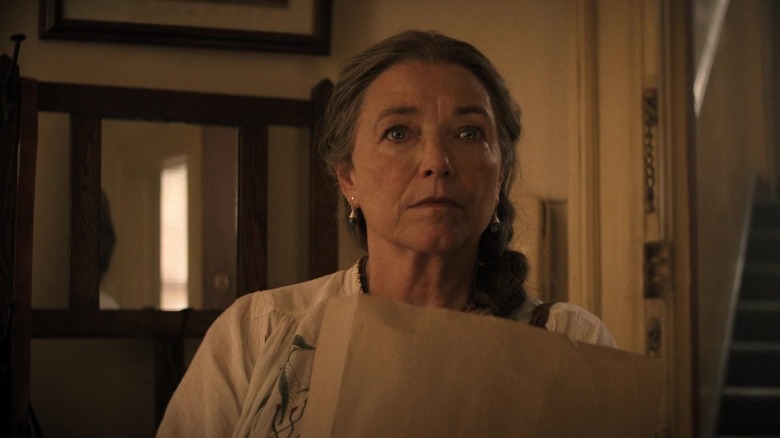
During its development, Steven Spielberg was slated to direct "Dial of Destiny," but his involvement waxed and waned depending on his schedule. Eventually, Spielberg dropped out of the project, passing directorial labors to Mangold. It seems there was some creative headbutting between Spielberg, Ford, Lucasfilm, and the people at Disney over what the next Indiana Jones film should be. When Mangold took over, a new screenwriting process began. Allen was, it appears, made privy to Spielberg's earlier versions of the movie, and she liked what she saw. It wasn't until Mangold took over that her part was reduced. As she explained to The Hollywood Reporter in 2023:
"When Steven was still going to direct the film, I didn't have the opportunity to read any of those scripts, although I know that Marion was much more involved in the story at that juncture. [...] So, I knew James had hired new writers and that there was going to be a whole new approach with a new director and new writers, but I was really going into the unknown."
And then, when she saw the final approved script draft that Mangold was going to direct, she was shocked to learn that her scenes were all at the end. Allen understood the story function of it, of course, but would have appreciated more to do as an actor. It seems that the filmmakers wanted to remove Mutt, played by Shia LaBeouf in "Kingdom of the Crystal Skull," for reasons of their own. Mutt was a contentious character among fans, with some liking him and some hating him. In the end, Mangold and his writers decided to kill the character off-screen, leading to new story wrinkles that had to be addressed.
Marion's role in Dial of Destiny was affected by Mutt's death
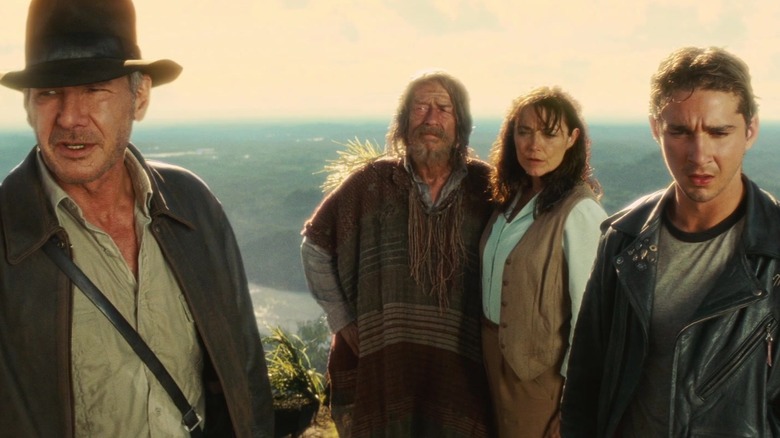
Of course, removing Mutt led to the connected removal of Marion. As such, Allen didn't know she would essentially have a glorified cameo in "Dial of Destiny" until she read the film's final script. Her appearance wraps up Indy's and Marion's story, but she didn't get to do any adventuring of her own as she did in "Raiders of the Lost Ark" and "Kingdom of the Crystal Skull." As Allen recalled:
"The next thing I knew, I was reading a script [...] and of course, I was disappointed. I had thought that I would be majorly a part of the film, and that was just not the direction they decided to go. [...] I think they had some problems to solve with the story in terms of Shia LaBeouf not coming back, and they chose to create this story that Mutt had been killed in the war and that it put a wedge between Marion and Indy. I mean, you could have knocked me over with a feather when I read it. But I was really happy that they came back together in the end."
"Dial of Destiny" made roughly $384 million at the box office, which is an impressive amount but a pittance when compared to its massive budget. According to Forbes, the film may have cost as much as "an eye-watering $387.2 million," with Disney believed to have lost more than $130 million on making it. And while the movie is reasonably entertaining and brings Indy's adventures to a tactful end, it never rises above the realm of "pretty good" or "okay, I guess." It's full of small disappointments and baffling decisions that only caused the budget to bloat, like using state-of-the-art digital "de-aging" effects to make Ford look younger in the film's prologue.
Marion's appearance at the end is more integral to "Dial of Destiny" than that pricey, action-packed cold-open. The film's creatives could have tripled Allen's salary, asked her to be part of the entire movie, and likely made something more emotionally satisfying.