

Focker In-Law Sets A New Standard For Legacy Sequels

It's a little surprising to realize, but legacy sequels like "Focker In-Law" aren't the outliers they used to be. In fairness, legacy sequels are not a brand new phenomenon. For example, Martin Scorsese's "The Color of Money" was a sequel to "The Hustler" released 25 years after its predecessor's debut in 1961.
Yet, the "legacy sequel" is a more specific concept than merely a belated sequel. Whether intended as a soft reboot or a larger continuity pivot, a legacy sequel typically involves a perspective shift to a new (and often younger) protagonist, relegating the former leads to supporting roles. This trend arguably began with J.J. Abrams' "Star Trek" in 2009, and it was solidified by "Tron: Legacy" the following year. In fact, it's entirely possible that the latter film gave the legacy sequel its terminology.
Many more legacy sequels have cropped up since then, with most of them following this template. For a period, they were generally limited to science fiction films, including 2015's "Star Wars: Episode VII — The Force Awakens" and "Blade Runner 2049" from two years later. Since then, though, the legacy sequel has moved beyond the sci-fi genre to encapsulate action ("Top Gun: Maverick"), horror ("28 Years Later"), and even comedy ("Coming 2 America").
That brings us back to "Focker In-Law," the fourth film in the "Meet the Parents" franchise. Most legacy sequels attempt to recapture (if not re-stage) the movie that started it all, and "Focker In-Law" does indeed revisit the basic premise of "Meet the Parents." But rather than having longtime star Ben Stiller pass the torch to new cast member Ariana Grande, the film keeps his Greg Focker as the protagonist. It's proof positive that legacy sequels don't always need to replace older characters and can let them grow gracefully with audiences instead.
Focker In-Law resists the legacy sequel tropes
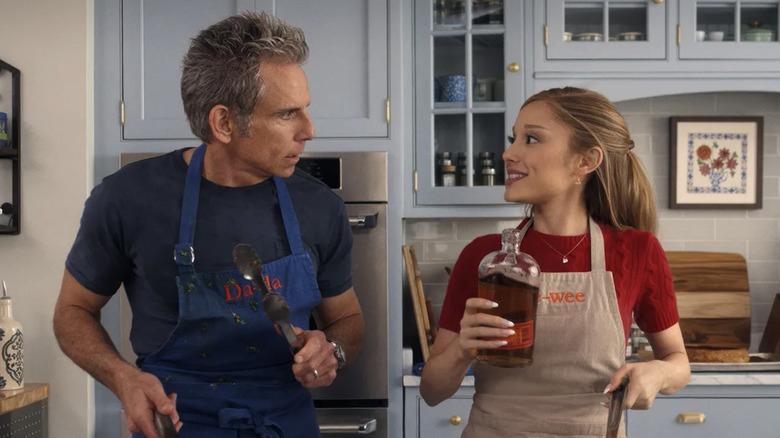
In "Focker In-Law," the now fully-middle-aged Greg Focker has two grown children of his own, and his son Henry (Skyler Gisondo) has met the love of his life, Olivia Jones (Ariana Grande). With Gisondo and Grande being buzzy young stars, it would've been understandable if writer/director John Hamburg decided to make the film from their perspective. This would essentially be "Meet the Parents" again, only this time, Olivia and Henry would be in the position Greg was years ago when he had to impress his fiancé's father, Jack (Robert De Niro). But changing Greg from the protagonist to the antagonist could've made for a lot of easy gags and forced sentiment, and it would've been very unoriginal.
However, Hamburg instead chooses to keep the focus on Greg's neurosis and knack for making huge messes out of non-issues, which has been the comedic driving force for the rest of the franchise. As such, the premise of the film is less about Olivia fitting in (she effortlessly does so with everyone but Greg) and more about Greg coming to terms with his age, his son's adulthood, his overprotectiveness, and his self-centered nature.
In this way, "Focker In-Law" is almost a coming of age story about a middle-aged adult. It's not totally rare, but it does feel notable in a medium that primarily tries to appeal to young viewers. Hence, by instead flipping the script and placating older audience members, the film's focus on Greg feels like an extension of the franchise's themes rather than a recapitulation. After all, growing up and learning doesn't stop when one hits middle age and oftentimes meeting the parents can be just as nail-bitingly uncomfortable if you're now the parent yourself.
"Focker In-Law" is in theaters now.