

Wildwood Director Travis Knight Reveals The Innovations That Made The Epic Stop-Motion Film Possible [Exclusive]
Travis Knight has been working in stop-motion for more than 25 years, first as an animator and eventually as a director. He's been a key creative voice at Laika since the company's founding in 2005, and made his feature directorial debut a decade ago with the stunning "Kubo and the Two Strings." At that time, he told /Film about how he and his team developed techniques to utilize both stop-motion and computer generated imagery to create the stunning water sequences in that film, and the company's toolbox has grown significantly since then.
10 years later, with the live-action movies "Bumblebee" and "Masters of the Universe" under his belt, Knight returned to direct his second stop-motion feature film — and if you thought "Kubo" was epic, wait 'til you get a load of "Wildwood." This fantasy story, which was originally optioned by Laika way back in 2011, is about a girl who ventures into a magical world to save her kidnapped younger brother, and it's by far the most ambitious project the stop-motion studio has ever mounted. The result is a visually dazzling spectacle that makes fantasy feel fresh again.
I had the opportunity to speak with Knight earlier this week over Zoom, and during our spoiler-free conversation, he told me about the innovations that made the movie's biggest moments possible, how Peter Jackson's "Lord of the Rings" trilogy inspired "Wildwood," and more.
Note: This interview has been lightly edited for clarity and brevity.
How Laika embraced blending stop-motion and CGI
/Film: Around the time of "Kubo and the Two Strings," I remember hearing that you had started incorporating visual effects to capture things that would be impossible to achieve with traditional stop-motion. How has that mixture evolved in the decade since then?
Travis Knight: Well, we've actually integrated visual effects and technology from the very beginning. In fact, when I go back to the genesis of Laika, I think back to when all this started [...] At the time, stop-motion was dying. Stop-motion was an art form that didn't seem to have a future because everything that we could do in stop-motion, the computer could do better. It could do it faster. It could do it cheaper. It could do it with greater precision.
So I remember having this hard conversation with myself, which is like, "How can stop-motion continue to live and maybe even flourish in this modern era?" And it was by essentially embracing the author of our demise, the infernal machine — the thing that was trying to take all of our jobs, all of our livelihoods, away from us. If we could somehow try to figure out a way to integrate the technology into the process, maybe we could find a way that we could live together. It was a bit like a Luddite embracing a loom.
And when I took a further step back, I realized that a computer is just another tool, just like a pencil or a paintbrush, a 3D printer. So from the very, very beginning, we integrated art, craft, science, and technology into the process of making these things.
There were a ton of technological innovations that came to bear on "Coraline," many things that had never been done in the medium before, and it was because of the integration of those things. And with every film we've done, we've had further technological advancement, further craftsmanship advantages and advancements and learnings. Tools, techniques, tricks that we develop with every single film, that we then can apply to the next film. Things that used to be impossible, now we do as a matter of course.
So when we got to the point five films in, I felt like finally we've developed a big enough toolkit where we can take on a film of this scale in "Wildwood." This was seven years ago, and I said, "All right, guys, we're going to do this thing. We're ready." But Ben, we were not ready, and we had to grow and we had to learn and we had to suffer in the process and also hopefully become good enough that we were worthy of what the film was asking of us.
One Wildwood character forced the team to think outside the box to create it
What does that practically look like when you start a thing and you're not actually ready for it? The image that comes to mind is putting the railroad tracks down immediately right before the train goes over them.
It's a good metaphor.
But it seems incredibly stressful. So how do you do that when money is flying out the window?
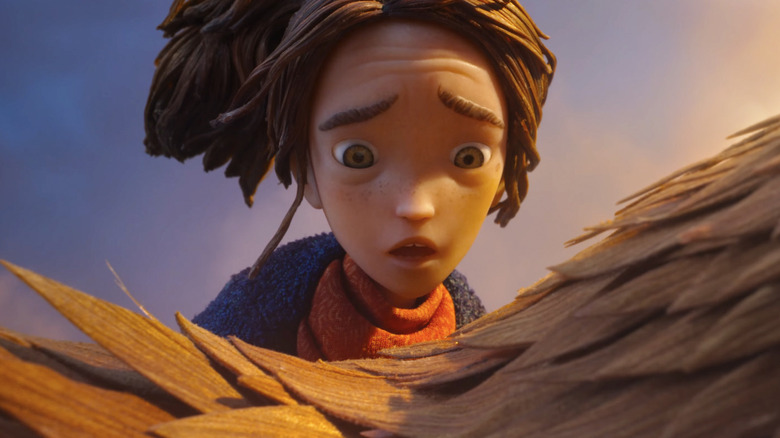
Well, money's not flying out the window because we're responsible stewards, but it is stressful, for sure. It is one of those things where there are certain things that you feel like you can handle [and] there's certain challenges that come your way that you couldn't have anticipated. I'll talk about just one aspect of that, which is just the puppet-making aspect. So in this film, we have this giant golden eagle [named The General], and it's an exquisite feat of art and engineering and craftsmanship.
Historically, we tend to make these things out of silicone, which is the material that most closely resembles human skin and the way that it interacts with light. But we couldn't have made The General with silicone because it would've been too heavy. The animator would not have been strong enough to physically move the puppet because there was so much material, it would've been too heavy to move.
So we had to come up with a new way to fabricate that puppet. Essentially, the thing is almost entirely made out of fabric, which is kind of an insane way to think about making a puppet. And its neck is essentially like a Slinky. It's not a typical jointed puppet. It's basically a Slinky that can move. Birds are shape-shifters.
Laika added muscles to its puppets for Wildwood
(Travis Knight continues)
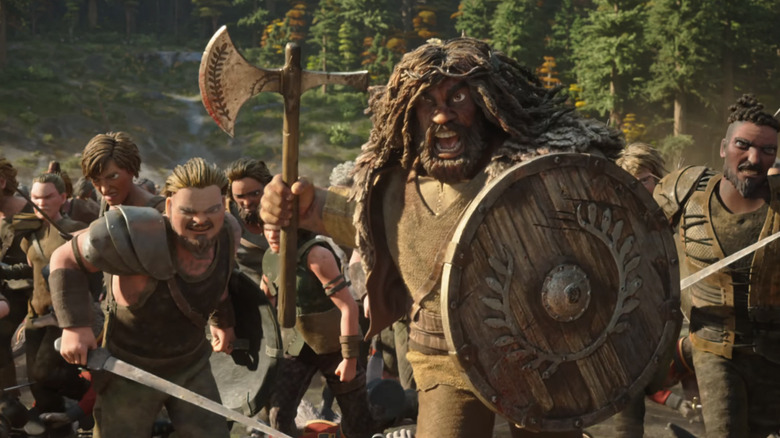
I think about some of the normal puppets that we made, the human puppets that we made, because a lot of this film is about physical effort and exertion and violence and battle and war.
I thought, "Wouldn't it be great if these characters really felt fully alive? And when they moved, that you had a sense of musculature underneath the skin?" And so I remember talking to Ollie Jones, our head of puppets, and I said, "Hey, Ollie, can we actually get muscles in these puppets?" And he looked at me like I had lost my f***ing mind and I saw him sag under the weight of it.
And then I saw the little genius hamster wheel in his head start to turn, and he figured out how to put muscles inside a puppet. So when a character bends their arm to strike another character, you can see the muscles actually bulge. And it's the kind of thing and it's the kind of attention to detail where you don't necessarily notice it, but the accumulation of all these details, these well-observed details, make the world feel alive and real in a way that it wouldn't ordinarily.
That's incredible.
Peter Jackson's Lord of the Rings films were a 'huge inspiration' for Wildwood
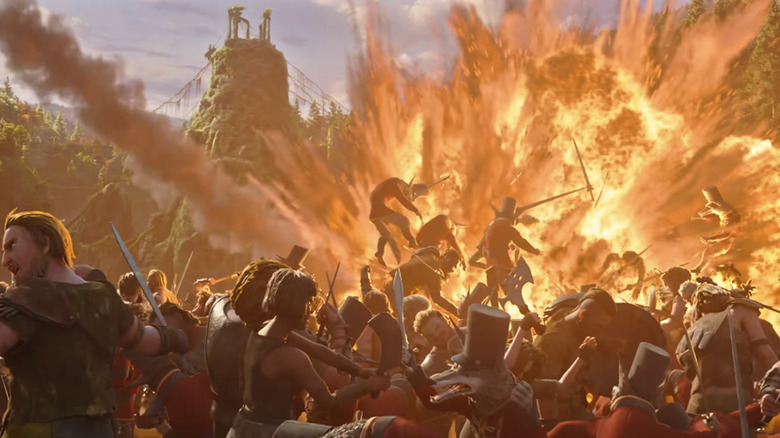
That final battle, man, I could not believe that that was stop-motion I was watching. I thought a lot about Peter Jackson's "Lord of the Rings" trilogy, especially during that part of the movie. Was that a purposeful inspiration point for you guys cinematically, visually, what you're doing there?
No question about it. I mean, look, Tolkien is a figure that looms large in my imagination. I've loved his stories since I was a kid. I could not believe what Peter Jackson and his team accomplished with "The Lord of the Rings" trilogy. It's one of the most astonishing feats of cinema ever. It was a huge inspiration for us on this movie. I remember in a reductive way, I said to Chris Butler, my creative partner on the movie — he was the first person I brought on — saying, "Okay, I want to make a stop motion Lord of the Rings." So that was absolutely something we thought about.
So knowing that we wanted to pull no punches when we got to the end, we really thought about how could we shoot this cinematically? How can we cut this in a way where it feels like a big live-action epic? It does not feel like it was shot on a tabletop with a bunch of miniatures. And that was a tricky thing to figure out, but it is a combination of things.
There's full scale sets, miniatures. There are puppets. There's a lot of visual effects in that portion of the film. There's digital puppets. It's all these incredible art forms that are commingling in a way that hopefully is seamless and creates a really immersive and exhilarating and hopefully terrifying experience for the audience.
Wildwood's director thinks the movie's PG-13 rating makes sense
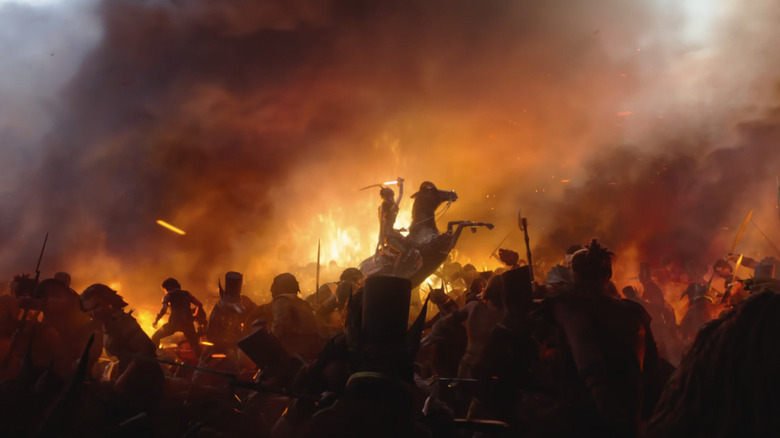
Without getting into spoilers, there's some fairly intense violence in this movie, and I was wondering if there was ever a version of this that was aiming for a PG rating, or if you guys just embraced that violence from the start.
There is violence in the movie, and there are battles in the movie, and there's war in the movie, and the intention was to show the cost of these things. The intention was not to try to fetishize violence. The intention was to actually show that violence is terrible and violence is traumatic. And if that's part of the story that you're telling, you have to show it.
In terms of the rating, that's something that comes at the end of the process. When you're done making the movie, you submit it to a ratings board, they give you a rating, and then you decide what to do with that. Well, we couldn't have changed it anyway because it takes us so long to make our film. But I think it's appropriately rated, actually. I think the film is — PG-13, to me, seems to say that this is a film that is for families, but you just have to be mindful, if you're a parent, that there is some intensity, and if your child is ready for intensity at that level.
But in my mind, there was never a version where we were going to water this movie down in any way because I wanted us to tell this story sincerely. That meant embracing what the story was asking of us, which is, in times, it is dark, it is intense. But I would also say that the cumulative experience is that it is a life-affirming one. There is great light and joy in this movie, but we earn that light and joy honestly by going to some dark places.
"Wildwood" is in theaters now.