

The Social Reckoning Is An Unworthy Sequel To The Social Network — Here's Why

"The Social Network" is a tightly-edited, stunningly performed, pitch-perfect movie — and once you see "The Social Reckoning," you'll come to the unfortunate understanding that its success was in spite of screenwriter Aaron Sorkin, not because of him. I don't say this lightly. "The Social Network," which released in 2010, used a crackling script by Sorkin (one that eventually won him an Oscar), and paired that script with the detail-obsessed director David Fincher, is one of my favorite movies ever made, and I firmly believe it's one of the best films of its generation. Whenever someone unwisely tells me they haven't seen "The Social Network," I practically "Clockwork Orange" their eyelids and make them experience it. (I'm fun, I swear.) I still listen to the score — written by Trent Reznor and Atticus Ross, who similarly won Oscars after the film's release — periodically, because it rips.
I was cautiously optimistic about "The Social Reckoning" when I went to a screening, but as I discussed in my review for /Film's sister site Looper, it doesn't just fall short. "The Social Reckoning" fails miserably as both a movie in its own right and especially as a standalone sequel to one of the best films of the 21st Century. (In his review for /Film, Chris Evangelista also detailed why this movie doesn't deserve to be mentioned in the same breath as its predecessor.)
Go ahead and call me hyperbolic all you want, but the Fincher-less "sequel" to "The Social Network" is a dreadful and, frankly, reprehensible film that sneers at its audience, presents a compelling story in the dullest way possible, and concludes with a re-telling of a real American tragedy that elicits groans instead of gasps. Spoilers ahead, but here's how "The Social Reckoning" fails to uphold the legacy of "The Social Network."
Everything about The Social Network works in harmony, while The Social Reckoning is a flat-out mess
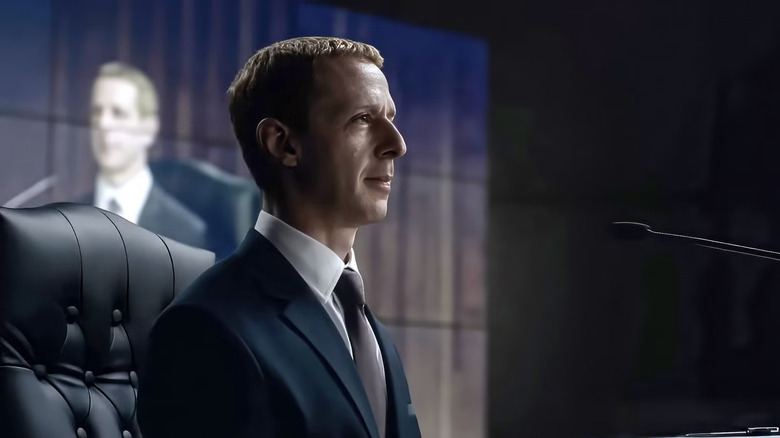
For years, rumors swirled about a sequel to "The Social Network," and on some level, that makes sense! Aaron Sorkin and David Fincher's movie, which casts Jesse Eisenberg as future Facebook founder Mark Zuckerberg as both a bitter Harvard student and an even more bitter young upstart embroiled in multiple lawsuits (across two different timelines), ended its story with Mark waiting for his ex-girlfriend to respond to his friend request on Facebook, leaving a lot more story to tell. Outside of these films, it's no secret that Facebook has changed the landscape of the internet, and the company now known as Meta also owns Instagram (something obliquely referenced in "The Social Reckoning").
The story told by "The Social Reckoning" could be an interesting one, but instead, Sorkin crafted a script that whacks you over the head for nearly two hours, forcing normally excellent actors like Mikey Madison (as whistleblower Frances Haugen), Jeremy Allen White (as journalist Jeff Horwitz), and Jeremy Strong (replacing Eisenberg as an older, more robotic, and more craven Zuckerberg) to deliver clunky lines about how free speech is important and belabor every single point. This film has none of the elegance or verve of its predecessor. Imagine if "The Social Network" had a forgettable score, the actors looked like they were being held at gunpoint, and the story had no actual, fleshed-out characters to speak of. Nobody in "The Social Network" feels human or real, from the way they speak to the way they act, and what makes this particularly depressing is that "The Social Network" was an astoundingly thorough character study of Mark — a man who makes a platform meant to foster human connection, something he's unable to do organically.
Aaron Sorkin shouldn't direct his own scripts, and The Social Reckoning makes that abundantly clear
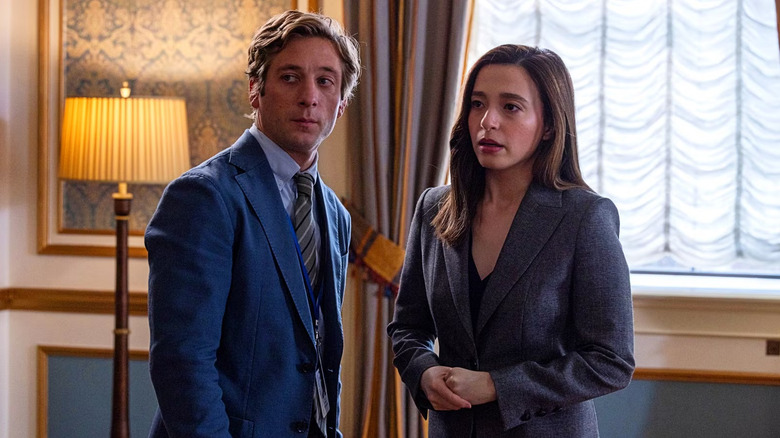
For better and probably for worse, Aaron Sorkin is known for his bombastic, over-the-top, and heightened dialogue in his scripts, although your mileage may vary. (For every classic like "The West Wing," there's something like "The Newsroom," a show with its head so far up its own butt that it treats the 24-hour news cycle with the exact same importance and reverence as the United States presidency.) Clearly, with the right director, Sorkin's work sings. You can see this not just in "The Social Network" but in "Moneyball," the sports drama directed by Bennett Miller that was released in 2011. Herein lies the problem: Sorkin pulled double duty on "The Social Reckoning" and directed his own script. He should not ever be allowed to do that again.
Maybe the silliest thing in "The Social Reckoning," which feels like classic Sorkin nonsense, is the way it bookends its paltry slog of a story. In the opening, a young woman played by Portia Doubleday harasses two cops of color, filming the interaction and putting it on Facebook. We learn that she was a friend of Frances who was radicalized by extremist groups on the platform. As Frances delivers her testimony, we see, and I am not making this up, that same girl participating in the insurrection on January 6, 2021. Having Jeremy Strong's Zuckerberg react to this real-life event made sense, but tossing in a character from the dreadful "prologue" of the film is peak Sorkin self-indulgence.
"The Social Reckoning" is a bad sequel to "The Social Network," a bad movie, and confirmation that Sorkin needs to be sent to director jail. It is also, unfortunately, in theaters now.