

The Twilight Zone's Rod Serling Wrote A Polarizing TV Adaptation Of A Beloved Book
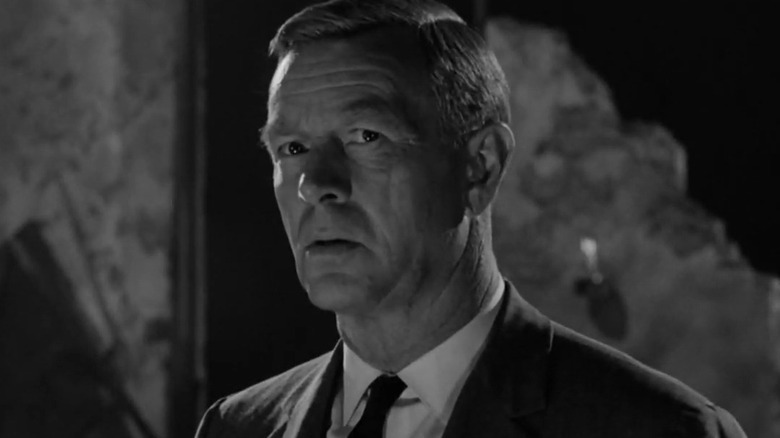
In 1964, celebrated filmmaker Joseph L. Mankiewicz, the writer/director of "All About Eve," and dozens of others, directed his only ever TV project in the form of "Carol for Another Christmas." As the title would have you believe, "Carol for Another Christmas" was a modernized retelling of Charles Dickens' "A Christmas Carol," and it starred Sterling Hayden, fresh from January's "Dr. Strangelove" as the Ebenezer Scrooge character. The teleplay for "Carol for Another Christmas" was written by Rod Serling, whose hit sci-fi anthology series "The Twilight Zone" had just gone off the air in June. In a bout of bad timing, "Carol for Another Christmas" didn't air until December 28 of that year, three days after Christmas.
In the update, Ebenezer Scrooge is renamed Daniel Grudge, and he is infused with a very specific politic. At the beginning of the special, Grudge, a powerful industrialist, is lambasted by his nephew (a young Ben Gazzara) for canceling a foreign exchange program that the nephew had hoped to take part in. Grudge gives a speech about how America should adopt a noninterventionist, nativist standpoint, and never interact with other nations. He also talks about building up a stockpile of nuclear weapons, and putting the rest of the world on their back foot. Grudge's nephew argues that, no, America has enough resources to help others, and that a worldwide community of peace is a better idea.
Maybe you can now understand why some critics referred to "Carol for Another Christmas" as preachy and mawkish. Rod Serling clearly had a point to make, and just made it outright, rather than couching it in metaphor or story. The review from the New York Times, which I'll quote below, ripped into Serling's screenplay with savage enthusiasm.
Imagine A Christmas Carol, but preachier
The New York Times review for "Carol for Another Christmas" was written by Jack Gould, and it's just one of the many unkind reviews the TV special received. He said that it was "a pretentious and wearing exercise in garrulous ineptitude, one of the more dismaying TV disappointments in several seasons." The show functioned as a soapbox, not an entertainment.
In this version of the story, Marley was not merely Scrooge's business partner, but his son, slain in World War II. The ghostly Dickensian flashbacks begin a lot more swiftly in "Another Christmas," with Grudge suddenly transported back to WWII to meet the Ghost of Christmas Past, played by Steven Lawrence. Past Christmases aren't so rosy for Grudge; he witnessed the victims of the bombing of Hiroshima.
The Ghost of Christmas Present is played by Pat Hingle from Tim Burton's "Batman," and he shows Grudge that, to this day, there are abusive internment camps being overseen by the United States. They have an argument about government assistance programs. Grudge opposes them, thinking they build people without a sense of self-reliance. It's an argument that right-leaning pundits have been using for decades.
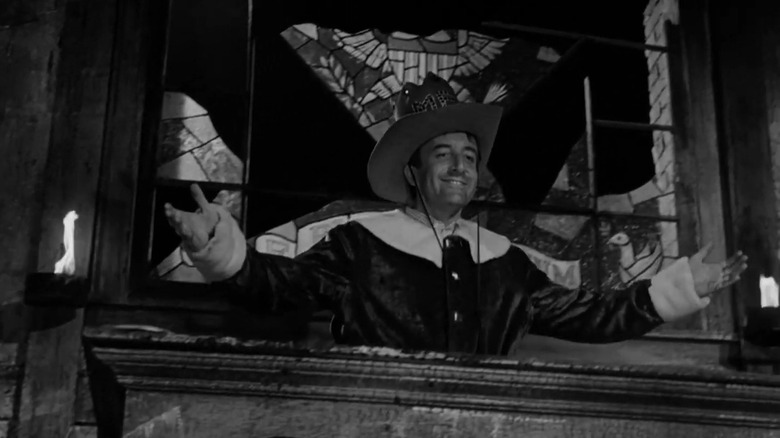
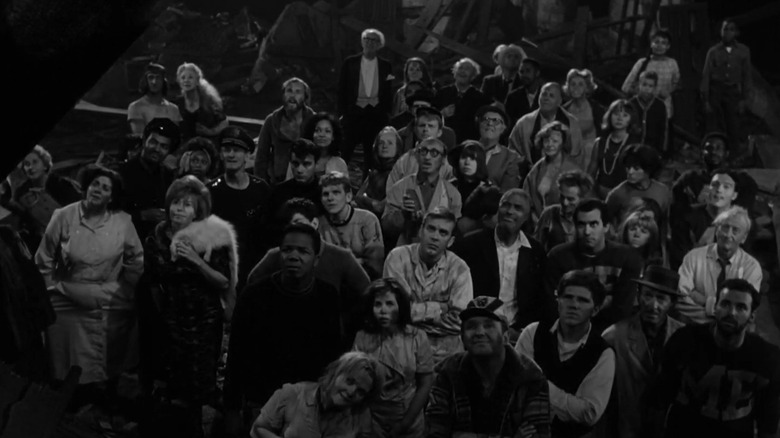
The Ghost of Christmas Future is played by Robert Shaw, and she shows Grudge a post-apocalyptic nightmare wherein a kooky demagogue, The Imperial Me (Peter Sellers), has taken over a tribe of people and instigated a whimsical campaign of murder and terror against all other "tribes." Do you get the point yet? Do you get it? This is not a warning against Dickensian greed and stinginess, but a life-ending warning against modern American nativism.
The show also stars Eva Marie Saint, Britt Ekland, Barbara Ann Teer, and Percy Rodriguez. One can watch it on Tubi.
War is not healthy for children and other living things
While "Carol for Another Christmas" is indeed preachy about is anti-nativist moral, know that it comes from a time — and a screenwriter — that advocated for peace. Most people recognized that rising isolationism and fear began to mark the Cold War, and called for simpler ideas of negotiation and disarmament. The world feared nuclear annihilation, as seen in Stanley Kubrick's "Dr. Strangelove," which also starred Sterling Hayden and Peter Sellers. Old-fashioned notions of male insecurity were going to, the film argued, lead us directly into a world-ending conflagration. That, and lingering Nazi-based notions of white male purity.
Artists responded by making pointedly antiwar, pro-peace tracts throughout the 1960s, and such ideas began to leak their way directly into pop media. Rod Serling definitely was an advocate for peace, as seen with this TV special, and with several episodes of "The Twilight Zone." In 1965, artist Lorraine Schneider designed her famous antiwar poster that reads "War is Not Healthy for Children and Other Living Things." In 1966, Gene Roddenberry created the largely pacifistic "Star Trek," which depicted a future world where human conflict had been overcome and everyone worked together in harmony. By 1969, the Plastic Ono Band was singing "Give Peace a Chance."
It should be noted that "Carol for Another Christmas" had a political function beyond Serling's opinions. As detailed on the TV Party website, it was actually backed by the United Nations as a means to advertise its function. The show was supposed to show that the U.N., if it were to ideally function, would usher in world peace. Nativism just needed to be rooted out. Overall, most critics noted, however, that "Carol" was a didactic drama that alienated viewers. The U.N. didn't need it.