

25 Years Ago Today: One Of The Worst Adventure Movies Ever Debuted In Theaters
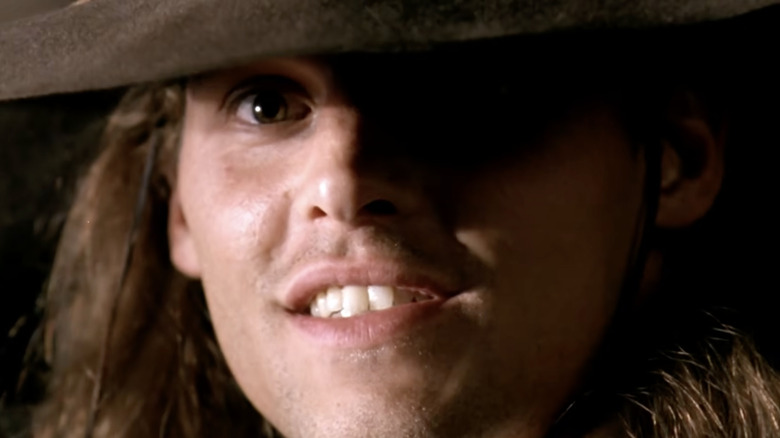
It's possible many folks missed seeing Peter Hyams' 2001 historical swashbuckler "The Musketeer" on the big screen because it was released on September 7, 2001, a mere four days before the September 11 terrorist attacks. That, one might rightfully note, would have distracted you from going to the movies. There was no way people were going to find and spread buzz about another Alexandre Dumas adaptation under those circumstances.
Of course, one might have also missed "The Musketeer" because it was widely panned by critics, so they wisely elected to stay away. "The Musketeer" is generally hated by those hoodwinked into actually seeing it, and it's barely remembered by everyone else. The most notable thing about it is the film's unusual hipster blend of French authorship and Hong Kong martial arts-based action. The film's stunt choreographer was Xin-Xin Xiong, a famed actor and stuntman who worked a lot with Hong Kong legend Tsui Hark. The advertising made it clear that "The Musketeer" was going to feature a lot of elaborate swordplay, wire work, and other types of action not usually seen in adaptations of "The Three Musketeers."
In this case, "Three Musketeers" protagonist d'Artagnan was played by American actor and former model Justin Chambers, who had been working in TV for a few years up to that point and had co-starred in the movies "The Wedding Planner" and "Liberty Heights." This was clearly intended to be Chambers' big break. Luckily, when the film bombed, he only had to wait a few years before scoring his career-making role as Dr. Alex Karev on "Grey's Anatomy." In addition, the movie co-stars Mena Suvari (then fresh off "American Pie" and "American Beauty"), as well as Tim Roth as the Man in Black, Stephen Rea as Cardinal Richelieu, and Catherine Deneuve as the Queen.
The Musketeer is an uneasy blend of French swashbuckling and Hong Kong action choreography
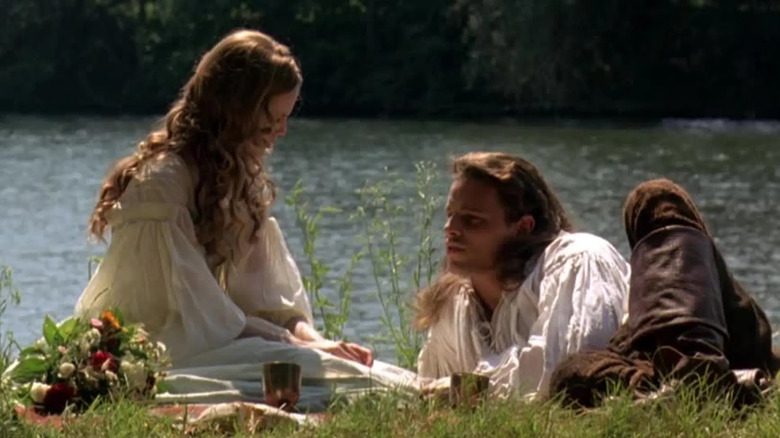
The Three Musketeers are, of course, also in "The Musketeer," with Athos played by Jan-Gregor Kremp, Porthos played by Steve Speirs, and Aramis played by Nick Moran. The plot only vaguely follows that of Alexandre Dumas' 1844 novel, however, and introduces a new character, the Man in Black, who's closer to a 1980s action movie villain than anything Dumas cooked up. Case in point: d'Artagnan sets out to take revenge on Tim Roth's villain for killing his parents in the film. What's more, while d'Artagnan romances an older woman named Constance in Dumas' book, he spends "The Musketeer" wooing Francesca (Mena Suvari), a character who's patently younger than him.
There are still some elements from Dumas' novel, though, including d'Artagnan's secret trips across France and the devious machinations of various politicians. Quite sadly, though, the mysterious character Milady is absent from this re-telling. That's a pity. She's my favorite part of Dumas' book.
But "The Musteteer" was clearly orchestrated for people who either hadn't read Dumas' novel and/or had found previous "Three Musketeers" film adaptations old-fashioned and boring. This, on the other hand, was a juiced-up, martial-arts-forward actioner that aspired to recapture the popularity of Ang Lee's technically dazzling wuxia epic "Crouching Tiger, Hidden Dragon" (which had opened in theaters the year before) and the Wachowskis' 1999 sci-fi touchstone "The Matrix." In other words, this was a wire-fu "Three Musketeers" movie, which might not seem like a bad idea on paper. But in execution? There's nothing notable about it. Even if it hadn't been released in theaters shortly before 9/11, "The Musketeer" still would've passed from the public's collective memory in due course.
The reviews for The Musketeer were awful
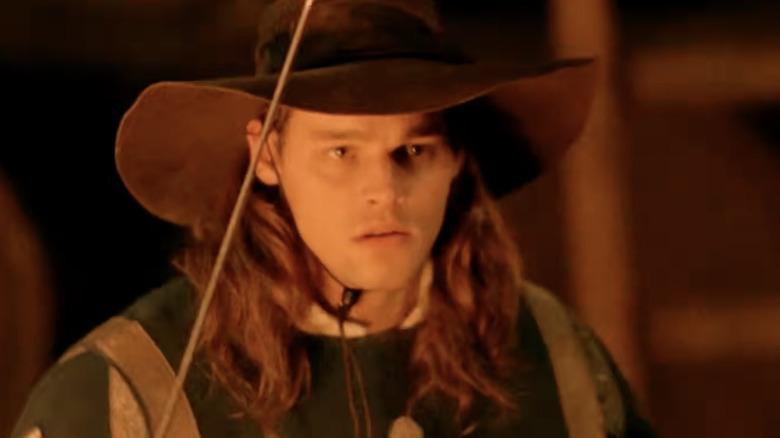
Roger Ebert gave "The Musketeer" one of its more glowing reviews, awarding it two-and-a-half-stars out of four, which is the highest score Ebert could grant a movie while still giving it a thumbs-down. He pointed out that, in a film like "The Musketeer," the story wasn't the point and neither, for that matter, was the actual French history. Both existed, Ebert wrote, as a mere place to hang the action sequences. If you liked the action, the logic goes, then you will like the film.
Naturally, Ebert admired the action, which is why he almost gave it a pass. Specifically, he liked a scene where d'Artagnan is dangling from a grappling hook down the side of a tower while swinging back and forth, sword-fighting various bad guys who are holding onto ropes as well. As Ebert noted with more than a touch of amusement:
"There are barrels in this movie. So many barrels they supply the leit-motiv, as they roll, thunder, spill, explode, and impede. At one point, d'Artagnan actually balances on top of a barrel and rolls it beneath his feet while sword fighting. Harder than it looks."
By comparison, virtually every other critic was much harder on the film. As many of them pointed out, the movie's photography is shadowy and indistinct, which means the action scenes, impressively realized they may be, aren't visible more often than not. If you're going to film impressive wire work, actually film it.
"The Musketeer" would go on to bomb at the box office. 25 years later, it's become one of those films that exists primarily on taxonomic lists. Journalists only really watch it nowadays to write rankings or retrospectives.
And here we are.