

Shirley Temple And 2 Movie Legends Headlined This Underseen 1948 Western
We may receive a commission on purchases made from links.
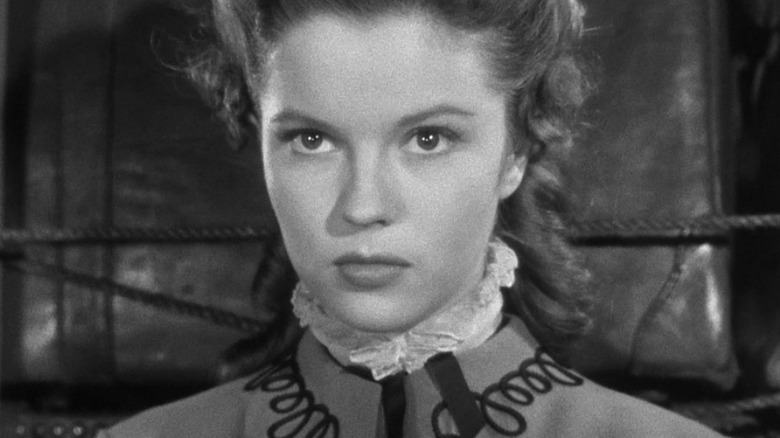
In 2012, critic Dave Kehr wrote an essay for The New York Times about John Ford's relatively underseen 1948 Western film "Fort Apache," and he pointed out how it bucked some of the era's more racist trends by portraying Indigenous Americans as, well, actual humans. In too many U.S. Westerns released prior to 1948 (and after as well, sadly), Indigenous Americans are depicted as monstrous enemies to be defeated, with the term "cowboys and Indians" becoming a well-known American colloquialism. "Fort Apache" wasn't wholly revolutionary, but the fact that it had some sympathetic Indigenous American characters at all was a miniature coup. On top of that, it was a giant studio "A" picture that starred Shirley Temple, Henry Fonda, and John Wayne (and basically saved Wayne's flagging film career).
"Fort Apache" follows (seriously) Miss Philadelphia Thursday (Temple), a young woman traveling with her father, Owen (Fonda), to his new military position at the titular fort. On the way there, Philadelphia begins making goo-goo eyes at the young Michael O'Rourke (John Agar), the son of a prestigious Sergeant Major (Ward Bond). Meanwhile, Fort Apache itself is overseen by Captain Kirby York (Wayne), who has a lot of trouble explaining the realities of life there to the snippy Owen.
A big part of the movie involves Owen repairing relations with local members of the Apache people on a reservation, as his predecessor (Grant Withers) treated them poorly by offering very little food, way too much booze, and other shoddy wares. Many of the Apache have left for Mexico, and Owen is eager to bring them back. His plans are ill-advised at best, though, and he ends up causing a lot of death and damage.
Fort Apache stars Shirley Temple, John Wayne, and Henry Fonda, and it's less racist than you'd expect
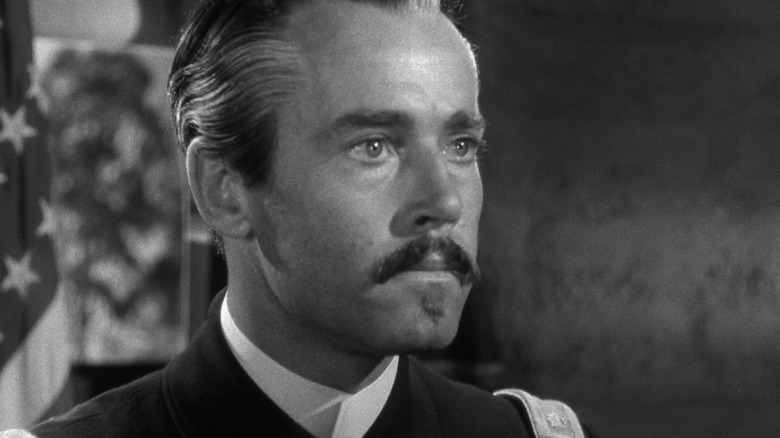
"Fort Apache" climaxes with Owen Thursday taking a bunch of soldiers to confront the remaining Apache, hoping to take them back by force. Captain York warns Owen that a frontal assault will just get him and his soldiers killed, but Owen wants to try anyway, hoping to prove himself with a military victory. He loses. Quite badly in fact.
In an epilogue, however, it's shown that Thursday came to be celebrated at a hero despite being a disrespectful, unskilled clown. York, who witnessed his lack of savvy, keeps his mouth shut. It's unusual for a John Wayne movie to confront the "legends" of the West and reveal them as frauds, given that he himself is one of the central symbols for racist Western "legends." Every few years, a new generation of journalists digs up the infamous 1971 Playboy Magazine interview where Wayne admits, with open throat, that he is racist, homophobic, and an unapologetic white supremacist. Personally, he had more in common with Owen Thursday than Captain York.
It should be noted, of course, that "Fort Apache" is fully fictional. The events of the film are merely extrapolated from details about the Battle of the Little Bighorn (aka. Custer's Last Stand) and the Fetterman Fight. Even so, the movie is authentic through its first stretches as it explores everyday life at a remote fort in the late 19th century. Nevertheless, everything else has been wholly imagined when it comes to the film's plot. For more on that, you should check out the 1995 essay book "Past Imperfect: History According to the Movies."
What did critics think of Fort Apache?
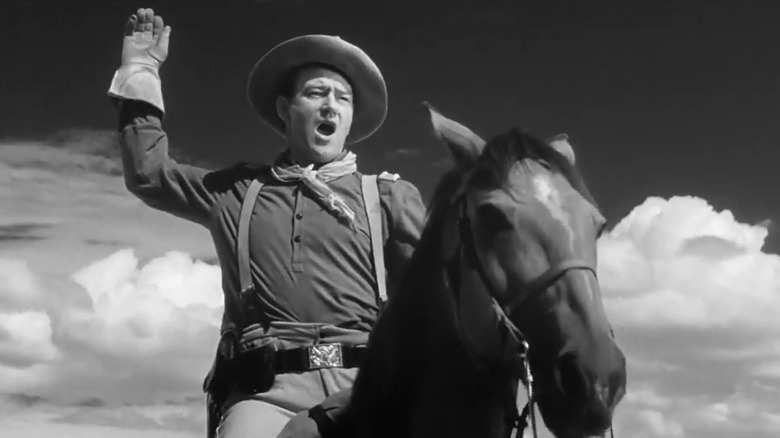
For the most part, people seem to love "Fort Apache." It's now considered part of an unofficial film trilogy that John Ford and John Wayne made together, along with 1949's "She Wore a Yellow Ribbon" and 1950's "Rio Grande." When Variety reviewed "Fort Apache" prior to theatrical release in 1947, it described the movie as follows:
"Cast is as tremendous as the scope achieved by Ford's direction and, as a consequence, some of the roles are very short but all effective. Henry Fonda is the colonel, embittered because he has been assigned to the remote fort after a brilliant war record. John Wayne makes a virile cavalry captain, wise in the way of the Indian. Shirley Temple, the colonel's daughter, perks her sequences in romance with John Agar, West Point graduate. Latter impresses."
(Yes, that is how many old-school reviews were worded.)
Jump ahead roughly 60 years later, and you'll find that Keith Phipps was equally impressed when he reviewed the film as part of the John Wayne/John Ford DVD box set for the AV Club in 2006. Phipps noted that the movie was impressively resigned, concluding "with a virtual sigh, recognizing that the bloody misadventures of Henry Fonda's Custer-like commander will be remembered long after the more sensible, battle-averse Wayne has been forgotten." The DVD set also includes classics like the stone-cold classic "Stagecoach," "The Searchers," the Christmas Western "3 Godfathers," and a few others. It's the perfect gift for your dad.