

David Bowie Gave An Acting Masterclass In One Of The Best Anti-War Movies Ever Made
We may receive a commission on purchases made from links.
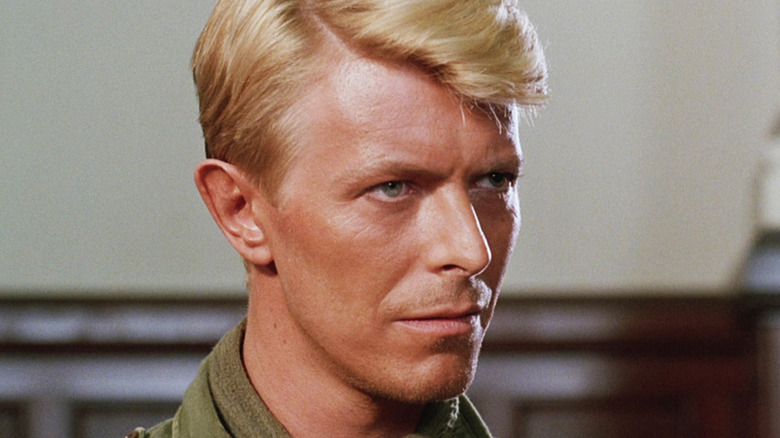
In a better world, we would have had a David Bowie Bond villain. Thankfully he gave us several great performances, from stealing the show in "Labyrinth" to the time Bowie worked with Christopher Nolan on "The Prestige." Then, there's 1983's "Merry Christmas, Mr. Lawrence," an adaptation of Laurens van der Post's 1963 short-story collection "The Seed And The Sower" and his 1970 book "The Night of the New Moon." Directed by legendary Japanese filmmaker Nagisa Ōshima, the film stars Bowie and, like the books, chronicles the experiences of Lt. Col. John Lawrence (Tom Conti) as a prisoner of war in World War II. Bowie plays Maj. Jack "Strafer" Celliers, a newly-captured prisoner, in what was one of his best and most underrated performances.
By the end of the 1970s, Bowie had already established himself as a capable actor, most notably by playing Thomas Jerome Newton in Nicolas Roeg's 1976 sci-fi drama "The Man Who Fell to Earth." In July 1980 he made his debut as Joseph Merrick in the Broadway production of "The Elephant Man" and the critics were immediately impressed. Trouser Press, for instance, claimed that Bowie "brought magic and music to the play's language," while Variety praised his "ability to project a complex character" and "his sensitive projection" of the role.
It wasn't just critics who were impressed, either. Japanese filmmaker Nagisa Ōshima had seen Bowie on-stage and felt the actor would be perfect for his upcoming war film, "Merry Christmas, Mr. Lawrence." Perhaps it was the parallels between Merrick's life of suffering and the horrors endured by prisoners of war that gave Ōshima the idea to cast Bowie. Whatever the case, it turned out to be an inspired choice on the director's part.
David Bowie impressed critics with his portrayal of a POW

Nagisa Ōshima was already a renowned filmmaker by the time he approached David Bowie to star in "Merry Christmas, Mr. Lawrence." Having started his career in the late-'50s he courted controversy for his films "Death By Hanging" (1968) and "Ai No Corrida," ("In The Realm Of The Senses") (1978), with the latter even leading to an obscenity trial in its native Japan (Ōshima was ultimately found not guilty). But while the Japanese government might not have been a fan of the director's transgressive style, Bowie certainly was.
Not only was he a big fan of Japanese culture in general, as recounted in Nicholas Pegg's "The Complete David Bowie," the star was a fan of Ōshima, and was immediately interested when the director asked him to be involved in "Merry Christmas, Mr. Lawrence." "He asked me if I had read the book and I hadn't," said Bowie. "But I had certainly seen a few of his movies and I immediately agreed to do it without seeing the script, mainly because it was such an opportunity, a once-in-a-lifetime experience to work with someone like Ōshima."
It helped that "Merry Christmas, Mr. Lawrence" was co-written by Paul Mayersberg, the scenarist responsible for "The Man Who Fell To Earth." Mayersberg intentionally wrote Celliers' lines with Bowie in-mind, and it paid off. As the new arrival to the Java-based POW camp in the film, Bowie proved he was, as the New York Times' Janet Maslin put it "a born film star." Describing his screen presence as "mercurial and arresting" Maslin praised Bowie for his "effortless" performance, in what ultimately came to be seen as one of the best Japanese drama movies of all time.
David Bowie impressed some esteemed filmmakers with Merry Christmas, Mr. Lawrence
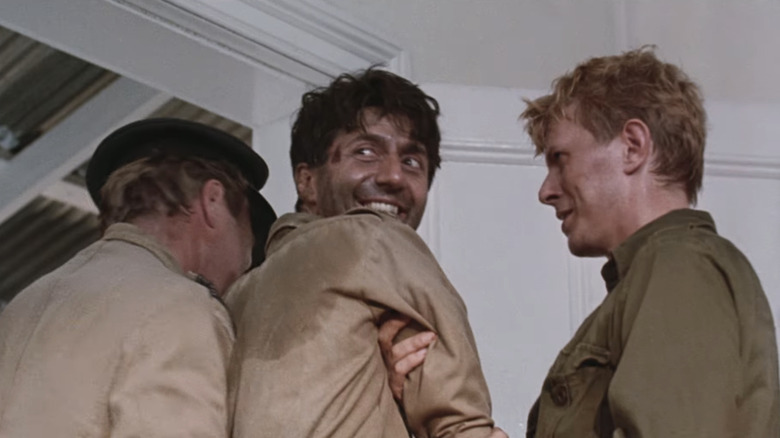
"Merry Christmas, Mr. Lawrence" sees David Bowie's British soldier Jack Celliers arrive at a Japanese-controlled POW camp during World War II. Captain Yonoi (Ryuichi Sakamoto), a strict devotee of the bushido code, oversees the prisoners alongside Sergeant Gengo Hara (Takeshi Kitano). Though unprepared for Celliers' defiant attitude, Yonoi is simultaneously drawn to him. Lt. Col. John Lawrence (Tom Conti) is the only prisoner who has ingratiated himself to the Japanese leadership via a friendship with Sergeant Hara. As Celliers repeatedly pushes back against Captain Yonoi, Lawrence does his best to bring the British and Japanese together.
At the time, Bowie wasn't quite the pop mega-star he would become. He filmed the music video for his 1983 hit "Let's Dance" directly after wrapping production on "Merry Christmas, Mr. Lawrence," after which his music career ascended to new heights. But he was eager to work with Nagisa Ōshima, and it showed in his performance as Jack Celliers, which turned out to be one of his best.
Today, "Merry Christmas, Mr. Lawrence" maintains an 89% critic score on Rotten Tomatoes, though many of the "top critics" weren't too impressed. That said, very few were critical of Bowie's performance. Roger Ebert, for example, didn't seem to like the film very much overall, awarding it two and a half stars and summing it up thusly: "Here's a movie that is even stranger than it was intended to be." But he didn't single out Bowie, saving his criticism for the Japanese actors, instead. What's more, "Merry Christmas, Mr. Lawrence" received arguably the best praise possible by making Christopher Nolan's 10 favorite movies list and becoming one of Akria Kurosawa's favorite films of all time.