

James Stewart's Final Role Was In A Quirky '90s Western That'll Leave You Nostalgic
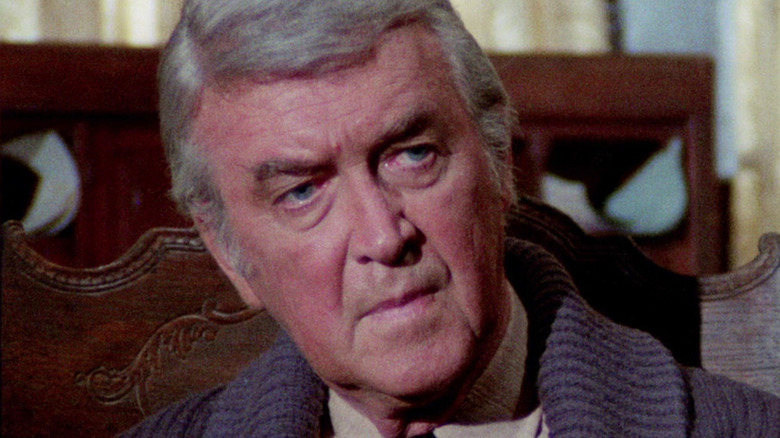
James Stewart became a Hollywood legend very early in his career. His first film credit was for Tim Whelan's 1935 crime drama "The Murder Man," a vehicle for Spencer Tracy. 1936 saw Stewart keeping immensely busy, appearing in eight feature films, some of them for notable directors like William Wellman and W.S. Van Dyke. In 1938, he starred in Frank Capra's "You Can't Take It With You," and he was pretty much solidified in the public consciousness. He and Capra made three films together, and Stewart became a stalwart among several star directors. He was in eight Anthony Mann movies, four Alfred Hitchcock movies, and three John Ford movies to boot.
Stewart's open-faced, aw-shucks persona is now considered a Hollywood archetype, and no other actor has quite matched his energy. He rarely played heavies, and even in his edgier roles, suffused his characters with a simplistic, forthright guilelessness that remained eternally appealing. Films like "Vertigo" were the exception to the rule.
Stewart remained busy for decades, and didn't slow his acting output until the mid-1960s. This is to say, he only made two or three films in a year, rather than eight. He was only in six films in the entire '70s, and one in 1980. Stewart's final role came in 1991 when he played the voice of a brave anthropomorphic dog sheriff in Phil Nibbelink and Simon Wells' animated sequel "An American Tail: Fievel Goes West." His character was named Wylie Burp, a nod to the fact that Stewart played Wyatt Earp in the 1964 film "Cheyanne Autumn." "Fievel Goes West" wasn't as huge a hit as the first "American Tail," but it's still a surreal, fun, gorgeously animated film.
James Stewart's final role was voicing Wylie Burp in An American Tail: Fievel Goes West
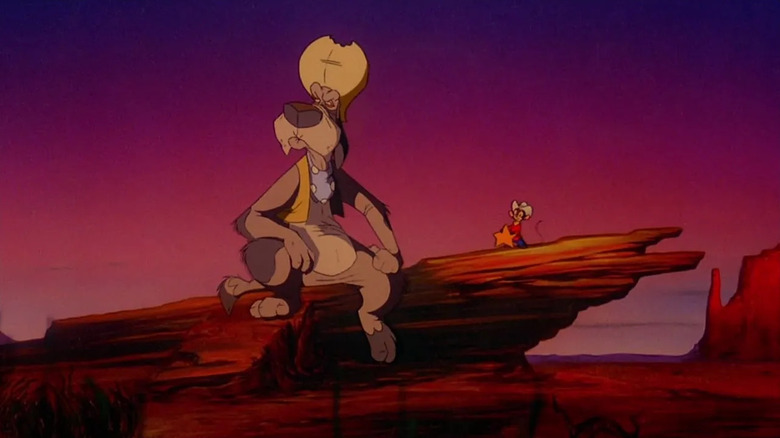
For those who weren't there, it's hard to describe the overwhelming popularity of Don Bluth's 1986 animated film "An American Tail." Made on a budget of $9 million, the film made a whopping $84 million at the box office. It was put out by Steven Spielberg's Amblin Entertainment, so it had quite the imprimatur, and some prognosticators at the time felt that movies like "An American Tail" would push one-time animation champ Disney out of the animation mainstream forever. The film was once accused of plagiarizing Art Spiegelman's "Maus." It's supremely weird that no one talks about it anymore.
"An America Tail" told the story of a group of mice, the Mouskewitz family, who emigrated from Russia in 1885 to try for a better life in America. They heard that there were no cats in America, for one, and it seems appealing. Upon arrival, however, the youngest of the mouse family, Fievel (Phillip Glasser) is separated from his family, and gets lost. He spends the rest of the film trying to find them again. This, as he must face cat gangs and other struggles of moving to a new country. He becomes friends with a friendly cat named Tiger (Dom DeLuise), and the film featured performances from Nehemiah Persoff, Christopher Plummer, and Madeline Kahn.
"An American Tail: Fievel Goes West" was the first sequel to the hit film, and it caught up with the Mouskewitz family five years later, finding that their lives in America weren't terribly rosy. They're still broke, and a local cat has launched an anti-mouse campaign in New York. The family flees to Utah. This is 1890, so it's a rough, dusty place. Fievel ends up meeting Wylie Burp, his Old West hero, also having fallen on hard times.
Remember all the American Tail sequels?
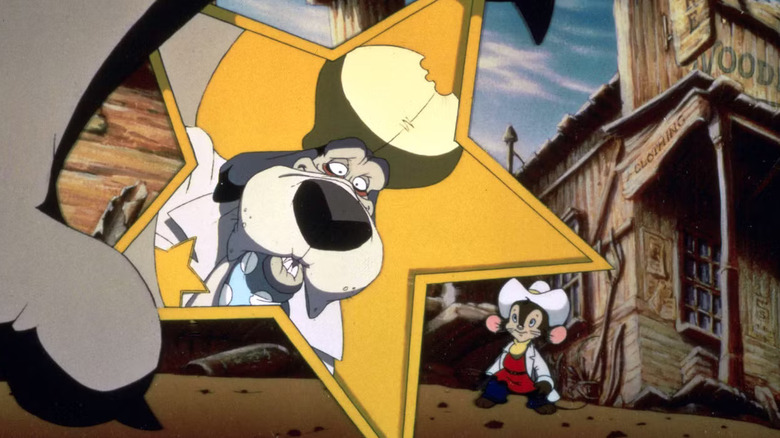
Wylie Burp doesn't appear in "Fievel Goes West" until later in the film, after all the central conflicts have been introduced. The villain of the film is a British cat named Cat R. Waul (John Cleese), who, along with his henchspider T.R. Chula (John Lovitz), intends to hoodwink the local mice into building him a local saloon with every intention of eating them after. Like in the first film, Fievel is separated from his family and spends a portion of the film wandering in the desert with Tiger.
Wylie Burp was one of Fievel's pulp heroes, and he's thrilled to find that Wylie Burp, now very old, might be able to help with the crisis. Wylie Burp plays a major role in the film's final climax, and serves as Fievel's mentor. The film ends with Wyle placing a sheriff's badge on Fievel's chest. This will be the next phase in Fievel's life. If any voice can grant you the advice to move into your next adventure, it would be Jimmy Stewart's.
"Fievel Goes West" wasn't the knockout hit of the 1986 original, making only $40.8 million on its $16 million budget. After that, "An American Tail" spun off into a 1992 TV series called "Fievel's American Tails," which only lasted for one 13-episode season. There was still enough gas in the tank, however, for two straight-to-video sequels called "An American Tail: The Treasure of Manhattan Island" and "An American Tail: The Mystery of the Night Monster." Those were both released straight to video in the United States in 2000. By then, though, few still cared about the franchise.
"Fievel Goes West" isn't on any streaming platform, but it can be rented from various online stores.