

Paul Newman Made His TV Debut In A '50s Sci-Fi Anthology Show That Needs More Love
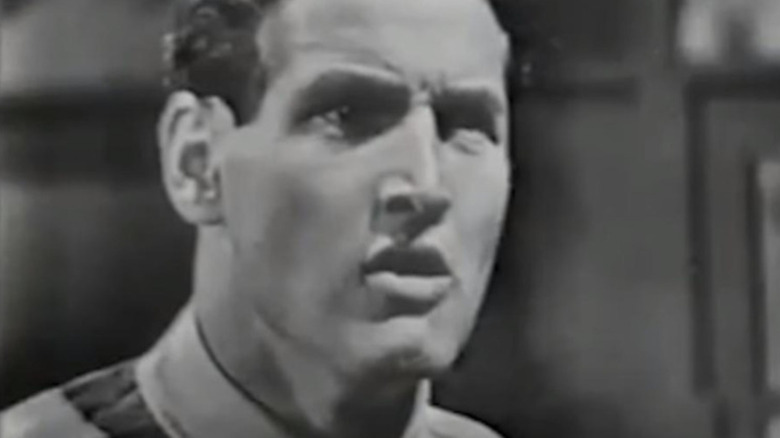
Even most stalwart sci-fi fans haven't yet gotten around to watching the 1951 anthology series "Tales of Tomorrow." The series ran on ABC for two seasons back in the day, lasting for an impressive 85 episodes. The live-performance series adapted many famous sci-fi stories from notable authors like H.G. Wells, Mary Shelley, and Jules Verne, and boasted scripts from contemporary sci-fi celebrities like Arthur C. Clarke and Theodore Sturgeon. Most notably, "Tales of Tomorrow" promptly secured the talents of many famous or soon-to-be-famous actors. Boris Karloff, Lee J. Cobb, Veronica Lake, Bruce Cabot, Rod Steiger, Burgess Meredith, and even James Dean all appeared on the series. From the looks of it, "Tales of Tomorrow" was the "Law & Order" of its day.
Sadly, because of the sorry state of television archiving in the 1950s, many episodes of "Tales of Tomorrow" are now considered lost media. The surviving 50 episodes of the series are in the public domain, and one can watch them on the Internet Archive right now. Sci-fi fans know a homework assignment when they hear it.
For the purposes of this article, we're focusing on the final episode of the show's first season, "Ice in Space," which aired on August 8, 1952. The episode is about a mysterious block of ice from space that has the same properties as the Ice-9 from Kurt Vonnegut's novel "Cat's Cradle." It freezes anything that comes into contact with it and doesn't melt. The bulk of the episode is a headbutting competition between an Air Force Major (Edmon Ryan) and a bullheaded congressman (Raymond Bailey). Paul Newman plays a supporting soldier named Sergeant Wilson. It was Newman's TV debut and his earliest screen credit.
Paul Newman's first screen credit was in Tales of Tomorrow
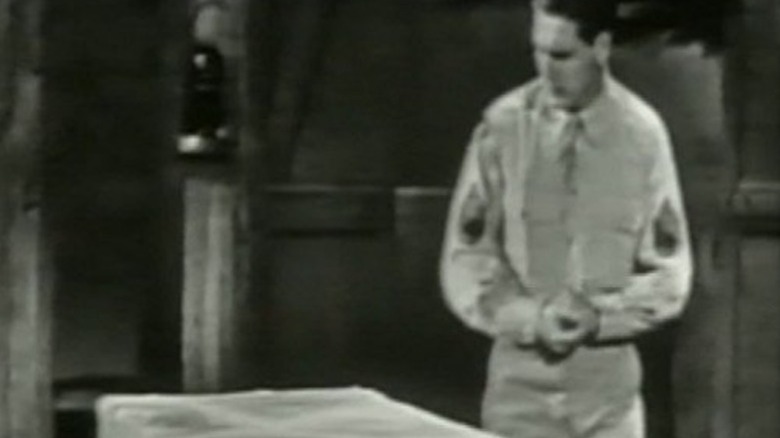
Because it was a live show and TV special effects were primitive in the early 1950s, "Tales of Tomorrow" is a slow-moving, static series. A lot of "Ice from Space" is two-shots of men in offices bantering about some sort of alien threat off-camera. Luckily, the performances are solid enough that such a thing builds tension rather than merely avoiding the fact that the series didn't have a lot of money to work with. The conversations between Edmon Ryan's and Raymond Bailey's characters are all first-rate vintage TV acting. Some might recognize Bailey from his role as Mr. Drysdale on "The Beverly Hillbillies" or from a few episodes of "The Twilight Zone."
The plot involves a rocket that was sent into space with some experimental mice on board. The mice return frozen solid, and the rocket has a new, mysterious cargo: the aforementioned frozen cube.
It's never explained how the cube got on board the spaceship, but the soldiers in the room are increasingly concerned that it seems to be slowly growing and that there's no real way to stop it. It doesn't melt under heat; it can't be cut or chopped up. It just keeps growing and freezing things. Paul Newman doesn't have a huge role, merely standing among other soldiers looking worried. He does, however, do his job well.
Many might notice a similarity between "Ice from Space" and Christian Nyby's 1951 film "The Thing from Another World." Instead of a monster in the ice, though, this time, the ice itself is the monster. The TV series has a sweaty, worried tone. It's a proper horror story.
Paul Newman's early career
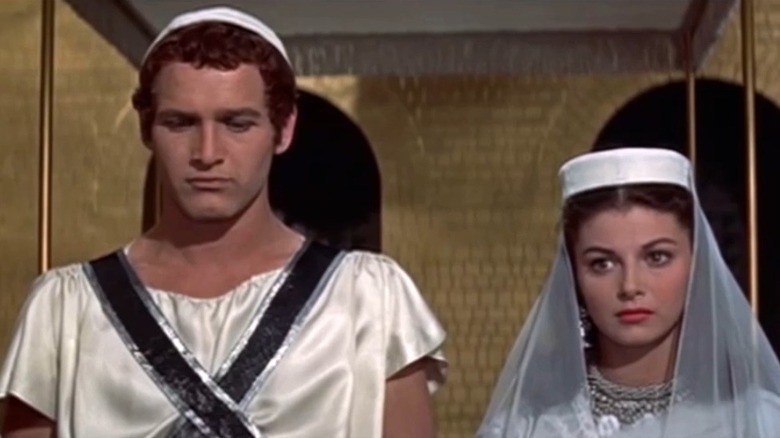
Although "Tales of Tomorrow" was hardly a breakout showcase for Paul Newman, he still managed to springboard into larger projects right away. His second screen credit was playing one of the lead characters in the 1954 big-budget Warner Bros. historical epic "The Silver Chalice." Newman played Basil, a sculptor who, rather than inheriting his adopted father's home, was sold into slavery by his iniquitous brother. The film is set in AD 20, so the Apostles float through the drama, as does Nero (played by Jacques Aubuchon). The film tanked, but Newman was unruffled, starring in multiple more TV projects in 1955 and 1956, and in the feature film "Somebody Up There Likes Me."
By 1958, Newman was a recognizable movie star, and played a heterosexual version of the character Brick in a celebrated film adaptation of Tennessee Williams' "Cat on a Hot Tin Roof." The film earned Newman his first acting Oscar nomination, a feat he would repeat in 1962 (for "The Hustler"), 1964 (for "Hud"), 1968 (for "Cool Hand Luke"), 1982 (for "Abscence of Malice"), 1983 (for "The Verdict"), 1987 (for "The Color of Money," which he won), 1994 (for "Nobudy's Fool"), and 2003 (for "Road to Perdition"). Yeah, there was something about that Newman guy.
Newman's rise in the late 1950s was meteoric. He went from more obscure movies like "Until They Sail" and "The Long, Hot Summer" to hits like "Cat on a Hot Tin Roof" and "Exodus" in sure course. And that's not even counting the man's motorsport career, but that's an article for another time.