

Batman: Caped Crusader Season 2 Introduces A New Twist On Joker's Laughing Gas
This article contains spoilers for "Batman: Caped Crusader" Season 2.
"Batman: Caped Crusader" Season 1 ended in a dark house. Several dead bodies strapped to chairs displayed horrific rictus grins. In the shadows, their pale skinned murderer declared, "Perfect."
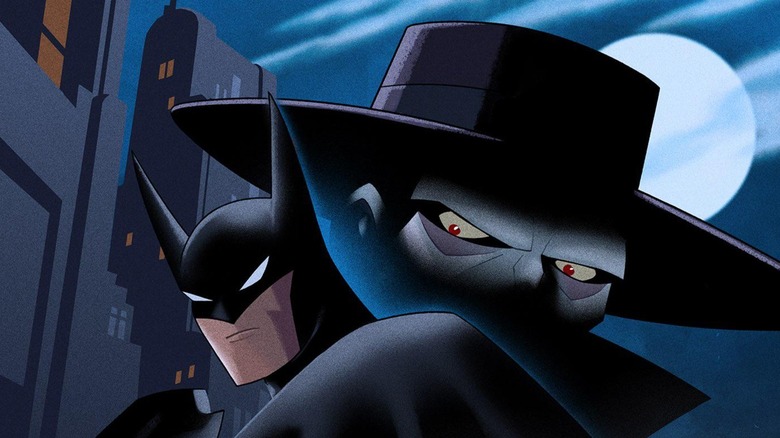
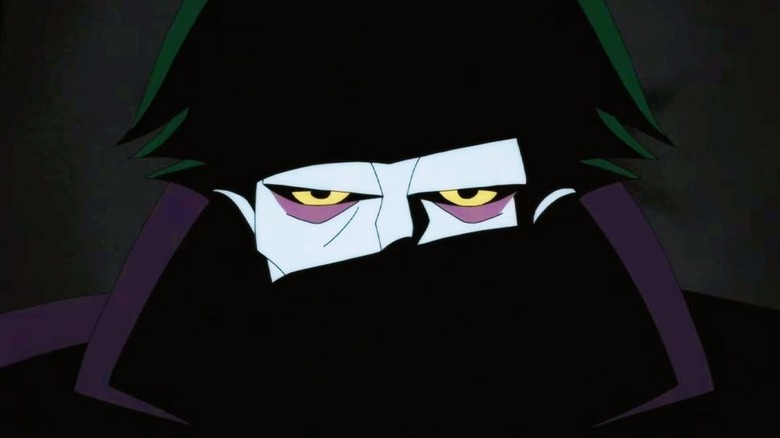
It didn't take Bat-fans long at all to guess who this new villain was, but "Caped Crusader" Season 2 still slow-rolls the Joker's introduction. He appears across the season but only in cameos and always with his face concealed by the framing or shadows. He finally takes the stage as the main villain in the last two episodes, "Dead Before Dawn" and "The Laughing Death." "Batman: Caped Crusader" harkens back to Batman's earliest days in the Golden Age of Comics, which is why it's also a period piece literally set in the 1940s. This comes through in how it now depicts the Joker.
In his debut, "Batman" #1, Joker was a more humorless villain, one who scowled as much as he smiled. His motif was more clearly centered around the Joker playing card, rather than being a clown. The Joker is a famous "wild card" in games like poker, and the Joker was likewise an unpredictable criminal mastermind. His very first crime is announcing Gothamite Henry Claridge will die at midnight, and he keeps that promise — because he'd already poisoned Claridge with his lethal laughing gas.
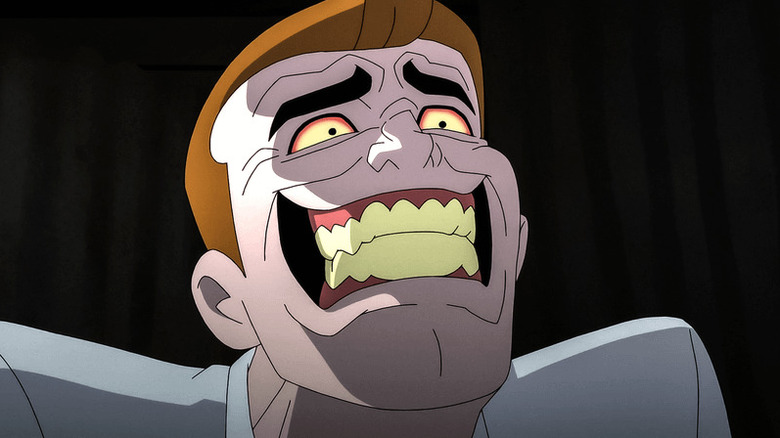
This unfolds almost exactly in "Dead Before Dawn." This Joker, voiced by Matthew Needham (Larys Strong on "House of the Dragon"), announces he will kill Gotham's mayor at midnight and then the city itself will fall at dawn. That's because Joker has tweaked his laughing gas to not merely kill its victims but transform them into sadistic, super-strong brutes with contagious bites. He intends Gotham to destroy itself in a plague of laughing zombies.
The Joker mixes his laughing gas with Hugo Strange's Monster Men formula
Even something as mature as "Batman: The Animated Series" still faced typical kids show censorship. The Joker's laughing gas was embraced as a workaround to rules on depicting violence. The Joker wasn't allowed to kill people, so he dosed victims with laughing gas. It was still scary while keeping the plausible deniability that they weren't really dead. It also didn't feel like censorship since the laughing gas has been the Joker's go-to weapon since the very beginning.
"Caped Crusader" combines the laughing gas with another evil concoction: Professor Hugo Strange's Monster Men formula, which can turn people into tall, strong, and not-too-bright giants. In the "Caped Crusader" Season 2 premiere, "Brute Force," gangster Eddie Nygma (Ronan Raftery) buys Strange's formula and uses it on his henchman, Mark Desmond/Blockbuster (Zach Lazar Hoffman). Episode 2, "Rocket's Red Glare," ends by revealing the Joker has killed Strange and raided his lab for the Blockbuster formula.
Across the two-part finale, Batman (Hamish Linklater) and Alfred (Jason Watkins) develop an antitoxin. They realize the Joker's plan is to bypass the laughing gas' limited infection range. A dead body can't infect too many people, but a living host driven to keep spreading the infection? That's how you get an epidemic and a Gotham City that dies smiling.
Someone who's not smiling? The Joker himself. This iteration is stoic and severe, with Needham's voice keeping an icy even timbre. When the Joker's plan comes to fruition in "The Laughing Death," he doesn't cackle in glee like Mark Hamill's Joker would. Instead, he solemnly recites William Butler Yeats' poem "The Second Coming," appropriately all about things spiraling out of control: "Turning and turning in the widening gyre; The falcon cannot hear the falconer."
Batman: Caped Crusader delivers a Joker with no use for jokes
The "Batman: Caped Crusader" creative team looked at the original inspiration for the Joker: "The Man Who Laughs," the 1928 silent film starring Conrad Veidt as Gwynplaine, a man whose face has been surgically altered to give him a permanent grin. As showrunner James Tucker explained to Entertainment Weekly:
"That led us to reinterpret Joker as a character who basically came from silent movies, who came from German expressionism, and that informed his stoicism and his coldness, because he's kind of a cold character in this interpretation."
The first time the Joker appears in "Dead Before Dawn," it's through a black-and-white TV broadcast, rendering him in the palette of a silent film. When he's fully revealed in "The Laughing Death," he resembles how Jerry Robinson drew him in "Batman" #1: receded hairline, wrinkled face, etc.
The villain doesn't even name himself the Joker, as Commissioner Gordon (Eric Morgan Stuart) just offhandedly calls him a "joker." But then, if this Joker doesn't laugh, why create the laughing gas? In the comic "Absolute Batman" (which has a similarly unfunny Joker), Alfred tells Bruce Wayne that clowns laugh out of contempt and act like buffoons because that's how they see everyone else. The same thought process probably applies to the nihilistic "Caped Crusader" Joker.
When the Joker does finally laugh, it's after he's been impaled by a construction spike and jumped from the skyscraper where he was fighting Batman. Keep in mind, "Batman" #1 ended with the Joker lethally stabbed before a last minute revision, starting the enduring trend of him cheating death. If "Caped Crusader" gets a third season, perhaps a more traditional, smiling Joker will appear (having been changed by his brushes with Batman and the Grim Reaper).
"Batman: Caped Crusader" is streaming on Prime Video.