

One Of Aldous Huxley's Best Sci-Fi Books Got A Butchered Adaptation On Peacock
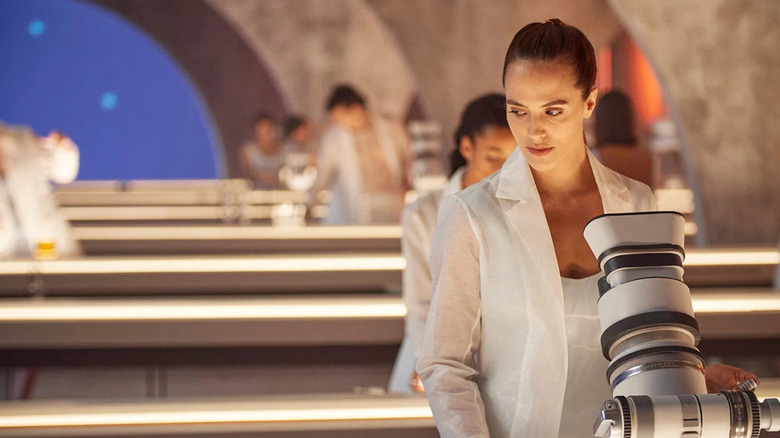
Most high school students have read Aldous Huxley's chilling 1932 sci-fi novel "Brave New World." It's often held up, alongside George Orwell's "1984" and Ray Bradbury's "Fahrenheit 451," as one of the world's best and most consistently salient pieces of dystopian literature. Huxley's novel takes place in the year 632 A.F. (After Ford) when humans are now all birthed in artificial birthing centers and arranged into one of five castes. Alphas are bred and raised to be society's leaders, while Epsilons perform menial labor. Everyone wears color-coded outfits to indicate their caste, and they have been raised to love the caste they're in. Everyone is on a constant regimen of a powerful mood-altering drug called Soma which makes them placid and soporific. Everyone gets to have casual group sex as much as they want.
Outside of the large cities, however, exist vast "Savage Reservations" where, gasp, people are still born naturally and don't rely on Soma to survive daily travails. People there have access to art and literature, things that are banned in the free-sex, empty-headed World State. It's in the Reservation that readers will meet John, the protagonist of "Brave New World." John, the lost son of city dwellers, is taken back into the State, and clashes with everything he sees. Everyone is placid and no one is passionate. Eventually, John begins pounding his fists on tabletops, explaining that everyone has the right to be unhappy. The book ends on a chilling note.
In 2020, the newly launched Peacock decided to draw in viewers with a big-budget, sexed-up TV adaptation of "Brave New World" starring Alden Ehrenreich as John and Jessica Brown Findlay as Lenina, a hatchery technician. The TV show was slick, ambitious ... and monkeyed around way too much with Huxley's source material.
The Brave New World TV series strayed far from the original novel
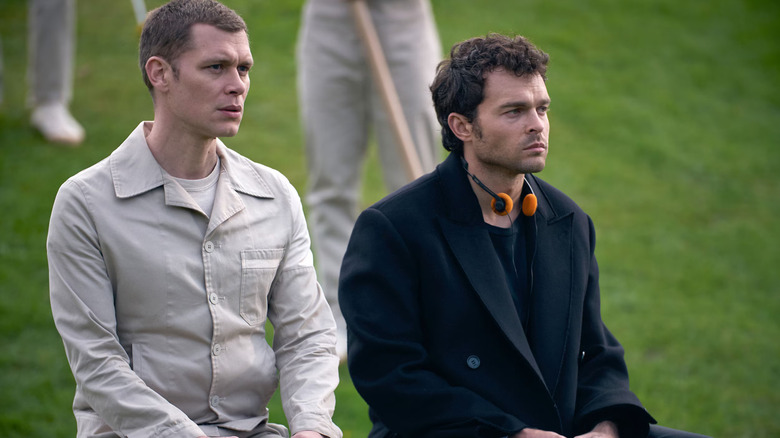
Aldous Huxley's novel is rich enough to make a still-timely TV series, of course, but the makers of Peacock's "Brave New World" felt the need to "juice it up" a little bit. The pilot episode, one might be surprised to find, contains ample sex scenes and plenty of nudity. That was in line with Huxley's vision of an open-sex society. The newly invented subplots, however, are a little silly. In one subplot, Lenina finds that Soma doesn't necessarily prevent Epsilons from occasionally killing themselves, while John, out in the Savage Lands, is gifted a bullet by a friend. In the following episode, there's an armed rebellion in the Savages, and the return to the Big City is inflected with gunfire.
Some of the other changes to Huxley's story are just baffling. The people of the New State are all connected via an artificially intelligent Master Control Program called Indra that can reach into people's brains and "correct" them if they get out of line. Indra eventually gets it into her head that wiping out all citizens is the best way to achieve peace. Yeah, Huxley didn't have any of that.
And the characters are also dramatically changed. Huxley wrote a character named Helmhotz Watson, a writer who is bored by the constant propaganda and slop-like drivel he is so often forced to write. He is eventually banished from the World State for reading contraband poetry to students. In the Peacock adaptation, the character is re-envisioned as Wilhelmina Watson (Hannah John-Kamen from "Ant-Man and the Wasp"), a creative director for the city's themed orgy/parties. She is forced to experience John's emotions via a lens-like device, and there is a big kerfuffle over exposing this lens to the public.
Brave New World is the action-forward, dumbed-down version of Huxley's novel
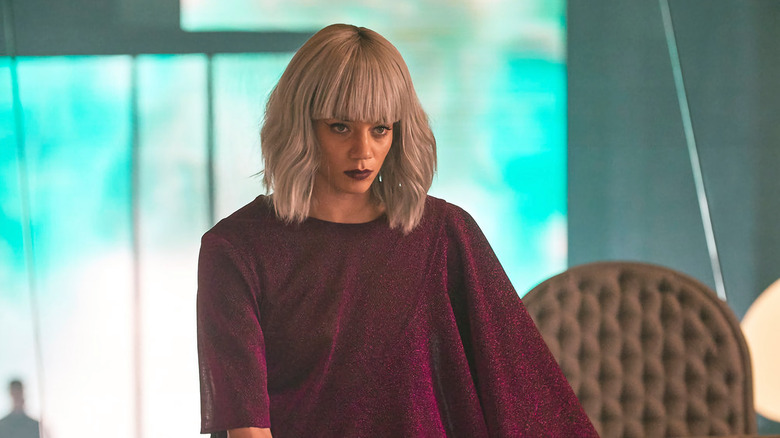
Oh yes, and to make sure there's more mayhem, a rebellion is constantly brewing, there are murderous conspiracies to keep the State in place, and there will eventually be a violent uprising. None of this is in the book. The message of "Brave New World" is that we, through our own impulses and through a general phobia of intellect, art, romance, and passion, will force an emotionless, blissed-out, unambitious world on ourselves. The Peacock version takes the blame out of our hands and puts it in the hands of shadowy conspiracies and misunderstanding A.I. overlords. (But given what some of the real world's ultra-wealthy have said about the future of A.I., maybe Peacock's version of the story is more timely than we initially thought.)
The production design of "Brave New World" is, at least, in line with Huxley. The original author conceived of a world full of constant drug use, casual sex (which the prudish Huxley disapproved of in real life), and infinite distraction at the "feelies" (the all-sense-encompassing future version of the movies). The TV version updated that hedonistic lifestyle to resemble constant bespoke raves, which turn into sex parties. These visions, while lascivious, do fall in line with Huxley's vision.
"Brave New World" only lasted for nine episodes before being canceled. It wasn't very well reviewed (Rolling Stone gave it two stars, for instance), and Huxley fans like myself disapproved of turning the book into something more action- and suspense-oriented. The show was one of the very first high-profile Peacock series to be canned by the service.
Even Captain America fouled up the meaning of the phrase "Brave New World." Why is this so hard?