

Why Are The Academy Awards Called Oscars?
We may receive a commission on purchases made from links.
It may not be Oscar season right now, but we can still delve into the question of how the Academy Awards got their "Oscars" nickname.
The Academy Awards themselves actually have a very cynical origin. The Academy of Motion Picture Arts and Sciences was founded in 1927 by ultra-mogul Louis B. Mayer (of Metro-Goldwyn-Mayer fame). The story goes that Mayer wanted to swiftly build a house in Santa Monica, California, and intended to use studio labor in its construction. Some new union contracts, however, demanded that the laborers, y'know, be paid a decent wage and not be forced to work 24/7. Mayer realized that if the entire industry began unionizing, his film empire — based largely on exploiting talent — would fall apart.
Mayer, then, booted up the Academy as a means of inter-studio negotiation. It was, in short, an easy way to skirt actual unionization. Also, filmmakers would be given something that they could fight over, and that would earn them a certain amount of abstract prestige. And prestige, it turns out, is cheaper than paying decent wages. In Scott Eyman's biography "Lion of Hollywood: The Life and Legend of Louis B. Mayer," Mayer was quoted as saying, "I found that the best way to handle [filmmakers] was to hang medals all over them. If I got them cups and awards, they'd kill themselves to produce what I wanted. That's why the Academy Award was created."
The "Oscar" nickname, though, wasn't part of Mayer's plan. The detailed book "The Academy and the Award" by Bruce Davis explored the various popular origin stories of the "Oscar," variously attributed to Bette Davis, a journalist named Sidney Skolsky, or the Academy's librarian, Margaret Herrick. The real origin, though, lies with none of them.
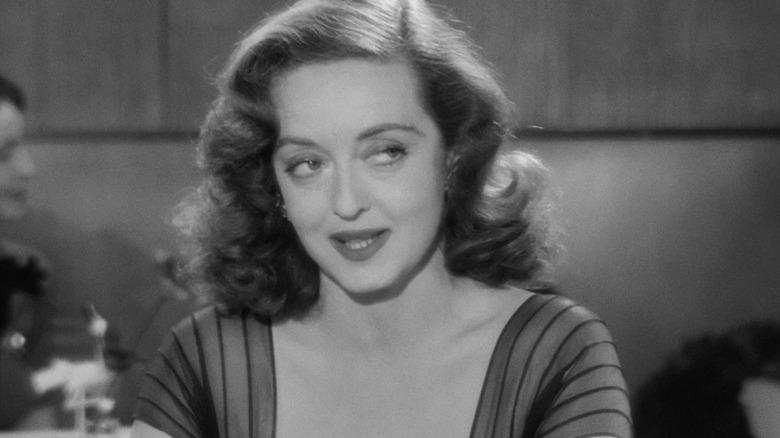
Bette Davis was said to have invented the Oscar nickname
Bruce Davis' book was handily summed up by an article in Deadline, which walks through the three most famous attributions of the Oscar nickname — although none of them may be true.
Davis' nickname for the Oscars is the most amusing. In 1932, she married her first husband, Harmon Oscar Nelson. The story goes that Davis, as she wrote in her autobigraphy "The Lonely Life," compared the Oscar statuette to Nelson when she won her Best Actress Oscar for "Dangerous," released in 1935. She recalled saying of the statuette that "his backview was the spit of my husband's. Since the 'O' in Harmon O. Nelson stood for Oscar, Oscar it has been ever since." Backview, of course, being her husband's rump.
Davis, however, admitted later that she made up that story. Specifically, she confessed in a later interview book called "Mother Goddam," written by Whitney Stine, saying that she relinquishes the rumor. The Deadline article also pointed out that some people had evidently already been called the Academy Awards "the Oscars" for a few years before Davis won hers for "Dangerous," so the timeline didn't shake out.
So if it wasn't Davis, then who? Personally, I grew up hearing the story of Margaret Herrick, a.k.a. Margaret Geldhill, the Adademy librarian who was introduced to the statue in 1931. According to The 1947/48 Motion Picture Almanac, Gledhill saw a statuette on her first day on the job and remarked aloud that it looked like her uncle, Oscar.
It's a cute story, but it might also not be true, as Margaret Gledhill didn't seem to have an uncle Oscar. The Deadline article notes that Gledhill and her husband used to kid each other over how the rumor got started.
Grouchy about the Oscars
Sidney Sklosky once wrote a memoir called "Don't Get Me Wrong — I Love Hollywood," wherein he claimed he came up with the nickname in 1934 while writing a dispatch under a strict deadline. The name came from an old Vaudeville gag wherein a bandleader would be told, "Will you have a cigar, Oscar?" Sadly, this also likely isn't true, as a news report from the same year noted that the term "Oscar" was already in popular usage by 1934.
Bruce Davis' book, then, looked deep, deep into the matter, and found that the real potential namer of the Oscar was one Eleanore Lilleberg, a Norwegian secretary for the Academy early on during its initial years. It seems that she was tasked with looking after the earliest statues and jokingly referred to them as Oscars. Davis actually bothered to track down Lilleberg's brother, Einar, to ask who "Oscar" might be referring to when his sister said it, and Einar said that they had known an army veteran named Oscar who always stood up straight. Sadly, we don't know the full name of the man that Eleanore Lilleberg was talking about.
That's the best story we have yet, and it hasn't yet been disproven, so it might be as close to the truth as we come.