

A Classic H.G. Wells Sci-Fi Novel Inspired This World War 2 Action Spy Movie
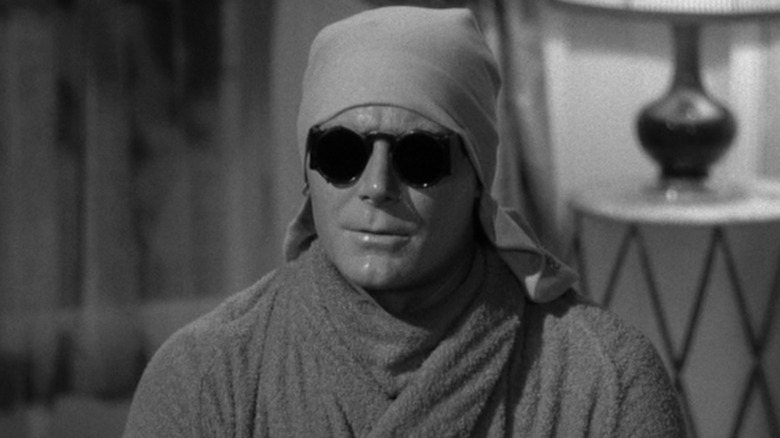
Horror fans are intimately familiar with the canon of the Universal Monster movies that were released from the early 1930s all the way through the mid-1950s. Tod Browning's "Dracula," Karl Freund's "The Mummy," and James Whale's "Frankenstein," "Bride of Frankenstein," and "The Invisible Man" opened the door on a shared monster universe that remains something of a universal truth to day. In 1942, George Waggner added "The Wolf Man" to the team, and Jack Arnold capped off the property with "The Creature from the Black Lagoon" in 1954. All of those films each got multiple sequels, and there were even crossovers between them, partially introducing the notion of a "cinematic universe" into the public lexicon.
For this article, we will focus on Whale's "The Invisible Man," which was based on the 1897 sci-fi novel by H.G. Wells. "The Invisible Man" starred Claude Rains as the scariest of Universal's movie monsters: Dr. Jack Griffin, a chemist who unlocks the secret of bodily invisibility. Griffin, however, is unable to recover his opacity and being invisible causes his moral compass to degrade. (If no one can see you, then committing crimes is much easier.) The film featured state-of-the-art visual effects that are still impressive to this day, while Rains' twisted performance is glorious. "Invisible Man" also starred Una O'Connor from "Bride of Frankenstein" and Dwight Frye from both "Dracula" and "Frankenstein."
Of course, the core concept of "The Invisible Man" is endlessly tantalizing, inspiring one to picture what they might do if they were invisible. In 1940, Joe May directed a sequel, "The Invisible Man Returns," and that same year, A. Edward Sutherland helmed the sultry "The Invisible Woman." But the most ambitious sequel came in 1942 in the form of "Invisible Agent," a WWII spy thriller.
Invisible Agent sent the Invisible Man to war
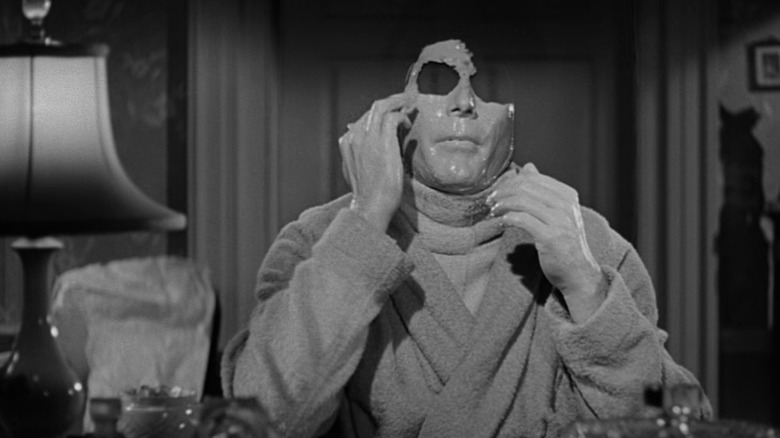
The concept of an invisible man is tantalizing enough, but in wartime, it seems like a logical tactical advantage. A spy, if they couldn't be seen, could easily sneak into enemy territory and report back any secrets they might witness, wholly undetected. The previous "Invisible Man" movies had been made before the United States had entered World War II, so a sequel about an invisible spy was perfect for the summer of 1942 when it reached theaters.
The movie catches up with Frank Griffin Jr. (Jon Hall), the grandson of Dr. Jack Griffin, the original Invisible Man. One night in his print shop, he is ambushed by a Nazi solider named Stauffer (Conrad Hall) and a Japanese agent named Ikito (Peter Lorre — I know, I know) who want to torture him to get the secret of his grandfather's invisibility formula. Frank escapes into the arms of the United States government, and he agrees to use the formula in their service but will only allow it to be used on himself. He is then tasked with sneaking into Germany to retrieve a list of German spies. Because he isn't a well-trained soldier, though, Frank isn't the most professional spy. In one scene, he gets drunk and plays pranks on a German soldier, and he even falls in love with a German saboteur named Maria (Ilona Massey).
"Invisible Agent" is more comedic than thrilling, as the previous sequels in the "Invisible Man" movie franchise had skewed away from horror and more toward humor. Indeed, "The Invisible Woman" was a straight-up sex farce about a former model (Virginia Bruce) who becomes invisible and then uses her powers to take whimsical revenge on an old boss. Horror became a thing of the past.
Invisible Agent is not a horror movie
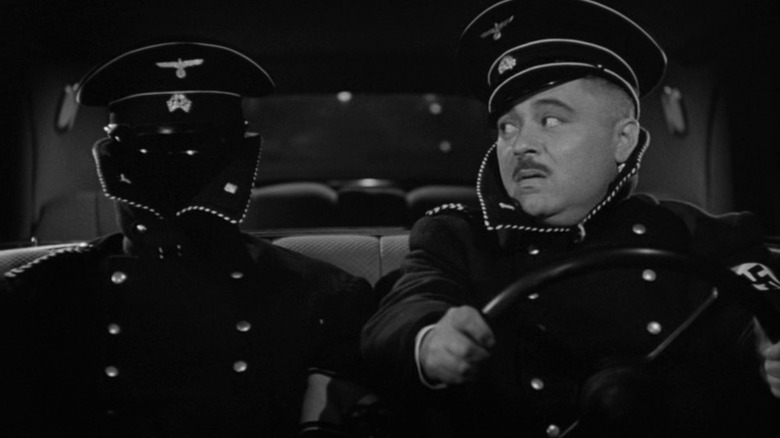
"Invisible Agent" is a lighthearted spy caper, but it's still happy to make fun of the Nazis. The stakes are high, but we're far from the terror and criminality of both H.G. Wells' "Invisible Man" novel and James Whale's original film adaptation. Again, after "The Invisible Woman," the movie series became more about comedy and visual effects than scares. Case in point: After "Invisible Agent," the "Invisible Man" didn't turn up again until 1948's "Abbot and Costello Meet Frankenstein," in which Vincent Price voices the character. That film, of course, is a slapstick farce about the titular comedy duo facing off against monsters. Then, in 1951, Arthur Franz played the Invisible Man in "Abbott and Costello Meet the Invisible Man."
/Film's own BJ Colangelo previously ranked "Invisible Agent" fairly low among "Invisible Man" movies, noting that it's missing the core concept of the character (that being invisible leads to him going on a power trip). Here, the film's invisible lead has restraint, and that is a grievous crime.
There were once plans to have Johnny Depp play the Invisible Man in the Dark Universe, but we all know how that turned out. Instead, Leigh Whannell directed 2020's "The Invisible Man," a horror film about a panicked woman (played by an excellent Elisabeth Moss) who comes to believe that her rich, abusive ex-boyfriend has faked his death and is now stalking her, having found a way to make himself invisible. It's a terrific movie, maybe the best "Invisible Man" film since the original.
And, of course, this all began with H.G. Wells' original novel. All sci-fi fans should read it. It's truly worth your time.