

John Wayne Was Surprised By The Brutal Conditions Of One Stagecoach Chase Scene
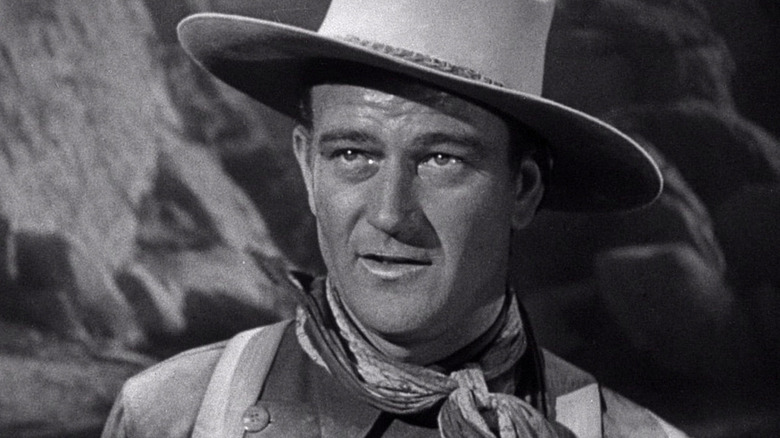
John Ford's "Stagecoach" is the platonic ideal of the American Western motion picture. The genre existed before it, but this film set the template that all subsequent oaters would observe, tweak, or full-on subvert. Oh, and it also made John Wayne a movie star (albeit with a good deal of effort).
For a movie that's been copied countless times, "Stagecoach" still plays like gangbusters. The tale of a stage run from Arizona Territory to Lordsburg, New Mexico, boasts an assortment of colorful characters played vigorously by terrific actors like Claire Trevor (who got top billing over Wayne), Andy Devine, John Carradine, Thomas Mitchell, and Chief John Big Tree. It's got your standard Apache assault, and it concludes with a showdown, but 87 years later, it's more stirring than most of the Westerns that came after it.
Ford was a well-seasoned director by this point (he'd won the Oscar for Best Director for "The Informer" in 1935), but people were second-guessing his casting on "Stagecoach." David O. Selznick thought Gary Cooper and Marlene Dietrich made more sense in the two leading roles, but Ford plowed ahead with Trevor and Wayne (to the latter's surprise). It's probably best he went with actors who had more to prove than those two established stars, because shooting "Stagecoach" was quite the ordeal. Indeed, the iconic chase across the salt flats was particularly grueling.
John Wayne was nearly defeated by the elements while shooting Stagecoach
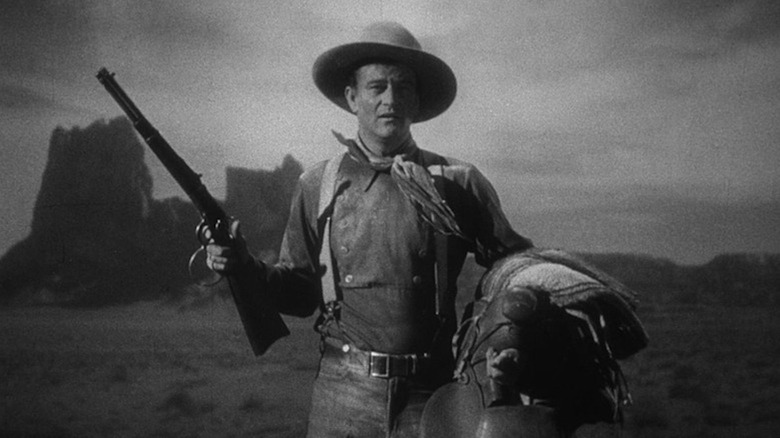
In an interview with Charles Higham, Wayne was asked about the frigid conditions on Lucerne Dry Lake outside of Victorville, California. That stagecoach chase may be one of the most thrilling action set pieces ever put to screen, but it was a bear to shoot. According to Wayne:
"Oh, I tell you. In my life I've never been any colder than it was up there that two or three days that we were on the dry lake. And the wind was blowing and there was a fine silt dust that just—your lungs are raw, your vocal pipes are shot. Of course, Andy [Devine] and I don't have to care too much about that. We get by by growling anyway."
This sounds rough, but, if nothing else, these conditions made the sequence look and sound authentic. And it's not like Wayne or Devine had to do the perilous work of jumping off the coach onto horses. That task fell to legendary stuntman and second-unit director Yakima Canutt (who, for all his death-defying exploits, lived 90 years on this planet).
According to Orson Welles, you can't make a more technically perfect film than "Stagecoach" (he watched it on a loop prior to shooting "Citizen Kane"), so we thank John Wayne and the cast and crew for enduring the elements to bring us a film that transformed the medium.