

Dennis Hopper's Forgotten '70s Anti-Vietnam War Movie Left Critics Divided
The 1976 drama "Tracks" was Henry Jaglom's second film as a director. The late Jaglom is well-known to lovers of indie film, having directed 20 movies from 1971 to 2017, most of them with his wives. He made several movies with Victoria Foyt and later with Tanna Frederick. He got started in movies, editing "Easy Rider" (the film that kept Jack Nicholson in the acting game) and often attracted big-name stars to his intimate projects. Jaglom worked in both drama and comedy, and was more influenced by theater and actorly instincts than high-end, super-slick Hollywood style.
"Tracks" was one of Jaglom's harder-hitting dramas, exploring the psychological effects the Vietnam War had on its veterans. Unlike many movies about World War II, which vaunted soldiers as hard-working heroes (see "Twelve O'Clock High," "Battleground," etc.), films about the Vietnam War were bitter and hard. 1977's "Rolling Thunder" explored how the war kind of robbed a soldier of his soul. 1978's "The Deer Hunter," 1979's "Coming Home," and the same year's "Apocalypse Now" were all about the hell that war creates; no one escaped without a part of them being killed.
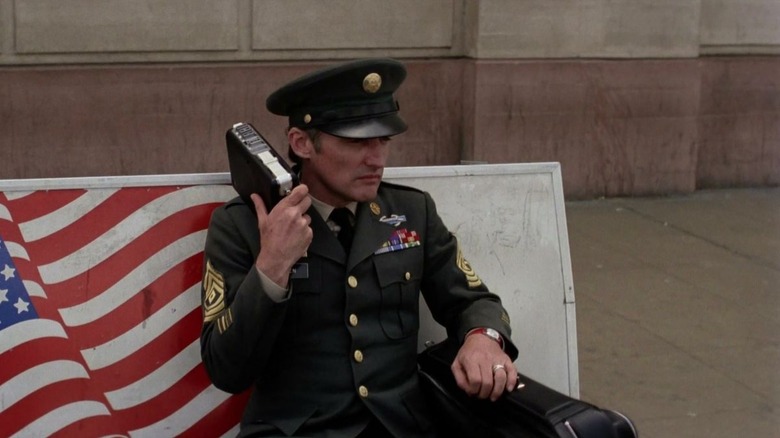
Beating them all to the punch, though, was "Tracks," starring Dennis Hopper. The story followed one Sergeant Jack Falen as he took a long train ride to a small California town with a fallen friend's body. He intends to oversee his friend's burial. On the long train ride, Falen begins having hallucinations, flashbacks, and extreme depression. Only a young college student named Stephanie (Taryn Power) can lift him out of his dark nights of the soul.
The film, despite its raw ambitions, wasn't super well-received and has only a 50% approval rating on Rotten Tomatoes (based on only eight reviews).
Tracks was an ambitious drama about the psychological damage of the Vietnam War
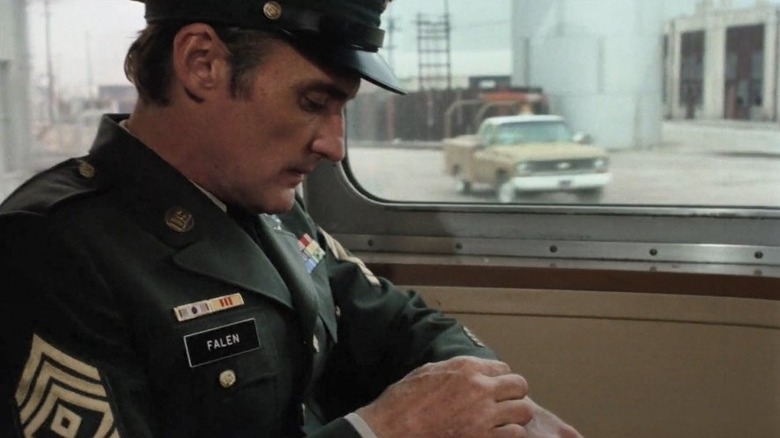
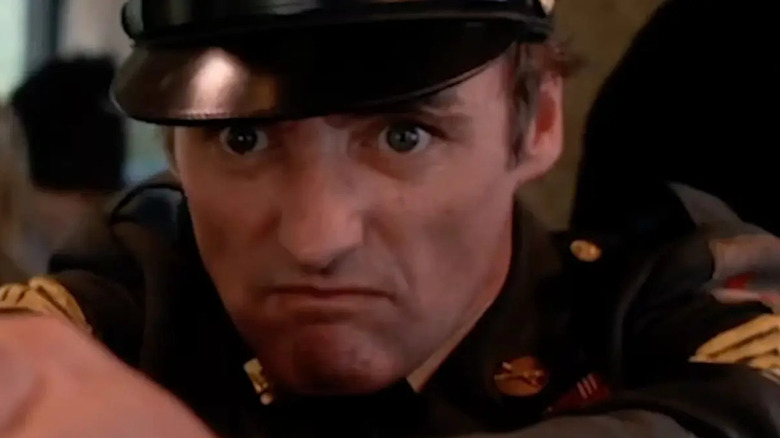
"Tracks" is essentially a portrait of a man falling apart. Dennis Hopper gets more and more unhinged as his train ride continues. Think of the fever dream of "Apocalypse Now," but instead of a boat ride into the heart of darkness, it's a low-budget train. According to Derek Winnert's website, the role of Falen was originally intended for Jack Nicholson. He also noted that Henry Jaglom felt that the whole movie might have been a hallucination, all experienced by Falen as he sat on a bus bench. Either way, reality seems to have been slipping away from the character. That's what Vietnam did to him.
Chris Petit, writing for Time Out, wrote that the film's hallucinatory nature made it incoherent. It was too arch for Petit, too abstract. "Perhaps Jaglom would be more incisive," he wrote, "if he tried less hard to make 'art.'" He did like Hopper's performance, though, writing that "Hopper's sweaty paranoia, a sustained and terminal piece of Method acting, keeps the film on the rails." Variety was kinder in its review, enjoying the hallucinatory elements. "Sometimes uneasy on its rails," the critic wrote, "[the] film has perceptive personages and works on the level of reality and hallucination as they interact to give a feel of the U.S." Gotta make those "rails" jokes.
Vincent Canby wrote in his review, quoted on Rotten Tomatoes, that the movie wasn't pointed enough in its protest, noting that it was running on vibes. "The movie has the stoned, improvised look of an artifact out of the 1960's," he wrote, "having less to do with considered opposition to the war than with a vague sort of dissatisfaction with everything, and no idea what to do about it."
Sight & Sound liked Tracks
"Tracks" is clearly an antiwar movie, made to protest America's misguided machinations in Vietnam, but if Canby's review was an indicator, it wasn't a clear-headed announcement of intent. It was more generally about how society is screwed, and the Vietnam War is just making everything worse, most importantly, the minds of our soldiers. See also: "Taxi Driver" from the same year.
The most extensive vintage review of "Tracks" came from Sight & Sound Magazine's Tom Milne. Milne noted that "Tracks" cleverly juxtaposes the dark damage of the Vietnam War with the bright-eyed propaganda of World War II, largely through its music selection. The corny soldier's songs of 30 years earlier no longer carry the same inspirational ring. Milne even wrote:
"What, exactly, was Vietnam for? No answer is forthcoming as [Falen] is met by varying degrees of embarrassment, indifference, hostility, and pity, and not for nothing is Henry Jaglom's film called 'Tracks.' As the train drives unswervingly on across America from West to East, the mystery and promise of its one-time pioneer landscapes are studiously ignored as the passengers bury their heads in preoccupations with private obsessions (chess problems, nutritional needs, land development, sexual urges), and as the despairing soldier is driven to try to jump these tracks and go off in reassuring search of his roots."
Milne writes that the whole of "Tracks" plays like an interplay between the dark violence of the present and the halcyon illusions of the past. The so-called glories of World War II are too simplistic to swallow in the modern day, if they ever existed in the first place.
"Tracks" was at least ambitious and prompted some critics to ponder it cerebrally. That's not nothing.