

How Steven Spielberg Got Clint Eastwood To Direct His 2006 War Movie With One Question
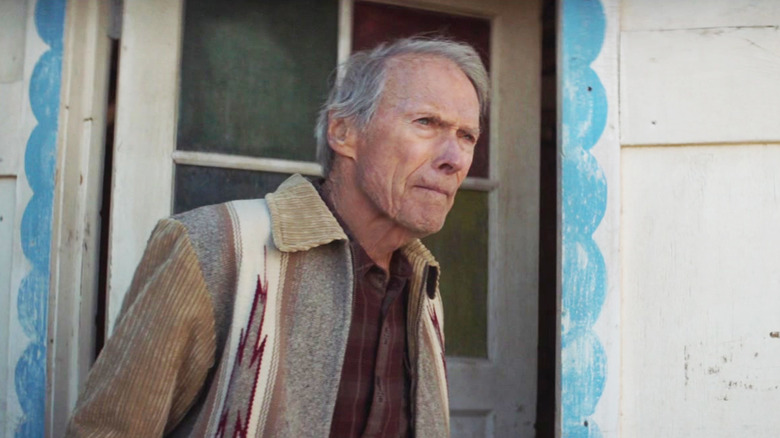
Clint Eastwood directed one of the most ambitious war movie projects ever when he oversaw the back-to-back production of "Flags of Our Fathers" and "Letters from Iwo Jima" in 2006. The idea was simple: chronicle the Battle of Iwo Jima from both the perspective of the United States forces and the Japanese soldiers. It resulted in two films that, while not the most commercially successful, earned widespread critical praise. In part, Eastwood has Steven Spielberg to thank for that. The "Jaws" director was a producer on "Flags" and wanted Eastwood to direct. How did he convince him? Simply by asking.
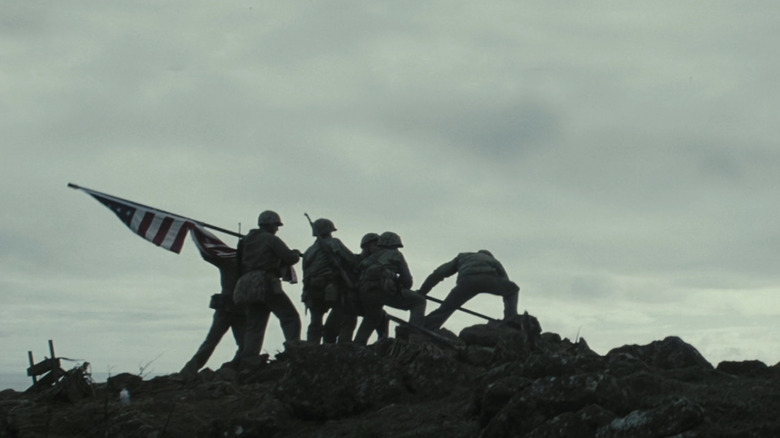
In February and March of 1945, Allied forces attacked the Imperial Japanese Army on the island of Iwo Jima. It was a savage battle that saw almost 7,000 U.S. Marines and 18,000 Japanese soldiers killed before the U.S. forces triumphed and raised their flag on the island. Joe Rosenthal photographed this historic moment in a shot titled "Raising the Flag on Iwo Jima." "Flags of Our Fathers" was essentially built around that very shot by way of an adaptation of the book "Flags of Our Fathers" by James Bradley and Ron Powers, whose fathers are depicted in the photo itself.
After his company, Dreamworks Pictures, bought the rights to book, Spielberg became attached as a producer. But he needed a director and thought Eastwood was perfect for the job. All he had to do was convince him to sign on. At the time, Eastwood had just delivered two of his most celebrated films — "Mystic River" in 2003 and "Million Dollar Baby" in 2004, the latter of which earned him Best Picture and Best Director Oscars. But would he be interested in a war movie? Well, as it turns out, yes, he was.
Clint Eastwood didn't need much convincing to direct Flags of Our Fathers
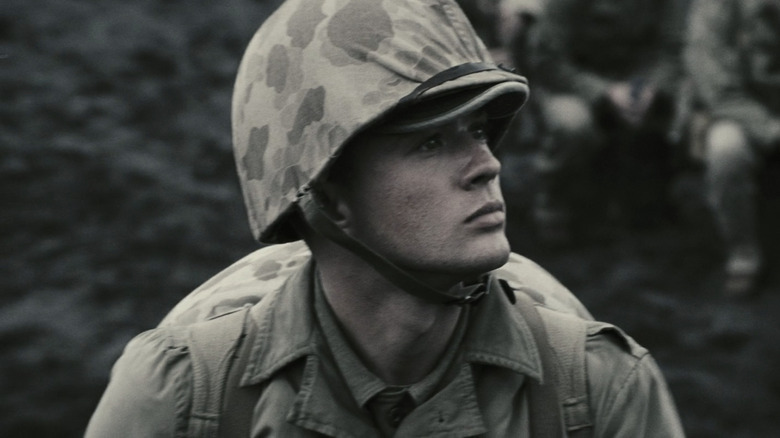
Today "Flags of Our Fathers" stands as one of the best war movies based on a true story. Clint Eastwood's film was unapologetically critical of war, even if it wasn't overtly anti-war, and critics loved it. It's a good thing he was able to direct the movie, then, seeing as it initially seemed as though the project had slipped through his fingers.
In a 2007 interview with The Observer's Philip French, Eastwood recalled how he read the book "Flags of Our Fathers" after it was published in 2000. He found it to be reminiscent of his 1995 romantic drama "The Bridges of Madison County" in that both revolved around people discovering stories from their parents' past. "Here was a true story of a guy who didn't know what his father did and the mystery is: Why didn't his father ever confide in him about the story?" explained Eastwood. "Then we find it was the experience of war and the guilt of false heroism and all kinds of stuff that made him somewhat of a recluse."
Eastwood was hooked. The only problem was, Steven Spielberg already had the rights. "I tried to buy the book," he said. "But it had already been bought by DreamWorks, so I thought Steven Spielberg had some plans for this property." Two years later, Eastwood was at an event also attended by Spielberg. "Steven came up to me and said, 'Have you ever read 'Flags of Our Fathers?” he remembered. "I told him I'd always liked the book, and he said, 'Would you consider coming over to our company to take it over and direct it? I said, 'Okay.' The conversation was just that long. We shook hands, and that was it."
Clint Eastwood and Steven Spielberg go way back
Interestingly enough, "The Bridges of Madison County" also started life as a Steven Spielberg project. The famed director's Amblin Entertainment bought the rights to Robert James Waller's 1992 novel with Spielberg intending to direct. That's when Clint Eastwood was cast in the lead. As Spielberg told Entertainment Weekly in 1995, "I've been friends with Clint since the 'Play Misty for Me' [Eastwood's directorial debut] days in the early '70s [...] He was always my first choice." Clearly, then, Spielberg and Eastwood had a friendly relationship. As the project developed, Spielberg dropped out as director, leaving room for his star to step up and take the reins.
All of which is to say that when it came time to ask Eastwood to direct "Flags of our Fathers," it wasn't as if Spielberg had come out of nowhere. There were several decades worth of friendship working in his favor, which almost certainly contributed to Eastwood's quick decision to accept — that and the fact he loved the original book. Had another filmmaker acquired the rights, however, Eastwood may well have hesitated despite his fascination with James Bradley and Ron Powers' story.
Ultimately, "Flags of Our Father" made $65.9 million in theaters globally, which wasn't bad except the film cost $90 million to make. Still, "Flags" was very well received by critics, who praised Eastwood for his mature take on the material. The idea that guided Eastwood while filming "Flags of Our Fathers" was fairly simple in that he embraced what he termed the real-life soldiers' lack of "gung-ho-ness." Using that to inform his take on the subject matter ultimately resulted in one of Clint Eastwood's best war movies, which surely made Spielberg proud of his old friend.