

Cameron Diaz's '90s Fantasy Movie With Ewan McGregor Has An Unbelievable Premise
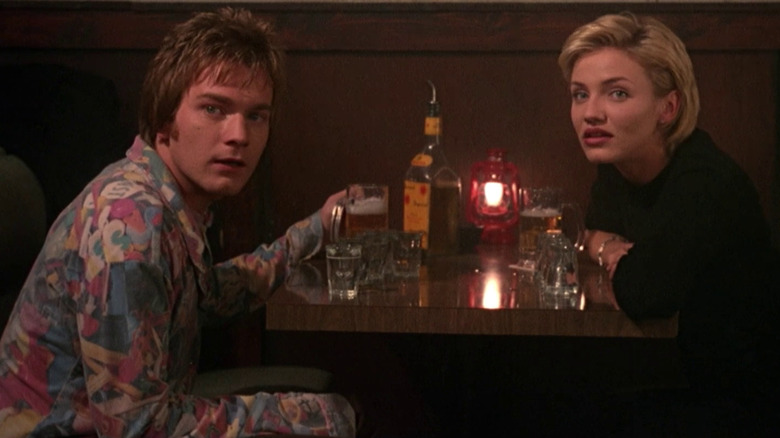
Danny Boyle's 1997 film "A Life Less Ordinary" was seen by some as his move toward the mainstream. Boyle caused a stir in 1994 with his dark comedy "Shallow Grave," a movie about a trio of roommates who unwisely rob their dead lodger. In 1996, however, he exploded onto the indie scene with his slice of Euro-MTV car-crash anarchy, "Trainspotting," a film about heroin addicts and their quest not to live a boring life. The former film was assured, but small-scale. The latter was sprawling, filthy, and refreshingly chaotic.
"A Life Less Ordinary," in contrast, is polished and slick and assertively quirky. Like his previous two movies, it starred Ewan McGregor, but he was joined by a spate of recognizable movie stars and prolific character actors, including Cameron Diaz, Holly Hunter, Delroy Lindo, Ian Holm, Stanley Tucci, Maury Chaykin, Tony Shalhoub, and Dan Hedaya. This was Boyle's "big break."
The A-plot of "A Life Less Ordinary" is ordinary. McGregor plays Robert, a janitor who is incensed that a cleaning robot has just taken his job. He works for an arrogant millionaire (Holm), who has a pretty daughter named Celine (Diaz). Celine is engaged to a man she hates (Tucci). Robert, in a mad kerfuffle at the office, will end up kidnapping Celine, kind of on a whim. While on the lam together, the pair begin to fall in love. This was a similar plot to a film from around the same time called "Excess Baggage."
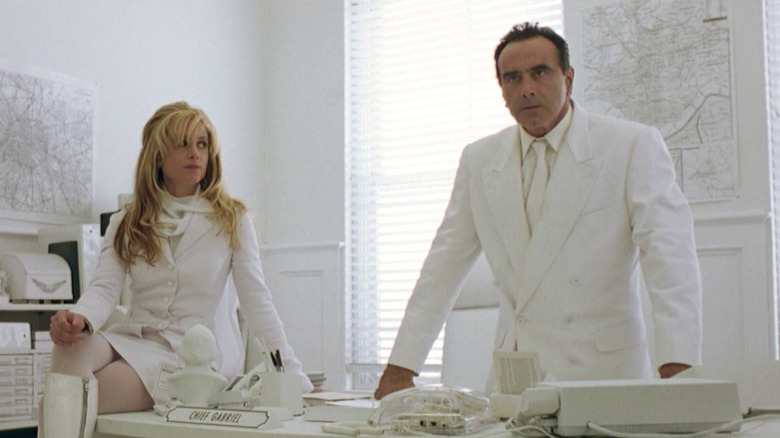
The B-plot of "A Life Less Ordinary," however, is less ordinary. It seems that the Almighty Himself is manipulating the two young lovers, and Lindo and Hunter play heavenly angels who are moonlighting as bounty hunters. Hedaya plays the archangel Gabriel.
A Life Less Ordinary is a kidnapping romance with angels
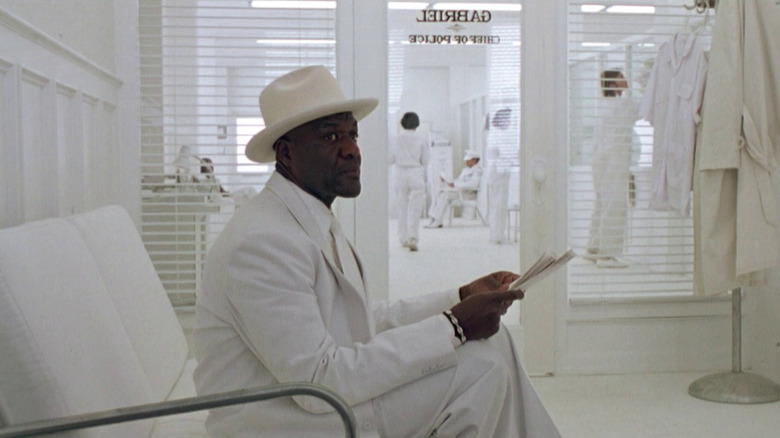
The angels angle is very, very weird. The idea behind it is sound: the Good Lord God interferes in human affairs to ensure love persists. But Danny Boyle and screenwriter John Hodge's visualization of the angles is a little off-center. The archangel Gabriel works in an ordinary police office and has a sign on his door reading that he's the chief of police. The Holly Hunter and Delroy Lindo characters, named O'Reilly and Jackson, are on the outs because all their recent attempts to ignite love on Earth have failed, and they need to crack a "big case" in order to get back into God's good graces. The romance between Robert and Celine, they feel, should do the trick. If they fail, they'll become fallen angels and have to stay on Earth indefinitely.
On Earth, as mentioned, they take the form of bounty hunters, and interact with the human characters as if they were ordinary movers of the plot. This angelic interference in a crime story may reflect a movie trope of the era; in films like "True Romance" and "Natural Born Killers," the criminals commit increasingly heinous crimes, but their love is still so pure, they seem to get away with everything, and are almost aided by divine providence. Both "Romance" and "Killers," it should be noted, were written by the same person, Quentin Tarantino, so Boyle might have been lightly jabbing at one of his contemporaries.
Boyle lays on the style pretty thick, adding a few additional cartoonish conceits. We see inside the chest of one of the characters, for instance, and their heart is a large, glowing, heart-shaped lantern. At the end of the movie, an errant bullet makes its way through that heart.
Critics weren't fond of A Life Less Ordinary, but the soundtrack rocked
Like so many movies from the 1990s, "A Life Less Ordinary" had a banging soundtrack. It boasted tracks from Beck, R.E.M., Luscious Jackson, Sneaker Pimps, and The Prodigy, but also lighter tracks by Elvis Presley, Bobby Darin, and, most excitingly, Squirrel Nut Zippers. The '90s were a time when a movie could lose money at the box office, but more than recoup its losses from a hit soundtrack CD.
"A Life Less Ordinary" did indeed stumble at the box office, making $14.6 million on a $12 million budget. Critics also weren't fond of it, finding its quirkiness and silly story conceits to be a little too much to bear. Roger Ebert gave the film two stars (out of four), writing that "The film expends enormous energy to tell a story that is tedious and contrived." Despite the angels and weirdo style, Ebert noted that "it's a conventional movie that never convinces us that it needed to be made." He also, throughout his review, seemed to be baffled by the roles the angels were supposed to be playing in all this.
Owen Gleiberman, writing for EW, loathed the movie, giving it an F. He opened his review writing that "We've all seen movies that go off the rails. Occasionally, though, a film is so out of balance, so extravagantly misconceived, that it goes off the rails, zooms over the cliff, and crashes into the canyon, laughing all the way." He felt the film's style was contrived, and that the two leads were annoying, with McGregor being too much of a puppy dog, and Diaz being too much of a brat.
Boyle's next film, "The Beach," was a massive success. Although it ruined Boyle's and McGregor's friendship.