

Ewan McGregor's Big Break Came In This Rarely Discussed '90s Mystery Thriller
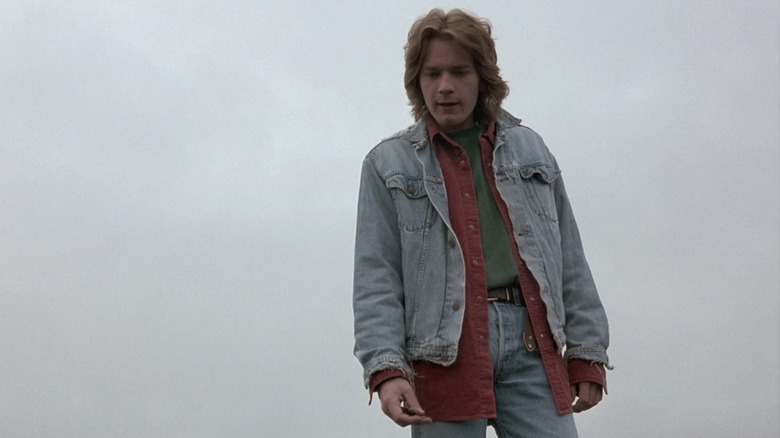
In the 1990s, if the Hollywood scene wasn't your bag, an aspiring cineaste could indulge in a marvelous and remarkable influx of independent movies and international imports. A new generation of voices, from Spike Lee to Steven Soderbergh and a host of others, infiltrated arthouses. Many daring, low-budget, genre-bending movies took root. In 1994, for example, a young British upstart named Danny Boyle also threw his hat into the ring with the release of "Shallow Grave," a $2.5 million film that earned $19.8 million at the box office. "Shallow Grave" starred a trio of then-unknown actors, including Ewan McGregor, Christopher Eccleston, and Kerry Fox.
"Shallow Grave" was Ewan McGregor's big cinematic break. It debuted at Cannes on May 16, which was only ten days after the release of his very first credited movie, the Robin Williams vehicle "Being Human." Prior to that, McGregor only had a few TV credits, including the show "Lipstick on Your Collar" and the miniseries "Scarlet and Black," based on the Stendhal novel. He was only in his early 20s at the time. Working with Danny Boyle on "Shallow Grave" began a working relationship between actor and director that would extend to several movies. "Trainspotting" was released in 1996, cementing McGregor's status as a worldwide star. We consider "Trainspotting" to be Boyle's best movie.
"Shallow Grave," meanwhile, was about three impish roommates in Edinburgh, all of them silly smart alecks, who lease an empty room in their flat to a newcomer. The newcomer is swiftly found dead in their apartment ... leaving behind a huge pile of cash. The three lead characters unwisely decide to dispose of the body and keep the money for themselves, inspiring a growing sense of panic and moral decay for the rest of the movie.
Shallow Grave is a taut, intense film, well-remembered by '90s teens
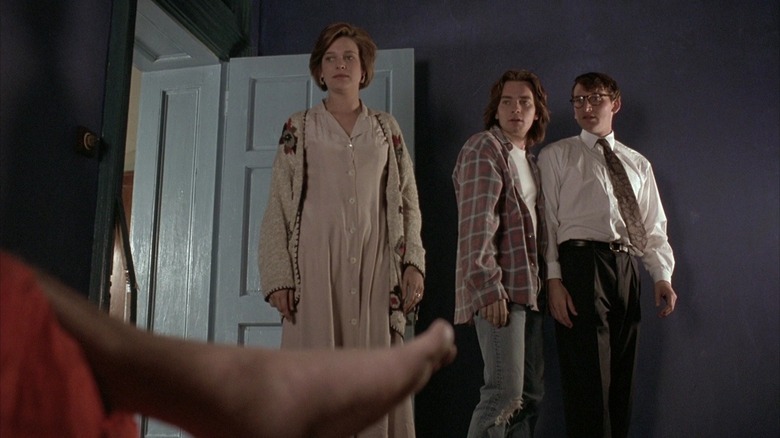
"Shallow Grave" was highly acclaimed in 1994, and was well-known to explorers of art houses everywhere. The hipper college students of the day had "Shallow Grave" in their VHS collection in their dorm rooms. Perhaps many college students saw themselves reflected darkly in the hearts of the lead characters, as they seemed playful, sarcastic, and even a little unintentionally (or intentionally) cruel.
The film's opening involved Juliet (Kerry Fox), Alex (Ewan McGregor), and David (Christopher Eccleston) interviewing new potential flatmates, and they have turned the process into a catalyst for their own whimsical whims. They mock the applicants, and giggle at their expense. Audiences like their sense of humor, but Danny Boyle is careful to leave in a sense of cruelty. These aren't the best people. David, an accountant, is the shyest of the lot, but seems to be dragged into his flatmates' sardonic energy. They finally take in Hugo (Keith Allen), a quiet writer. Hugo, however, dies of a drug overdose almost right away, with a suitcase of money under his bed.
If movies have taught us anything, though, it's that keeping mysterious suitcases full of cash is a terrible idea. Juliet, Alex, and David, however, clearly haven't seen enough movies, and decide to dispose of Hugo's body and keep the cash. David is tasked with cutting up Hugo's body, and Juliet with stuffing it into the incinerator. The act of chopping up a dead human does a great deal of damage to David's psyche. David succumbs to paranoia, moves into the attic, and begins to suspect his flatmates of wanting to rat him out. Juliet and Alex try to enjoy their ill-gotten wealth, but seem unable.
Things get worse from there.
Shallow Grave pushed the limits of casual violence
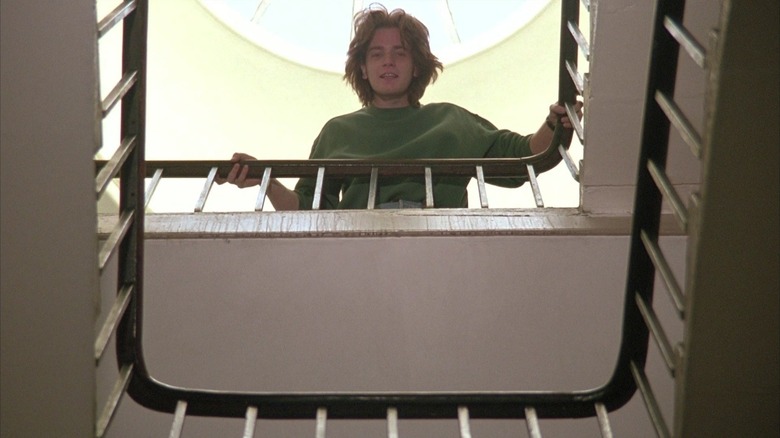
Eventually, an additional crime plot is revealed, and more bodies begin to accumulate. At least one of the main characters will betray at least one of the others. Blood attracts blood, it seems. "Shallow Grave" ends on a very bleak note.
1994 was a banner year for violence, as it was also the year Quentin Tarantino's "Pulp Fiction" was released. In both film, a standard thriller's blood quotient was upped, as their respective directors likely sought to push the envelope. Some critics didn't like the moral emptiness of "Shallow Grave," with Roger Ebert writing in his review that no one in the audience could possibly identify with the three lead characters. "One of the problems, I think," Ebert wrote, "is that all three conspirators are so unpleasant. Not evil — that would be fine in material like this — but simply obnoxious in a boring way." Ebert ultimately only gave the film two stars out of four.
But many others enjoyed it, and it was watched widely by a very specific group of Gen-Xers (a group I happen to belong to). We here at /Film called it one of Ewan McGregor's best movies. It certainly kept Danny Boyle on critics' radars. When Boyle returned in 1996 with his film adaptation of Irvine Welsh's "Trainspotting," his estimation as an important filmmaker was cemented. That was another film that earned huge numbers at the box office, worked with a small budget, and pushed the boundaries of what kind of sex, drugs, and violence could be depicted on film.
Ewan McGregor, it should be noted, appeared in "Trainspotting" as well, playing the lead character, as well as in 1997's "A Life Less Ordinary." Boyle and McGregor also worked together for the sequel, "T2: Trainspotting."