

Sean Connery Almost Starred In One Of 1980's Most Controversial Thrillers
We may receive a commission on purchases made from links.
Filmmaker Brian De Palma specializes in lurid thrillers, like his 1980 serial killer mystery flick, "Dressed to Kill." De Palma is a famous student of Alfred Hitchcock (even if he contests that). "Dressed to Kill" is half "Vertigo," half "Psycho," and especially mimics the latter movie's shocking two twists.
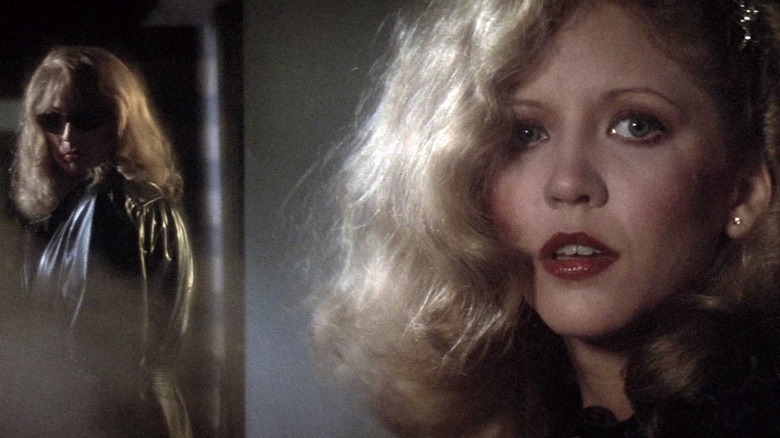
Housewife Kate Miller (Angie Dickinson) is set up as the lead early in the movie, only to be killed by a knife wielding murderer, à la Marion Crane (Janet Leigh). The killer? Dr. Robert Elliott (Sir Michael Caine), a transgender woman at war with herself psychologically. But Caine was not the only actor De Palma considered for the movie's twist villain.
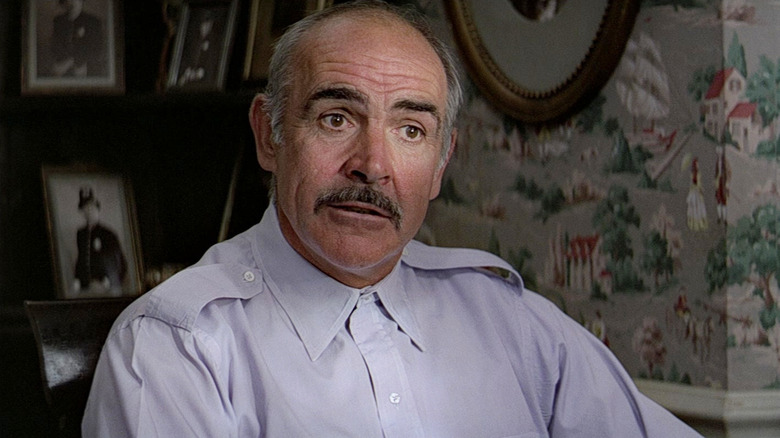
According to "Casting Might-Have-Beens" by journalist Eila Mell, the original choice was none other than Sean Connery. (Dickinson was also a second choice after Liv Ullman declined her part.) Yes, the original James Bond, one of the cinematic icons of stiff upper lip and heterosexually dominant masculinity, would have portrayed a transgender woman. It's hard to imagine De Palma was not being cheeky in wanting to cast Connery, but per Mell, the actor was already committed to another movie, so he had to decline.
It's not mentioned what the other project was, but in 1981, Connery starred in both the sci-fi film "Outland" and Terry Gilliam's "Time Bandits" (where Connery helped out in more ways besides acting). Connery or no, "Dressed to Kill" hasn't escaped being critiqued as a reactionary — some might say misogynistic — film in the same way the James Bond franchise hasn't. In its day, "Dressed to Kill" was criticized by feminists for supposedly exploiting violence against women. Now, when transgender people are less stigmatized than in 1980, "Dressed to Kill" also looks like a transphobic fantasy from a less tolerant era.
The transphobic legacy of Dressed To Kill, explained
"Dressed to Kill" doesn't stand alone. "Psycho," of course, has a similar gender-related twist, and one can also compare it to the later 1991 film "The Silence of the Lambs," in which the serial killer Jame "Buffalo Bill" Gumb (Ted Levine) murders women to make himself a female presenting skin suit. But "Dressed to Kill" looks the worst to a modern eye.
Take the laborious exposition scene at the end of "Psycho," where a psychiatrist (Sam Oakland) explains the killer Norman Bates' (Anthony Perkins) history and affliction in detail. The psychiatrist explicitly says Norman is not a "transvestite," explaining that he dressed in women's clothing only "to keep alive the illusion of his mother being alive."
"Silence of the Lambs" remains controversial and criticized among the transgender community, but it splits hairs in a similar way. The movie argues that Buffalo Bill is not really transgender (which is why he's been declined for gender-affirming surgery), he's only mentally ill — and those conditions are not the same thing. "Silence" director Jonathan Demme invoked this reading in a 2014 interview with the Huffington Post, but he expressed support for the trans community in that same interview.
"Dressed to Kill" makes no such distinction, instead explicitly linking Elliott's transness and her inner conflict over it to her impulse to kill. Even the title links transness and violence; Elliott is dressing like a woman to kill others.
Brian De Palma, to his credit, understands why transgender people might have a problem with "Dressed to Kill." Speaking to Entertainment Weekly in 2016, he stated, "Obviously I realize that it's not good for their image to be transgender and also be a psychopathic murderer. But I think that [perception] passes with time. We're in a different time."