

The First Movie With A Post-Credits Scene Was This '60s James Bond Spoof
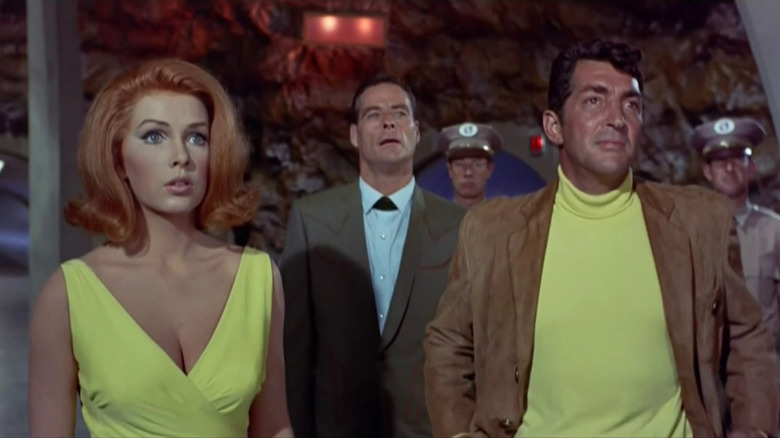
From 1960 to 1993, author Donald Hamilton published many books for the widely beloved Matt Helm thriller series. Matt Helm, for those unfamiliar, is a rough-hewn American super-agent who's usually tasked with tracking down and murdering enemy agents. He's not so much a spy like James Bond but a government-hired assassin. He's also bitter and cynical in demeanor, with the Matt Helm novels frequently referencing the adventures that came before. This was a departure from other literary spy properties at the time, most notably the James Bond books.
Bond, of course, made the jump to the big screen with 1962's box office hit "Dr. No" starring Sean Connery as Agent 007. That film wasn't just a success, though; it rattled the entire zeitgeist. More so, it invented what everyone now thinks of as the modern spy, i.e. racy, globe-trotting daredevils who drive expensive cars, have nifty gadgets, kill evil-doers, and bed sexy people. Bond himself, meanwhile, became a recognized archetype so quickly that parodies were inevitable.
Indeed, it didn't take long for comedic Bond riffs to show up, most of them mocking the character's cartoonishly overwhelming sexual prowess. Sure enough, one of the more notable Bond spoofs of the era was a comedic, tongue-in-cheek 1966 Matt Helm film adaptation titled "The Silencers." In the movie, Dean Martin plays Matt Helm not as a taciturn assassin but a campy, drunken partyboy surrounded by gorgeous women, as portrayed by Stella Stevens, Cyd Charisse, and Daliah Lavi. It's a silly, silly movie that has little to do with Hamilton's original books.
So, why is it historically significant then? Well, as it happens, "The Silencers" is the very first major movie to feature a notable post-credits "stinger" promising the definite return of the character in an upcoming sequel.
The Silencers was the first movie to feature a post-credits sequel tease
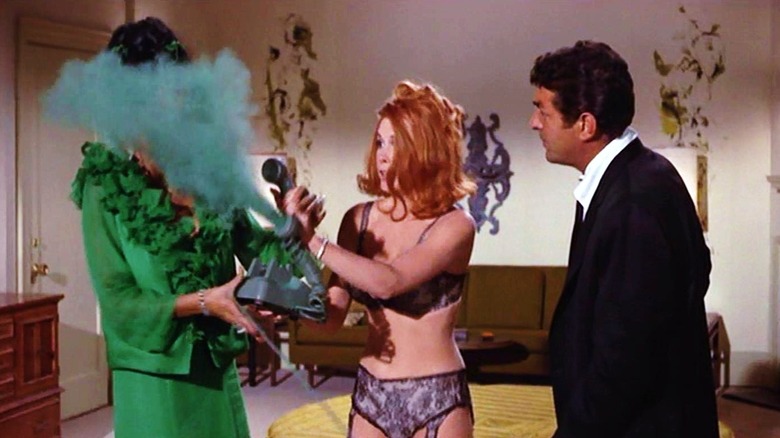
In "The Silencers," Matt Helm is presented as a retired secret agent who has moved onto being a photographer for beautiful models. His assistant/girlfriend is the flirty Lovey Kravezit (Beverly Adams), and he is content. Naturally, he's then convinced to rejoin his old spy agency to stop the twisted Chinese criminal Tung-Tze (played by the not-Chinese actor Victor Buono) from exploding a bomb and starting a nuclear war. Tung-Tze works for a malicious organization called BIG O. Wink, wink, nudge, nudge.
With a film as fluffy and silly as "The Silencers," it's not much of a spoiler to say that Matt Helm stops the bad guy and saves the day. Moreover, this was the first of four Matt Helm movies made from 1966-1969. "The Silencers" hit theaters in February 1966, with its follow-up, "Murderers' Row," arriving the following December.
"Murderers' Row" was also teased at the end of "The Silencers." One can find it easily enough online, but "The Silencers" features a cute, 30-second scene that comes up after the film's credits. It depicts Matt Helm shirtless on a large, round, rotating bed, surrounded by gorgeous models in lingerie. Groovy music plays on the soundtrack, and a caption reads: "Coming up next, Matt Helm Meet Lovey Kravezit In 'Murderers' Row.'" Matt then kisses the woman to his right, then the one to his left, before exclaiming (in arousal), "Oh my god." The promise is a little odd, though, as Matt has already met Lovey Kravezit prior to that.
"The Silencers" is, in fact, listed earliest on the website What's After the Credits, leading many to accept that it was the very first movie to have a post-credits scene. But there's more to discuss on that front.
Credits weren't always at the end of movies
Of course, the idea of "end credits" was something of a novelty when "The Silencers" came out. Before the 1960s, movies typically opened with all their pertinent credits and ended with a simple "The End." Some movies (like James Whale's 1931 film "Frankenstein") noted that a good cast bears repeating and would add some credits at the end. Disney's "Fantasia" similarly moved its credits to the end. But most movies had them right up front.
As Acting Magazine observed in 2025, changing trends in filmmaking aesthetics led to credits being treated as the punctuation to a movie rather than the prologue. The website even quotes Jean-Luc Godard as having argued that end credits are more artistically satisfying; as he put it, "We wanted to enter the film world the same way we enter a room — with curiosity, not credentials." More pointedly, however, the shift likely had a lot to do with the crumbling of the studio system at the end of the 1940s (thanks largely to the Paramount Decrees) and the "freelance" nature of actors' and crewmembers' jobs in the decade that followed, as they had previously been employed under long-term studio contracts. In such a landscape, surely contracts were being negotiated and credits were being added.
By 1966, more and more movies were featuring credits at the end, serving as a way to slowly shut the book on the film. As such, a post-credits "stinger" was now possible. Fast-forward to modern times, and post-credits scenes have become the bread and butter of the Marvel Cinematic Universe, among other franchises. For that matter, we here at /Film regularly report if movies have post-credits scenes. We likely all have Matt Helm to thank for that.