

The Handmaid's Tale Author Margaret Atwood Once Made A Bold Claim About Star Trek's Sci-Fi Status
We may receive a commission on purchases made from links.
A big part of the age-old "Star Trek" vs. "Star Wars" debate is a matter of genre. The "Star Trek" franchise centers on people living in a future when humanity has developed super-advanced miracle technologies like faster-than-light travel and food replicators. Although these technologies are far from us living in the 21st Century, they seem plausible and not merely speculative. Importantly, the creatives behind "Star Trek" have long been careful to use real-world scientific language to describe its tech, making it seem more scientifically plausible.
"Star Wars," meanwhile, features non-humans and spaceships, but it's more sci-fi fantasy than pure sci-fi. For example, there's less attention paid to the functionality of the spaceships and more to their narrative function. Moreover, it basically features psychic warlocks and brave wizards dueling with glowing swords and using spells on one another, albeit with sci-fi explanations for all of these things. (See: "Star Wars" creator George Lucas' controversial introduction of midi-chlorians.) "Star Wars" also takes place in the distant past far away from Earth, so its leads technically aren't actually humans. Its world-building may be sci-fi, but its story is essentially fantasy.
The line between sci-fi and fantasy has always been considered thin — the two genres are typically filed together in bookstores — and analyzing the differences between them can result in exciting debates about genre theory. Indeed, Margaret Atwood, the author of the classic dystopian novel "The Handmaid's Tale," once went on record about this very subject as it relates to "Star Trek" and "Star Wars." In her 2011 essay book "In Other Worlds: SF and the Human Imagination," Atwood argued that both properties should be considered fantasy. As she noted, even the speculative sci-fi elements of "Star Trek" are still based around things that couldn't happen in reality.
Margaret Atwood felt Star Trek is more fantasy than sci-fi
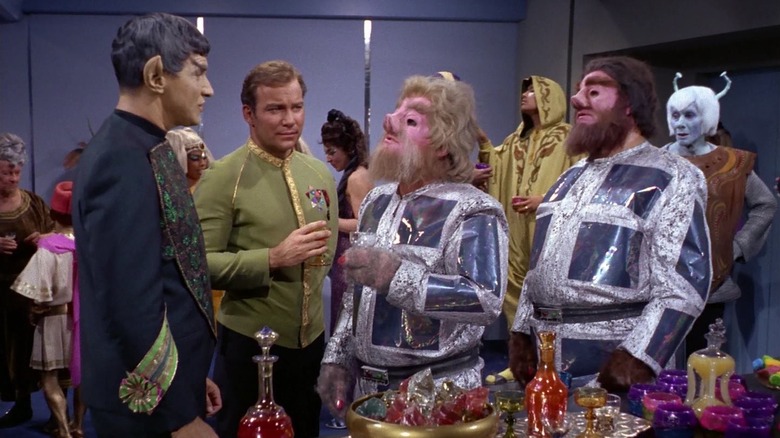
It's possible Margaret Atwood feels "Star Trek" is unrealistic because of its conceits about non-Earthlings. In the franchise, as we all know, humans have explored the heavens and encountered all manner of sentient extraterrestrial species. These aliens, however, tend to look and operate a lot like humans, and while they possess different cultural backgrounds, they're generally very human in their customs. After meeting these non-Earthlings, humanity similarly entered a U.N.-like peace pact with most of them.
Faster-than-light travel may be possible someday, but the nature of extraterrestrial life remains theoretical. In an essay from "In Other Worlds," Atwood recalled a conversation she had with author Ursula K. Le Guin in 2010 about genre, and that discussion led Atwood to consider that "Star Trek" might be more fantasy than sci-fi. Le Guin, who died in 2018, was most famous for her Earthsea fantasy novels (which were once adapted to film by Studio Ghibli) and tended to write medieval tales of magic. However, she also penned the Hainish Cycle, a notable sci-fi book series about a space confederacy and speculative societies involving humans living on distant planets. Le Guin, then, gave a lot of thought to genre theory.
Atwood recalled her conversation with Le Guin, and found her definitions of sci-fi and fantasy to be plausible:
"In a public discussion with Ursula Le Guin in the fall of 2010, however, I found that what she means by 'science fiction' is speculative fiction about things that really could happen, whereas things that really could not happen she classifies under 'fantasy.' Thus, for her — as for me — dragons would belong in fantasy, as would, I suppose, the film 'Star Wars' and most of the TV series 'Star Trek.'"
That seems pretty clean.
Margaret Atwood and Ursula K. Le Guin had slightly different definitions of sci-fi and fantasy
So, the issue, for Margaret Atwood, is one of plausibility. However, she noted that historical context is important in such definitions; she's looked to past sci-fi classics and noted that their limited view of technology at the time made them seem more plausible to their authors than they might to a modern audience. But where Ursula K. Le Guin appeared more open with what she considered sci-fi, Atwood is a little more strict:
"Mary Shelley's 'Frankenstein' might squeeze into Le Guin's 'science fiction' because its author had grounds for believing that electricity actually might be able to reanimate dead flesh. And 'The War of the Worlds?' Since people thought at the time that intelligent beings might live on Mars, and since space travel was believed to be possible in the imaginable future, this book might have to be filed under Le Guin's 'science fiction.' [...] In short, what Le Guin means by 'science fiction' is what I mean by 'speculative fiction,' and what she means by 'fantasy' would include some of what I mean by 'science fiction.' So, that clears it all up, more or less."
Mind you, Atwood wrote those words in 2011. Most Trekkies will happily categorize the "Star Trek" franchise as sci-fi and not fantasy, but even the stanchest of Trekkies would have to agree that Gene Roddenberry's original "Star Trek" series is, overall, a subset of utopian fiction. Utopian literature is, of course, a subgenre of fantasy wherein the author envisions a place or time when everything is better. In other words, "Star Trek" is a wish-fulfillment fantasy about a brighter future. So, it's fair to say that it's at least part fantasy.