

Star Trek: The Original Series' Chain Of Command, Explained
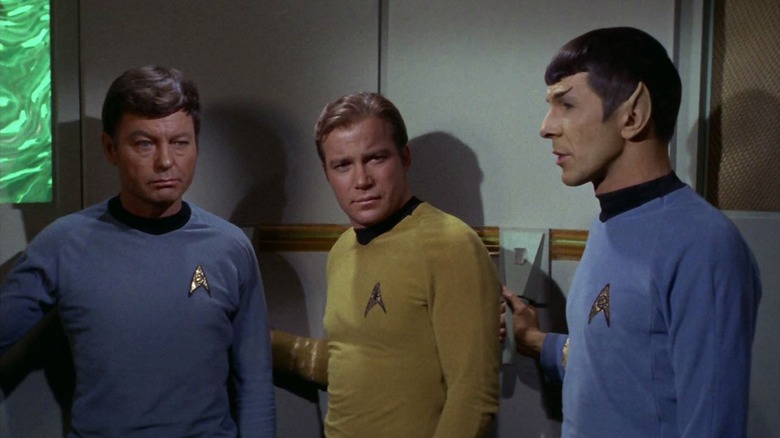
As all Trekkies can tell you, Captain Kirk (William Shatner), the captain of the USS Enterprise, would regularly — and unwisely — go on away missions. The captain of the Federation flagship could, on a whim, beam down to dangerous, unknown worlds where he could easily be killed by salt vampires, rock monsters, and God knows what else. What's more, Kirk often brought his chief medical officer, Dr. McCoy (DeForest Kelley), and his first officer, Spock (Leonard Nimoy). It's a well-worn, incredulous joke among Trekkies that a large portion of the Enterprise's senior staff would so often leave the ship behind to check out, say, the poison dart flower planet.
When Kirk and Spock were off the ship, the Enterprise was often put in the command of Scotty (James Doohan), the chief engineer. One might wonder if Scotty wanted Kirk and Spock to run into a mishap on an away mission to receive a sudden career bump.
Which then leads one to wonder what the actual chain of command was on "Star Trek." We all know Kirk was the captain, and Spock was his first officer, and Scotty was his second officer. But Starfleet is a militarily structured space navy, and would no doubt have a long line of succession extending down through the ranks, listing each officer that would become captain, should the previous one die in a horrible accident.
There are a few things we can infer from the positions in which certain Enterprise bridge officers worked, and some fans have published their theories on the matter. The theories, however, don't always fall in line with real-life naval command systems, which "Star Trek" is extrapolated from. This article, then, will be a delve into the ranks and positions on a starship combined with real-world juxtapositions.
Rank determines who takes command in an emergency
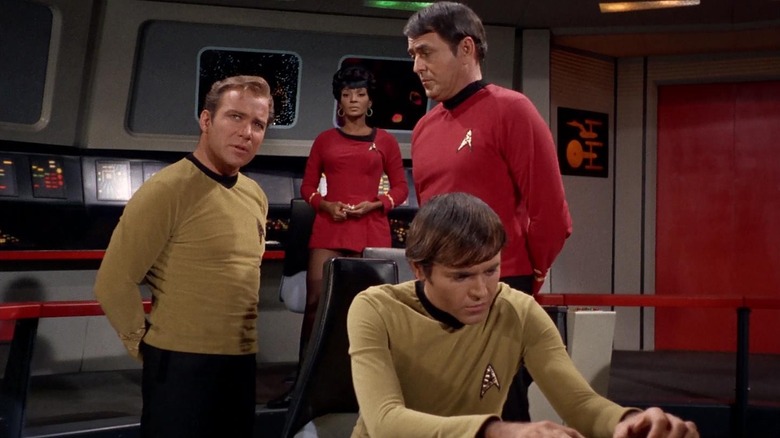
On the Sci-Fi & Fantasy website, a fan posited that the line of succession changes depending on who is working on the bridge at any given time. For instance, if Captain Kirk is injured or incapacitated while he's on the bridge, the line of succession would be dictated by rank, and if the officer in question is a line officer; that is: an officer who is deemed eligible for command. Because Spock is the second highest-ranked officer on the bridge, he would take command should Kirk be absent.
The second officer, as we know, is Scotty. Although because he is the main engineer on the USS Enterprise, he is often in engineering. If he wasn't on the bridge in an emergency, command would shift to the next line officer in a golden tunic (that is, officers who are on a command-based career track). That means Sulu (George Takei) would take command. Beyond that, it would go to any bridge line officer on the bridge, descending by rank. Below Sulu, for instance, would be Ensign Chekov (Walter Koenig, who knew "Star Trek" was doomed early on), who, while only an ensign, seems to be a member of the ship's senior line staff.
If Kirk, Spock, and Sulu were all unable to perform their duties, Chekov would have his time to shine. Uhura (Nichelle Nichols) would not be allowed to take command, as she is an operations officer (in a red uniform), and only line officers in gold uniforms would next be eligible. Yes, Scotty wore a red uniform too, but his position as chief engineer is more uniform-appropriate than his position as a line officer.
But what is the actual line of succession in Star Trek?
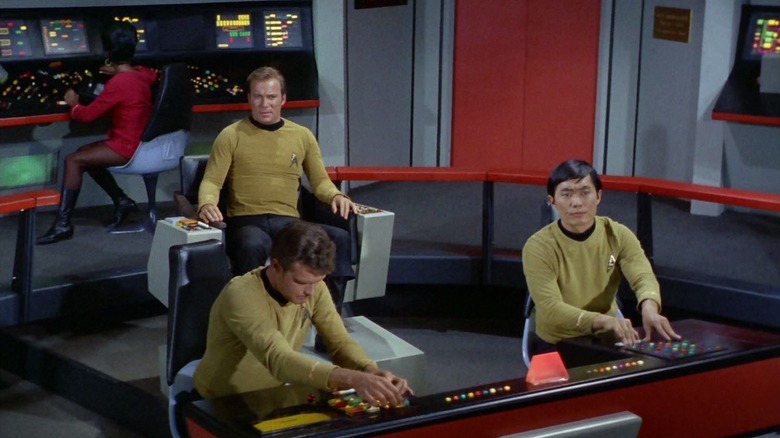
Also, by naval standards, the person in command needs to be on the bridge, and are not allowed to command from elsewhere on the ship. Only the captain and first officer are allowed to do that. If there are no line officers on the bridge during an emergency, an enlisted officer (like a chief or a security guy) would take command temporarily until a ranked officer shows up.
In a 1996 interview with Cinefantastique Magazine, Nichelle Nichols pointed out that Uhura was fourth in command after Scotty. This played out in the episode of "Star Trek: The Animated Series" (the second-best "Star Trek" animated series) called "The Lorelei Signal," wherein all of the men on the Enterprise had been incapacitated, and Uhura became the commander. It was the only time in "Star Trek" history that her character was expressly in charge of the ship. Uhura's line position may be true in the world of "Star Trek," but it stands in contrast to modern naval practices.
Of course, even that chain of command goes out the window if the captain expressly assigns someone else to be in command while they're away. If Kirk turns to, say, Ensign Ramirez and says, "You are to take command while I go on this mission to Death World," then Ensign Ramirez will captain the Enterprise, even if Spock is also on the bridge. Spock might question why Kirk is ignoring the ordinary chain of command — it would be an unusual order — but if Kirk explains himself well enough, then Spock will have to follow Ensign Ramirez's orders until Kirk returns.
So the chain of command is clear, but it's not set in stone. It all seems to be based on which officer is the most trusted, the highest ranked, and also where they fall in the official chain.