

This '70s Western Starring Charles Bronson And A Samurai Movie Legend Deserves More Fans
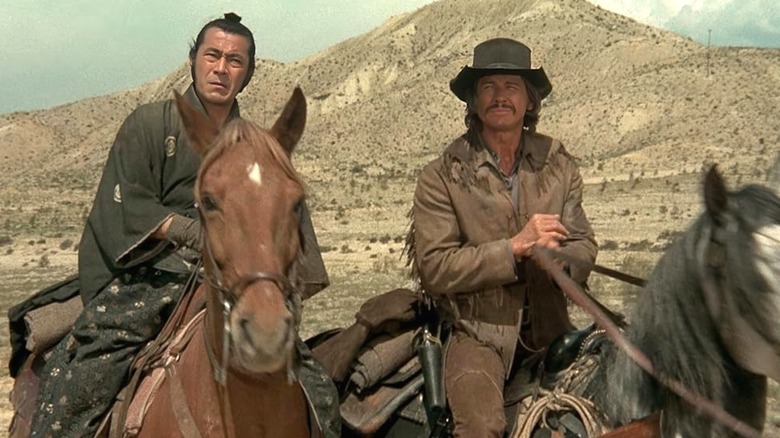
If you think about iconic actor-director collaborations, Toshiro Mifune and Akira Kurosawa immediately come to mind. This inseparable duo made 16 movies together, including influential titles like "Rashomon," "Throne of Blood," and "Seven Samurai." It is no secret that Kurosawa's samurai cinema (which mostly featured the talented Mifune) helped shape '60s Westerns, with literal and thematic parallels being drawn between the lone samurai and cowboy. In fact, John Sturges' "The Magnificent Seven" draws liberally from "Seven Samurai" to create its own exciting epic, boasting an ensemble cast that includes Charles Bronson.
So, why haven't most folks heard about Terence Young's 1971 Spaghetti Western, "Red Sun," which features both Bronson and Mifune? Well, one obvious reason could be the fact that 1971 birthed certified classics like "The French Connection" and "A Clockwork Orange," which might've overshadowed this humble title. Also, the critically acclaimed "McCabe & Mrs. Miller" was released in the same month as "Red Sun," (deservedly) hogging the limelight with its clever subversion of genre conventions. "Red Sun," however, was a box office hit in Japan, thanks to Mifune's star power and Bronson's enduring popularity as a gritty action hero.
"Red Sun" also stars Alain Delon (who appeared in the acclaimed neo-noir, "Le Samouraï") and Ursula Andress, who was Bond girl Honey Ryder in the first-ever James Bond film, "Dr. No." While the film's cast is a medley of talented folks, is "Red Sun" a meaningful or entertaining Western?
Folks like Denne Bart Petitclerc ("The Legend of Jesse James") were involved with the script, and the screenplay was penned by Laird Koenig, who had previously worked with Young on "Bloodline." The result is a mostly amiable genre title that ventures in some odd directions, but it is ultimately as well-crafted as one would expect a middling Western to be.
Red Sun is an enjoyable, action-packed glimpse into the Wild West
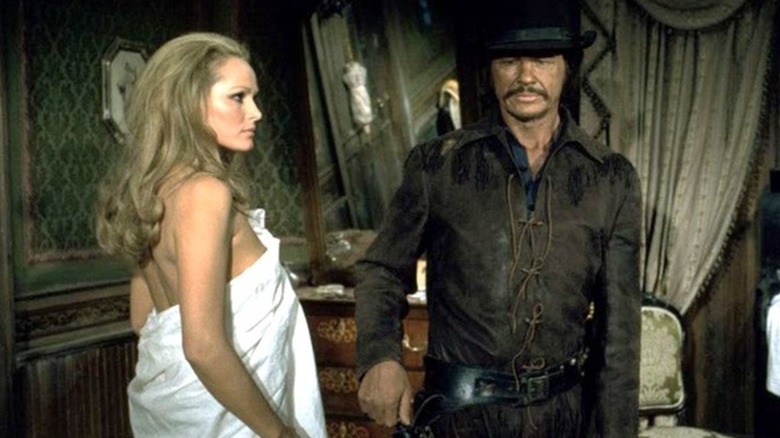
"Red Sun" opens with bandit leader Link (Bronson) and his right-hand Gauche (Delon) prepping to rob $400,000 from a train. Inside, samurai retainer Kuroda Jubei (Mifune) is guarding a ceremonial sword that is meant as a gift for the president, but Gauche steals it and kills one of the bodyguards. Before Link can celebrate, Gauche double-crosses him and leaves him for dead, while Kuroda swears to make Gauche pay for his crimes. This opening train robbery sequence is impressively kinetic, setting the stage for the fluid shootouts that "Red Sun" will quickly transition into.
These unusual circumstances allow our leads, Bronson and Mifune, to team up, laying bare the differences between American and Japanese sensibilities with regard to honor, trust, and comeuppance. These concepts are obviously exaggerated as per genre traditions and taken to ludicrous extremes to evoke humor.
This lighthearted element is much-appreciated in a film that could've taken the self-serious route and run the risk of being a dull adventure. "Red Sun" makes space for such levity while allowing Link and Kuroda to navigate subtler emotions that gradually morph and define their relationship. Meanwhile, Andress' Cristina gets caught up between Link and Gauche's newfound enmity, pushing the story to its climactic center.
You might find some parts of "Red Sun" predictable, but Mifune's presence keeps things interesting enough until the end. There's a scene in which Kuroda slices a tiny mosquito with a katana — a ridiculous, but fun insertion that proves that Kuroda is not just a stereotypical upholder of samurai honor.
Although critics weren't particularly impressed with "Red Sun" at the time, the film deserves a reappraisal through fresh eyes. There's genuine fun to be had here, which is always a welcome sentiment in my book.