

Roger Ebert Despised Keanu Reeves' Cult DC Movie That Still Needs A Sequel
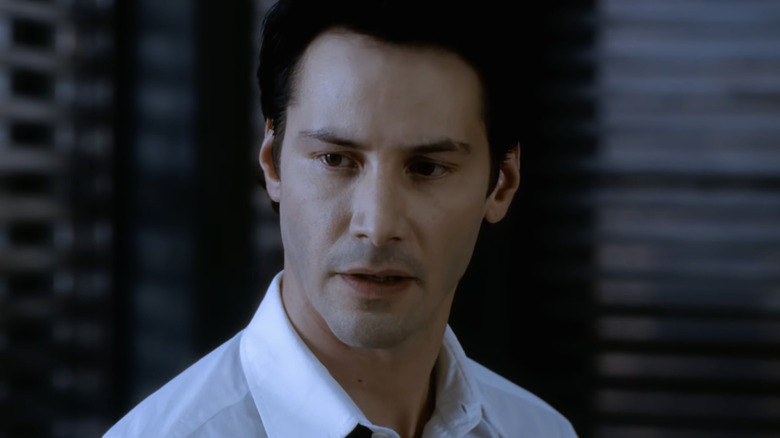
Francis Lawrence's 2005 satanic thriller "Constantine" is based on DC's famed "Hellblazer" comic books, which are notorious for their violence and adult subject matter. They were published by DC Comics' Vertigo, an imprint reserved for the company's more mature titles like "The Sandman," "Preacher," and "Y: The Last Man." Meanwhile, the character John Constantine himself was created by Alan Moore, Steve Bissette, and John Totleben, and he's typically depicted as a hard-smoking, embittered antihero who works as a freelance exorcist, demon hunter, and detective who specializes in the supernatural. Imagine Fox Mulder (David Duchovny) from "The X-Files" by way of an R-rated Philip Marlowe, and you'll get the gist.
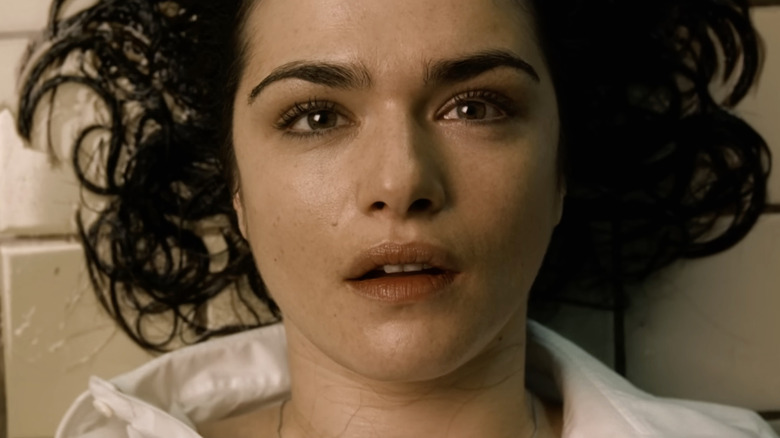
John Constantine is given the star treatment in Lawrence's movie, where he's played by Keanu Reeves. Like in the comics, Reeves' Constantine chain-smokes endlessly, leading to a pretty nasty case of terminal lung cancer. He also occasionally converses with the archangel Gabriel (Tilda Swinton) and asks for a Godly blessing to extend his life, but he's damned to Hell because he tried to die by suicide when he was younger. And while he was unsuccessful, the sin of suicide was enough to mark him for the Place Down Below. Indeed, the greasy Lucifer (Peter Stormare) can't wait to collect Constantine's soul. Elsewhere, Shia LeBoeuf co-stars as Constantine's sidekick, while Rachel Weisz portrays a police detective who sets the film's story in motion.
"Constantine" wasn't widely beloved when it first hit theaters, and many critics outright hated it. Roger Ebert was one of the film's haters, awarding it a mere one-and-a-half stars. Moreover, he was so uninterested in "Constantine" that he became distracted and started listing facts about penguins in his review, inspired by the documentary "March of the Penguins." Basically, Ebert couldn't give a tinker's dam about "Constantine."
Roger Ebert wasn't a fan of Constantine

Rather than being full of zingers, Roger Ebert's "Constantine" review strikes a wholly indifferent tone. He describes Constantine's backstory by writing, "Since he was a child, he has been able to see that not all who walk among us are human. Some are penguins. Sorry about that. Some are half-angels and half-devils." Perhaps Ebert is ever-so-subtly trying to recommend something you should see instead of "Constantine?" He also criticizes the film's design for Hell, writing that it "looks like a post-nuclear Los Angeles created by animators with a hangover."
Ebert additionally goes on to highlight what he feels are problems inherent to the film's premise. The movie deals with an ongoing battle between the forces of Heaven and Hell, you see, so Ebert wonders how God could even be threatened by a bunch of pesky little demons. They're the Almighty, after all. On top of that, Ebert questions how John Constantine, a lone exorcist who lives in a single city, could possibly be making a significant difference in a divine war that is being fought all over the world.
Ebert, a product of Catholic schools, takes equal issue with what he perceives as the dodgy theology of "Constantine." Most notably, one of the film's main characters is an alcoholic priest named Father Hennesy (Pruitt Taylor Vince), which gets Ebert recalling Catholic notions of absolution:
"Strange that there is a priest, since that opens the door to Catholicism and therefore to the news that Constantine is not doomed unless he wages a lifelong war against demons, but need merely go to confession; three Our Fathers, three Hail Marys, and he's outta there. Strange, that movies about Satan always require Catholics. You never see your Presbyterians or Episcopalians hurling down demons."
He's not wrong!
Constantine has gained a cult fanbase, but its sequel has been delayed
Speaking for myself: Many film critics often prefer writing about bad movies over boring ones. Bad movies may be bad, nauseating, or even offensive, but when the time comes to write a review, the critic at least knows exactly what to write and where they stand. A boring movie, meanwhile, inspires nothing. There are only so many ways to say that a film is bland, generic, and unremarkable. Thus, a one-star review can be harder to write than a zero-star review.
Clearly, then, Roger Ebert was struggling to find something to say about "Constantine." He just didn't care about it.
Since its original release, though, "Constantine" has found more widespread appreciation and gained a cult fanbase. Case in point: If one were to log into Letterboxd, they would find it has an average score of 3.4 out of five stars on the site, with about 10% of Letterboxd users awarding it five stars. A lot of its user reviews zero in on specific details as well, with some voicing their appreciation for Tilda Swinton playing the archangel Gabriel as, essentially, a nonbinary figure. Others still jokingly lambast the movie for suggesting that Keanu Reeves, of all people, would go to Hell when he died. Keanu is a saint!
Although it's been formally in the works for a few years now, "Constantine 2" is taking longer than expected to come together. There seem to be enough fans, and Reeves has amassed an overwhelming amount of good will, but the actor apparently doesn't like the scripts he's seen to date. So, until that changes, fans will have to keep on waiting for the sequel.
As for Ebert? He probably forgot about "Constantine" the instant he turned in his review.