

Roger Ebert Gave A Near-Perfect Score To The Last Movie He Ever Reviewed
Roger Ebert died on April 4, 2013, at the age of 70, and critics everywhere lost one of the elder statesmen of the craft. Ebert, as noted by authors far more talented than I, helped turn film criticism from an esoteric hobby enjoyed by the aristoi into a mainstream, everyday activity. Ebert, along with his TV partner, Gene Siskel, brought film criticism into America's living rooms, turning movies into a casual pop discussion, rather than something to be locked away in the pages of Cahiers du Cinéma.
In 2006, Ebert experienced complications during thyroid cancer treatment that robbed him of his jaw, and, along with it, his ability to eat, drink, or speak. One might think this would put a dampener on his film criticism career, but all it really did was take him off TV screens. For the last seven years of his life, Ebert remained amazingly prolific, reviewing new movies with a voraciousness all professional writers can envy. He became amazingly frank on his public blog, writing about his childhood, philosophies, and religious beliefs. Ebert was educated in Catholic schools, but in 2012, he published the essay "How I Believe in God," which cemented his humanism. And he was looking for elevating film experiences until the very end.
The last review Ebert published in his lifetime was for "The Host," the sci-fi romance based on the novel by Stephenie Meyer. He gave it two-and-a-half stars, which is the highest possible thumbs-down. It seems churlish to think Ebert went out on such an insignificant movie. The review was published on March 27, 2013.
The last review that Ebert ever wrote, however, was more fitting for his legacy. Published posthumously on April 6, Ebert spoke very eloquently about Terrence Malick's "To the Wonder," giving it three-and-a-half stars.
The last review Roger Ebert ever wrote was for Terrence Malick's To the Wonder
"To the Wonder" is an astonishing film about love, faith, and the mutability of those outsize seas within the human heart. Although a peaceful, astonishing work of philosophy, "To the Wonder" wasn't nearly as well received as Terrence Malick's previous movie, 2011's "The Tree of Life," since "The Tree of Life" had already said very similar things, and in a more indelible, personal fashion. This doesn't mean, however, that "To the Wonder" should be dismissed. When a master is at the top of his game, it's fine that he repeats himself a little.
Ebert noted the similarities between "To the Wonder" and "The Tree of Life," writing that "Malick depicts [the characters' relationships] with deliberate beauty and painterly care. The mood is often similar to the feelings of the early small-town scenes in 'The Tree of Life.' Malick has a repertory of fundamental images he draws upon."
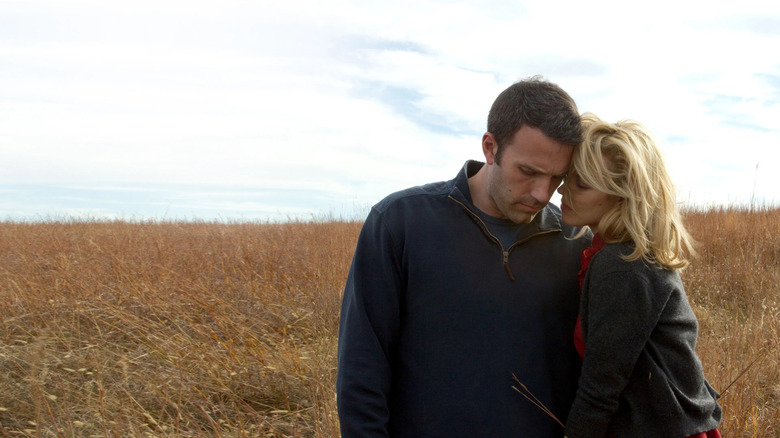
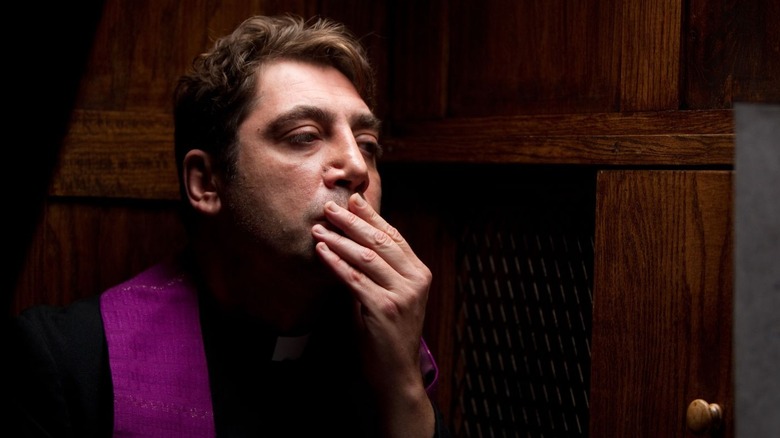
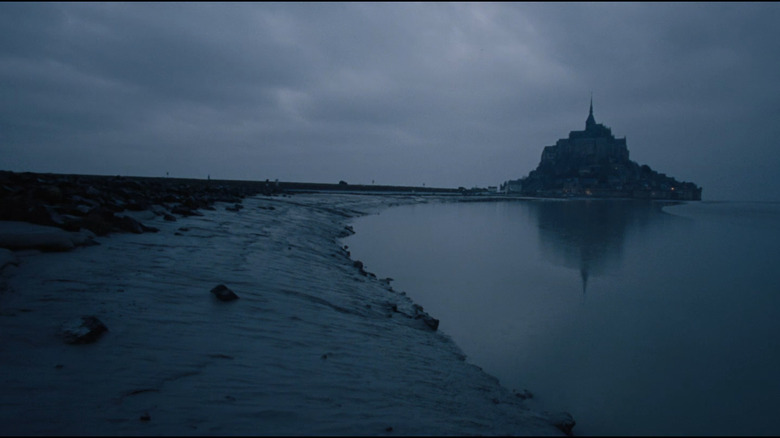
"To the Wonder," to catch you up, is about a couple, Neil and Marina (Ben Affleck and Olga Kurylenko), who fall in love in Paris. It's dreamy, halcyon, beautiful. They move to Oklahoma together with Marina's daughter, and the relationship, in vague ways, begins to sour. Feelings turn to resentment. Neil begins drifting gently toward another woman, played by Rachel McAdams. Meanwhile, a local priest (Javier Bardem) begins having, in an equally inexplicit fashion, a crisis of faith. God is drifting away from him. Ebert wrote:
"A more conventional film would have assigned a plot to these characters and made their motivations more clear. Malick, who is surely one of the most romantic and spiritual of filmmakers, appears almost naked here before his audience, a man not able to conceal the depth of his vision.
It's all moving and abstract.
Ebert's final review was grand and moving
Ebert, however, was not frustrated by "To the Wonder." Indeed, he found its lack of contrived plot clarity to be a strength. He wrote:
"'Well,' I asked myself, 'why not?' Why must a film explain everything? Why must every motivation be spelled out? Aren't many films fundamentally the same film, with only the specifics changed? Aren't many of them telling the same story? Seeking perfection, we see what our dreams and hopes might look like. We realize they come as a gift through no power of our own, and if we lose them, isn't that almost worse than never having had them in the first place?"
The final paragraph Ebert ever turned in to his editor noted that some audiences will find "To the Wonder" to be "elusive" and "effervescent." That:
"They'll be dissatisfied by a film that would rather evoke than supply. I understand that, and I think Terrence Malick does, too. But here he has attempted to reach more deeply than that: to reach beneath the surface, and find the soul in need."
A poetic final note. One might recall a line from Ebert's "How I Believe in God" essay about how he goes to churches not to pray, "but to gently nudge my thoughts toward wonder and awe."
The tides are an important symbol in "To the Wonder," and Malick seems to suggest that loves like love and faith wash in and out of our souls as part of our natural human cycle. Some days we are full of them, and some days we are empty. It's marvelous to think that Ebert, constantly on the search for great art, was able to end his career on such a profound film.