

Tim Burton's Batman Almost Featured Two Obscure Marvel Characters
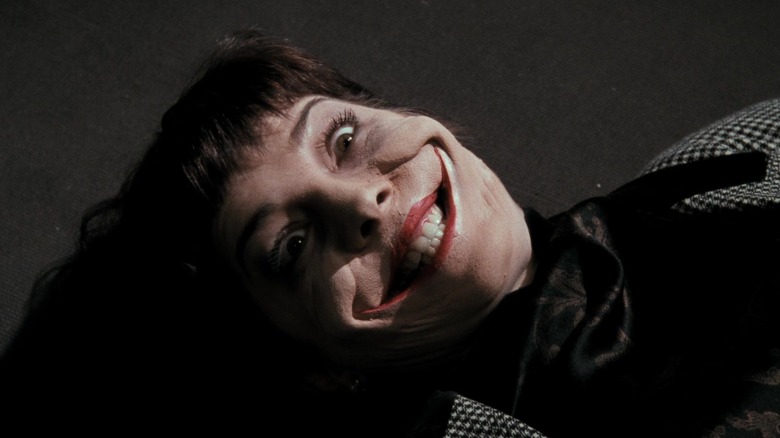
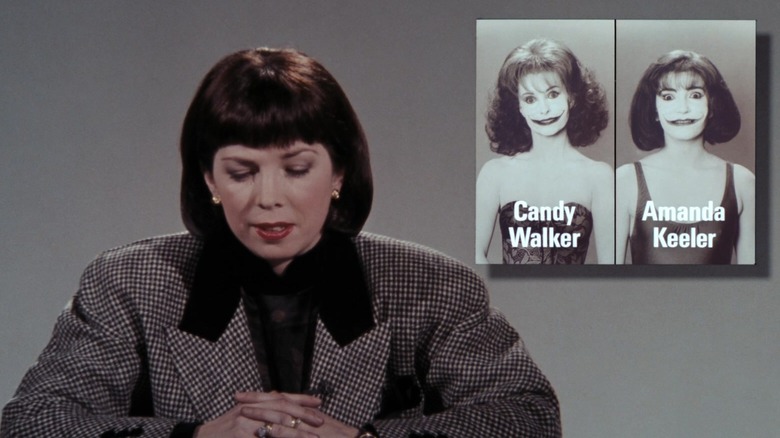
Partway through 1989 blockbuster "Batman," a newscaster named Becky (Kit Hollerbach) appears on the Gotham City news to announce a tragedy. It seems that two star models, Candy Walker and Amanda Keeler, have died suddenly due to a "violent allergic reaction." In a grim detail it appears that Candy's and Amanda's dead bodies are displayed on the news broadcast, their faces altered, stretched into Joker-like grins.
The news broadcast then cuts to Becky's co-anchor, Peter (Bruce McGuire), who continues to read the news as usual. While Peter is reading, Becky is suddenly struck by a case of the giggles. It interrupts the broadcast. Becky's giggles, however, turn into a frantic laughing fit. Becky falls out of her chair laughing, and suddenly dies on the floor. When her peers examine her, they find that her face has mutated, her mouth stretched into a wide grin.
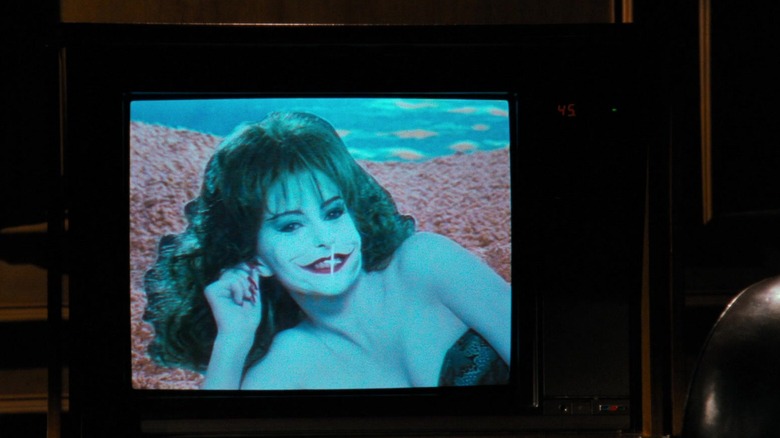
During Becky's collapse, the Joker (Jack Nicholson, who wanted to leave kids scared) pirates the TV signal and enacts a gleefully dark, satirical TV commercial. He explains that the killing laughing fit viewers just witnessed is caused by a chemical poison he invented himself, Smylex. The Joker's pirated announcement also includes images of Candy Walker and Amanda Keeler, still bearing their grim Joker smiles.
It turns out those specific character names weren't in the original draft of Sam Hamm's script for "Batman." In a 2024 post on Facebook, Paul Levitz, a longtime writer for (and eventual president of) DC Comics, said that he got to peruse the script and that the characters' names were originally "Millie Collins," and either "Patsy Walker," or "Katy Keene." Those were the names of supermodel characters owned by Marvel Comics and Archie Comics. It's a cute reference, but to avoid any royalties — or undue crossovers — the names were changed.
The non-DC Comics namedrops were a fun Easter egg in the Batman script
Levitz actually gets a few details wrong in his post, aside from not clearly remembering whether one of the names was Patsy Walker or Katy Keene. His post read:
"Lots of celebratory posts about 'Batman' today. My 'constructive' contribution to it was picking up that the Joker's two assistants were named after Millie The Model and Patsy Walker (if memory serves, coulda been Katy Keene) in the script and preventing that DC-Marvel crossover."
The models in question were not the Joker's two assistants, as the Joker only had male henchmen in Tim Burton's "Batman" — in fact, Levitz was actually referring to Candy Walker and Amanda Keeler, the two models the Joker murders with Smylex. The only female sidekick the Joker had in "Batman" was his girlfriend, Alicia (Jerry Hall), a woman he mutilates as an act of "art." But who are Patsy Walker, Katy Keene, and Millie Collins, the characters that Levitz calls out? It turns out they are rather obscure characters, all originally created in the mid-1940s.
The best-known of the three is probably Patsy Walker, invented by writer Stuart Little (his real name) and Ruth Atkinson for Timely Comics in 1944. Patsy was a teenage girl who had very usual melodramatic and humorous adventures, usually involving romance and boys. The character continued to appear in books when Timely Comics transformed into Atlas Comics in 1951, and again when Atlas rebranded as Marvel Comics in 1961. Fun trivia: a lot of the early Patsy Walker comics were written by MAD Magazine master Al Jaffee. Patsy was later reinvented in 1976 as the costumed vigilante Hellcat by Steve Englehart, and she made her live-action debut in Netflix's "Jessica Jones" and evolved into a full-fledged superhero (or villain?) in Season 3.
Who are Millie the Model and Katy Keene?
As for Millie Collins, she was invented by Ruth Atkinson for Timely Comics in 1945. She starred in her own comic, "Millie the Model" from 1945 through 1973, wherein she worked as a career gal in New York City. One of the star artists of Millie was Dan DeCarlo, best known for his work on Archie Comics in the 1950s.
Millie also spanned the Timely-Atlas-Marvel circuit, and also eventually crossed over with Marvel's superhero characters, albeit only in a cameo capacity. She was in issues of "The Defenders," "Dazzler," and "The Sensational She-Hulk" (the first two of which predated Tim Burton's "Batman"). So Patsy and Millie, being Marvel names, would have caused a big legal hassle for the DC Comics-inspired "Batman."
What about Katy Keene, though? She was a model character created by Bill Woggon in 1945. Katy sported a Bettie Page-like haircut, and, like Patsy and Millie, also starred in her own series of comedic/romantic misadventures. She first appeared in comics for M.L.J. Magazines, which would become Archie Comics in 1946. Katy Keene would become a more serious part of the Archie universe in the 1980s. Katy, too, would have caused a legal hassle if namechecked in Burton's film. Lucy Hale went on to play the character on the short-lived "Katy Keene" TV series.