

Michael Review: A Predictably Overly-Sanitized Biopic Of The King Of Pop
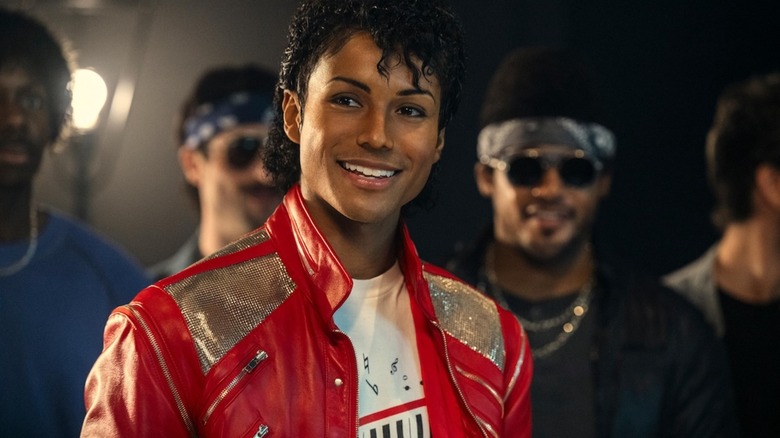
There are two important things to note about Antoine Fuqua's new biopic "Michael." First, this film only traces Michael Jackson's long musical career from the mid-1960s — when he was a boy in the Jackson 5 — up through December 9, 1984, the final performance of the Victory Tour. Secondly, several of Jackson's siblings served as the executive producers of "Michael," and Jaafar Jackson, Michael's own nephew, plays the King of Pop himself. It's a closely guarded, carefully-trimmed project that required family approval. The third act had to be reshot because of a legal SNAFU.
The reduced window of time allows Fuqua and screenwriter John Logan to follow only Jackson's meteoric rise and worldwide fame, filming the star like a glittering, peerless angel. Fuqua is careful to shoot a lot of fawning reaction shots of the people watching Michael Jackson at work, oohing and aahing at his unique contralto voice, his childlike demeanor, and his spindly, virtuosic dancing. And while Jackson's voice, talents, and uncanny cultural penetration cannot be denied, "Michael" feels oh-so-daintily constructed to ensure that no one in the Jackson family is offended, or even reminded of the King of Pop's well-documented and long-rumored peculiarities.
As such, "Michael" emerges as whatever the opposite of a warts-and-all biography is. This is a polished, flavorless, cracks-free paean to Jackson, celebrating his highs and only sometimes looking at the lows, as if they were mere dust-bunnies under the couch. None of the important, day-to-day details of Jackson's life are mentioned or even alluded to — who, for instance, is responsible for cleaning up after his giraffe? — and even the darker moments are skated past with ease.
Michael isn't a biopic, but a commercial for Michael Jackson
Rather than find the beating heart inside the King of Pop, "Michael" becomes just another artificial cog in the Michael Jackson publicity machine. It doesn't delve into the mysteries of Jackson, so much as argue that, golly, he was just a plain, normal guy.
In reality, Michael Jackson was an enigmatic figure who developed an addiction to painkillers and underwent several instances of cosmetic surgery. He collected zoo animals. Despite being one of the world's most public figures, Jackson's inner soul was difficult to pin down. He was eerie and distant, drawn to children, and socially awkward. He was seemingly ruined, psychologically, by early-onset fame and bottomless access to untold wealth. Jackson seemed disconnected from humanity, all while standing at the forefront of all popular culture. More satirical material was written about Jackson than about Ronald Reagan.
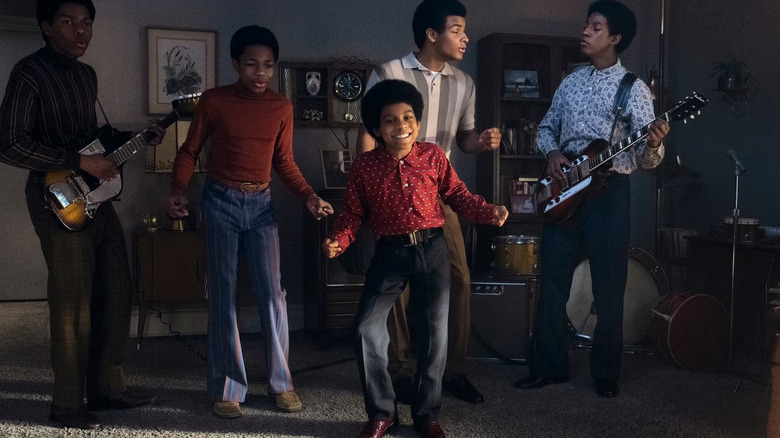
"Michael" posits that the young Michael Jackson (Juliano Krue Valdi) and four of his brothers (Jermaine, Tito, Marlon, and Jackie, played by Jayden Harville, Judah Edwards, Jaylen Lyndon Hunter, Nathaniel Logan McIntyre, respectively) were all groomed by their abusive father Joseph (Colman Domingo) to be musical superstars. Joseph would beat Michael with a belt at his own whims. The scenes of his childhood abuse are brief and merely unpleasant rather than horrifying and harrowing. Like it was something that happened once or twice, but really wasn't a big deal. This is an odd stance for any movie to take, downplaying the trauma that shaped the young Michael and his brothers. To escape the abuse, the movie version of young Michael reads storybooks of Peter Pan and dreams of having animal friends. It's only mentioned briefly that Michael doesn't have human friends of his own.
In Michael, Jackson is just a normal man who collects zoo animals
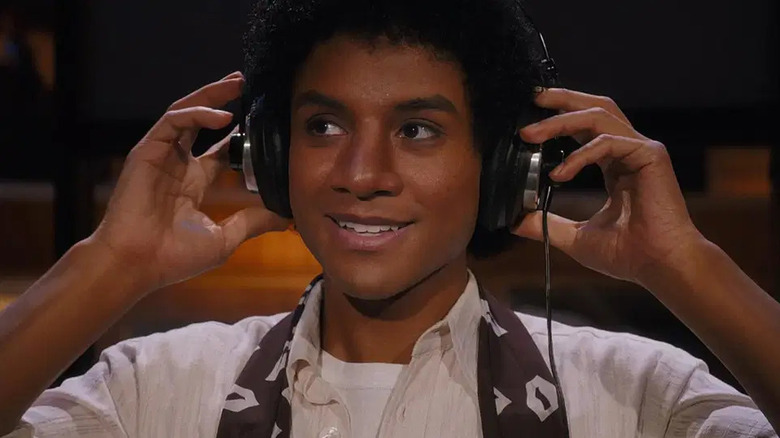
Throughout the early scenes of "Michael" the adolescent Jackson hangs out in his bedroom festooned with Disney paraphernalia and stuffed animals. His Peter Pan dreams are an indicator that Michael never really wants to age, remaining weirdly gentle and timid into his adulthood. The fierce dancer and beat-spitting musician the world later sees is depicted as a front for this smiling, placid, glowing youth.
Jackson talks about his musical goals to bring light to the world, to speak his inner soul, but "Michael" argues that his inner soul was nothing more complex than a love for ice cream, old comedies, and Mickey Mouse. Is that really all they have to say about the King of Pop? That he was just a big kid? I mean, he did really want to play Spider-Man in a movie.
Where is the humanity in all this? What are the realities of looking after a menagerie of zoo animals? Why doesn't Michael have any friends, and how does he feel about that? Does he have any interest in romance, or anything having to do with the adult world? And if he is so utterly insulated from actual reality, is that a triumph or a tragedy? "Michael" merely shrugs in acceptance. Why make a biopic of Michael Jackson if you're going to let his life go unexamined? To paraphrase Socrates, an unexamined life is not worth making a movie about.
Jackson was moved to pity by the plight of sick and ailing children, and "Michael" posits that it was born merely of his friendlessness in youth. When Michael brings home a llama or Bubbles the chimpanzee, it's presented as a mere eccentricity. A kooky thing that a kid might do.
All the interesting stuff is missing from Michael
By all reports, Bubbles was a very well-behaved chimp. But surely there was a mess to clean up. Perhaps there was something difficult for Jackson.
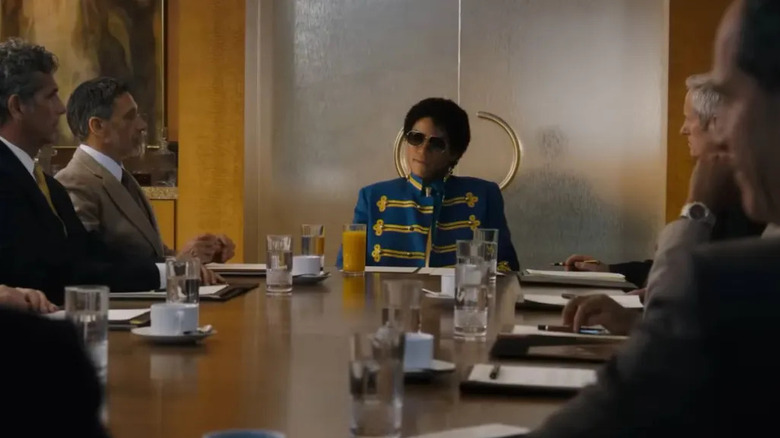
But no, nothing ever went too poorly for Jackson, "Michael" posits. The film's central drama involves Michael trying to wriggle out from under his father's influence, but since Joseph's abuse and imposing presence are so frustratingly downplayed, it's only depicted as a minor triumph for the King of Pop. Because of that drama, the film's most cathartic moment comes when Jackson hires his lawyer and manager John Branca (Miles Teller) to fire Joseph as Michael's manager. Michael is too non-confrontational to do it himself, but he is happy to do it via fax. It's the one moment where it seems like Michael Jackson is making some sort of personal decision on his own behalf.
Otherwise, "Michael" follows all biopic beats pretty closely and without nearly enough creative variation. This is a film that can be placed next to dull, plodding, beat-hitting films like the embarrassing "Bohemian Rhapsody." The true stories of the artists in question are far more interesting than the Hollywood formulas we use to tell them.
Conspicuously absent from the film is Michael's famous sister Janet. Janet appears in one dinner scene, and her face is obscured by another character. His sister La Toya is there (played by Jessica Sula), but she is little more than a mascot for his mother, Katherine (Nia Long). It seems that Janet didn't want to participate in the movie, so she was essentially edited out of the family. Janet's absence speaks volumes about the intentions and tone of Fuqua's film. If there was something even remotely rough about Michael Jackson's life, they just cut it out.
Michael is slick and dull
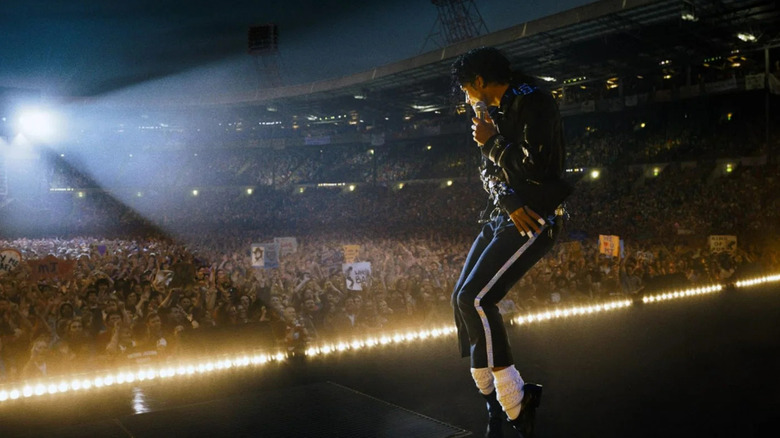
"Michael" at least allows some of Jackson's politics to come out. The film notes that he was inspired to write his hit song "Beat It" after seeing a news report about gang violence. The scene where Jackson gathers rival gang members in a warehouse to work out the choreography for the music video is one moment when "Michael" actually sings. And to his credit, Jaafar Jackson does an uncanny job of recreating his uncle's amazing dancing.
The lowest point in the film comes in the aftermath of the infamous 1984 incident when, while filming a Pepsi commercial, Jackson's hair caught on fire, leaving traumatic burns on his scalp. "Michael" pinpoints this as when he began his addiction to painkillers. The film also notes that Jackson had vitiligo, something he felt the need to hide, and which he used makeup and gloves to cover up.
But those seem like mere tragic inconveniences for the otherwise angelic Jackson, and Fuqua's film gives them all the oomph of a mid-level TV soap opera. "Michael" ends with a fast-forwarded epilogue to 1988 with Jackson performing his hit song "Bad" on stage, following by an on-screen chyron reminding audiences that "his story continues." Yeah, duh. If Fuqua and Logan end up making "Michael, Part II," will it address Jackson's notorious allegations of sexual assault? His marriages? His kids? His personal amusement park? His financial downturn? The continued surgeries? The deep ambivalence that the public felt for Jackson near the end of his life?
As it is, "Michael" is a mere cotton candy machine of a movie. At some point, we need to face the hard stuff.
/Film Rating: 5 out of 10
"Michael" opens in theaters on April 24, 2026.